
 0
0
 134 views
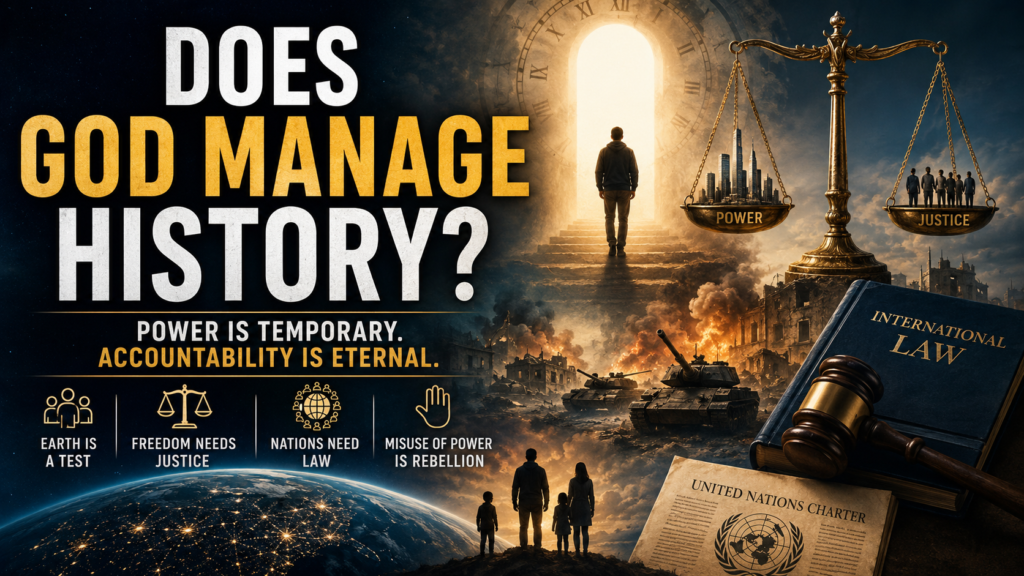
Power, Freedom, Sovereignty, and the Purpose of Human Life
Many of the problems humanity creates for itself may begin with a deeper intellectual failure: we forget the purpose for which human beings were placed on Earth.
Wars, occupations, persecution, forced regime change, enslavement, political repression, exploitation, and struggles for domination are usually explained through economics, nationalism, security, ideology, or competition for resources. Those explanations are important, but from a religious perspective there may be an even deeper problem beneath them.
Human beings begin behaving as though this world belongs permanently to them.
Nations act as though territory can become an eternal possession.
Rulers behave as though authority belongs inherently to them.
The wealthy may imagine that wealth establishes superiority.
Powerful states sometimes behave as though military or technological strength gives them a greater right to determine how weaker peoples should live.
But the divine creation plan begins from a radically different premise.
Earth is temporary.
Human life here is temporary.
Power is temporary.
Wealth is temporary.
Political authority is temporary.
National superiority is temporary.
Even civilizations are temporary.
If we understood this more deeply, much of our desire to dominate one another would immediately appear irrational.
Earth as the Arena of the Human Test
Within the religious worldview, God created human beings and placed them upon Earth for a limited period.
Earth is therefore not humanity’s final home in the ultimate sense.
It is the location of an examination.
Every human being enters that examination under different circumstances.
One person is tested through wealth.
Another through poverty.
One through authority.
Another through powerlessness.
One through exceptional intelligence.
Another through limited opportunity.
One through fame and social status.
Another through obscurity.
One nation may possess enormous military power.
Another may possess very little.
One civilization may temporarily lead in science and technology.
Another may depend upon it.
But these differences do not necessarily indicate who is more favored before God.
They indicate different forms of responsibility.
The person with wealth is not simply wealthy.
He is being tested through wealth.
The ruler is not simply powerful.
He is being tested through authority.
The scholar is not simply knowledgeable.
She is being tested through knowledge.
And a nation possessing extraordinary military, economic, or technological capability is not simply fortunate.
It is being tested through power.
This transforms the meaning of superiority.
Power is not proof of righteousness.
Power is an examination of righteousness.
One God, One Human Family, One Ultimate Destination
The original religious message is remarkably simple.
Human beings have one Creator.
Their earthly existence is temporary.
Their lives possess moral purpose.
They will ultimately return to God.
And their choices will matter beyond death.
From this perspective, the deepest human identity is not national, racial, tribal, economic, or political.
It is that all human beings belong to the same created family.
But human beings disagree.
This is part of human nature.
We interpret differently.
We develop competing interests.
We create traditions.
Traditions become identities.
Identities become institutions.
Institutions sometimes become rival communities.
And over generations, people can become so absorbed in the differences that they forget the original purpose altogether.
Religious tradition therefore understands revelation and prophetic guidance partly as a recurring correction.
Messengers remind humanity that beneath all its divisions lies a much simpler truth:
There is one God.
Human life has purpose.
Earth is temporary.
Human beings are morally accountable.
And another life follows this one.
The Day of Judgment becomes especially important because it prevents earthly power from becoming the final definition of success.
A dictator may escape human justice.
A murderer may never be convicted.
A wealthy exploiter may die surrounded by luxury.
A victim may die without seeing justice.
If earthly life were the complete story, many moral accounts would remain permanently unresolved.
The idea of Judgment declares that history does not contain the final verdict on history.
Why Freedom Is Essential to the Creation Plan
A meaningful moral test requires freedom.
If God created human beings merely to behave automatically, moral responsibility would have little meaning.
For worship itself to possess moral significance, human beings must be capable of choosing it.
For honesty to matter, lying must be possible.
For justice to matter, injustice must be possible.
For generosity to matter, selfishness must be possible.
For courage to matter, fear must exist.
The test therefore requires a protected sphere of human agency.
A person must be sufficiently free to choose.
That freedom is precious because without it neither moral growth nor genuine accountability can fully exist.
This also explains why tyranny is more than a political problem.
A tyrant does not merely control another person’s behavior.
He interferes with that person’s freedom to think, believe, speak, develop, worship, and make moral choices.
From this religious perspective, oppression damages the very conditions within which the human test is supposed to occur.
The Earth as a Protected Human Arena
Religious cosmology also presents Earth as a domain in which human beings live out their appointed test under God’s sovereignty.
Human beings are not the ultimate owners of the planet.
They are temporary inhabitants entrusted with responsibility within it.
The deeper idea is therefore not that humanity has been abandoned in an uncontrolled universe.
Rather, creation possesses an order.
The heavens and Earth operate under laws established by God.
Human beings conduct their lives within this protected order.
We do not need to imagine extraterrestrial beings or unseen forces possessing independent authority to interrupt God’s plan at will. Within the theological framework, nothing exists outside divine sovereignty.
Human beings are given sufficient space to carry out their responsibilities, make choices, seek God, build families, create communities, develop knowledge, and prepare themselves for accountability.
Earth is therefore not simply territory.
It is the arena of human moral responsibility.
That makes the violation of another person’s legitimate freedom more serious than we often realize.
Why Human Beings Created Government
Freedom does not mean the absence of order.
In fact, complete absence of order usually destroys freedom.
If everyone possessed unrestricted ability to use violence, steal property, seize land, or coerce others, then only the strongest would actually remain free.
Society therefore develops government.
Government, at its best, is not created to dominate citizens.
It is created so that one person’s freedom does not destroy another person’s freedom.
Law establishes boundaries.
Courts resolve disputes.
Police protect people from violence.
Institutions protect property and basic rights.
Constitutions restrain political authority.
Representative systems allow people some role in determining who governs them.
From the religious perspective, these institutions can be understood as human attempts to fulfill an important responsibility:
creating conditions in which people can live, worship, think, work, raise families, pursue knowledge, and undergo their individual moral test without constantly being threatened by the arbitrary power of others.
A just government therefore protects the conditions of the human test.
An unjust government interferes with them.
Freedom of Conscience Is Especially Important
This has particular significance in religion.
Faith produced through force is fundamentally different from faith produced through conviction.
If someone worships only because the government threatens punishment, the external action may exist while the inner moral choice has been compromised.
The freedom to seek truth, question, reflect, accept, reject, reconsider, and ultimately believe is therefore deeply connected with moral responsibility.
The same freedom also produces intellectual progress.
Science requires questioning.
Philosophy requires questioning.
Innovation requires questioning.
Social reform requires questioning.
Every civilization improves because someone eventually asks:
Why must things remain this way?
Suppress that question long enough and society becomes intellectually stagnant.
This is why the protection of freedom is not merely a political convenience.
It is connected with both moral development and civilizational development.
From Government to International Order
Human civilization eventually confronted another problem.
A government may protect individuals inside its borders.
But who protects a weaker country from a stronger country?
For thousands of years, the answer was often:
No one.
The stronger army invaded.
The victorious empire took territory.
People were expelled.
Populations were enslaved.
Resources were seized.
Governments were replaced.
Conquest itself created political legitimacy.
Humanity lived under this model for centuries.
But the destructive consequences accumulated.
Modern warfare made the problem dramatically worse because technological development gave states the ability to destroy entire cities and kill enormous populations.
The two World Wars demonstrated what could happen when powerful nations operated without sufficient international restraint.
Humanity learned at terrible cost.
And from that learning emerged an increasingly important principle:
Nations also require laws.
International Law as a Civilizational Achievement
The establishment of the United Nations and the development of modern international law represented an important stage in humanity’s moral and political evolution.
The central idea was simple but revolutionary:
A nation cannot claim an unlimited right to attack another country merely because it is stronger.
Military power does not automatically create legal ownership of territory.
Populations should not simply be expelled because another state desires their land.
Aggressive conquest should not be considered a legitimate instrument of ordinary politics.
Civilians require protection.
Prisoners possess rights.
Genocide is a crime.
Sovereignty matters.
Self-determination matters.
These principles remain imperfectly enforced.
Powerful states have violated them.
Weak states have violated them.
Alliances sometimes produce double standards.
International institutions can fail.
But human inconsistency does not invalidate the principles themselves.
We should distinguish between:
the failure to obey a law
and
the failure of the idea of law itself.
Humanity took centuries of bloodshed to reach the principle that relations among nations should be regulated by something other than superior military power.
That principle should not be casually discarded.
International Law and the Human Test
From the religious perspective developed here, international law serves a purpose even deeper than political stability.
Just as domestic law protects individuals from one another, international law attempts to protect entire populations from domination by stronger states.
A farmer in one country should be able to raise his family without wondering whether a neighboring empire will someday decide that his land belongs to it.
A student should be able to study.
A merchant should be able to trade.
A family should be able to worship.
People should be able to debate, create, build, learn, and live their short earthly lives without repeatedly becoming subjects of conquest.
In this sense, sovereignty and international order help preserve the space within which millions of individual human tests occur.
War disrupts that space.
Occupation disrupts it.
Mass displacement disrupts it.
Enslavement destroys it.
Genocide destroys human beings themselves.
Forced regime change can shatter entire societies when outside powers decide that they possess the right to determine another people’s political destiny.
This does not mean intervention is never morally justified; situations such as genuine collective defense or protection under recognized legal authority raise different questions. But the fundamental principle remains:
Power alone does not grant one nation ownership of another nation’s future.
When Power Begins to Rebel Against Purpose
This brings us to the most serious religious dimension of the argument.
When a nation uses power to dominate another people, the problem is not only political.
Within this theological framework, it also reflects a profound misunderstanding of the creation plan.
God gave human beings a temporary life in which they are accountable for how they exercise freedom.
A powerful ruler who unnecessarily removes the freedom of millions of people is therefore not merely changing borders.
He may be disrupting the conditions under which those people are supposed to live their lives.
A nation that invades another country merely to dominate it does more than violate political sovereignty.
It attempts to substitute its own will for the legitimate agency of another people.
A government that persecutes citizens because of their beliefs does more than violate civil liberties.
It interferes with freedom of conscience.
A state that believes military superiority allows it to determine who may live on particular land begins acting as though superior force creates moral ownership.
From the religious perspective, this is an extraordinary form of arrogance.
The ruler begins behaving as though his authority is greater than the purpose for which authority was entrusted to him.
Power Is Never Ownership
This is the mistake repeated throughout history.
Human beings confuse possession with ownership.
A ruler controls a country and begins thinking:
This country belongs to me.
An empire controls territory and begins thinking:
This territory belongs to us forever.
A civilization becomes technologically advanced and begins thinking:
We are naturally superior.
A military becomes overwhelmingly powerful and begins thinking:
No law can restrain us.
But nothing human is permanent.
The ruler dies.
The empire disappears.
Technology spreads.
Military advantages diminish.
Borders change.
Economic centers migrate.
Civilizations that once dominated continents become subjects studied by historians.
This recurring pattern should itself teach humanity something about the nature of power:
Power is entrusted, not owned.
The Deeper Meaning of Rebellion Against God
The phrase “rebellion against God” should be used carefully.
We cannot casually declare that every political action we dislike constitutes rebellion against the Almighty.
But the principle behind the phrase is important.
If God’s creation plan requires that human beings possess moral agency, then systematic oppression attacks something fundamental within that arrangement.
If God commands justice, deliberate injustice contradicts that command.
If human beings are accountable for power, the abuse of power becomes a moral failure.
If the Earth is entrusted to humanity collectively, treating entire populations as disposable becomes a violation of that trust.
The rebellion is therefore not that a nation has challenged God’s power—no human being could do that.
The rebellion consists in acting contrary to the moral purpose God established while behaving as though human power grants exemption from accountability.
That is a very different claim.
God’s sovereignty is never threatened.
The wrongdoer threatens only himself.
Why Powerful Nations Become Especially Vulnerable to This Illusion
Weak people rarely believe they control history.
Powerful people often do.
The same psychology affects nations.
A country possessing overwhelming economic, technological, or military capability can gradually develop a dangerous assumption:
The rules exist for everyone else.
International law becomes something to invoke against adversaries but reinterpret when it restricts allies.
Human rights become principles used against competitors but inconvenient when strategic interests intervene.
Sovereignty becomes sacred when one’s own borders are threatened and negotiable when someone else’s territory is involved.
At that point, law has been replaced by advantage.
And once law becomes merely an instrument of advantage, the world begins moving backward toward the age of conquest.
Humanity Cannot Afford to Return to the Age of Conquest
Human progress should not be measured only by technology.
A civilization possessing artificial intelligence, nuclear weapons, satellites, biotechnology, and advanced medicine can still behave according to political instincts inherited from ancient empires.
That would represent technological progress without moral progress.
The central international question of the modern era should not be:
Which nation possesses enough power to impose its will?
It should be:
What principles should apply to every nation regardless of power?
That is civilization.
The movement from the rule of strength toward the rule of law is one of humanity’s most difficult achievements.
It remains unfinished.
But unfinished progress should be completed—not abandoned.
Governments and Nations Are Also Being Tested
We usually speak about individuals being tested.
But perhaps institutions are also arenas through which individual and collective moral choices become visible.
A government receives authority.
What does it do?
A military receives extraordinary destructive capability.
How does it use it?
A wealthy nation controls enormous resources.
Does it exploit weaker societies or help strengthen them?
A country develops advanced technology.
Does it use that technology to improve human life or to increase surveillance and domination?
A permanent member of an international institution acquires exceptional influence.
Does it use that privilege to defend universal principles—or simply to protect allies?
These are not merely strategic questions.
They are moral questions.
And within the religious worldview, moral questions are ultimately questions of accountability.
The Purpose of Law Is Not to Replace God
International law is a human creation.
The United Nations is a human institution.
Constitutions are human documents.
Courts are human institutions.
None should be treated as divine or infallible.
They can be wrong.
They can require reform.
They can become politicized.
But human institutions can still reflect moral principles consistent with the divine purpose.
A hospital is human-made, yet healing is good.
A university is human-made, yet knowledge is good.
A court is human-made, yet justice is good.
Likewise, international institutions are human attempts to translate principles such as peace, restraint, dignity, sovereignty, and accountability into workable political systems.
Their human origin does not make their purpose meaningless.
Perhaps this is exactly what God expects intelligent beings to do:
use reason to construct institutions that reduce injustice and protect human freedom.
We Were Given Intellect Because We Are Expected to Improve the World
God could have created human beings without the ability to reason abstractly.
Instead, humanity can learn from experience.
We preserve history.
We compare civilizations.
We identify patterns.
We build institutions.
We modify laws.
We develop new technologies.
We recognize previous mistakes.
This capacity itself implies responsibility.
If previous generations discovered that unrestricted conquest produces devastation, we should not deliberately return to unrestricted conquest.
If humanity discovered that slavery violates human dignity, we should not reinvent slavery under another name.
If genocide taught us that certain forms of dehumanization can lead to catastrophe, we should recognize the danger when similar rhetoric returns.
If two World Wars taught humanity that unrestricted national ambition can destroy continents, those lessons should become part of our collective memory.
Progress means that later generations should not repeatedly pay the same price for lessons already learned.
The Creation Plan Is Not a Blueprint for Passivity
There is another important point.
Believing that God created the world according to a plan does not mean human beings should simply accept whatever occurs.
Quite the opposite.
If we were given intellect, freedom, conscience, and the ability to organize societies, then we are responsible for using those gifts.
When injustice appears, we should confront it.
When institutions fail, we should improve them.
When governments abuse authority, citizens should seek lawful accountability.
When international law is applied selectively, the solution should be to make it more consistent—not discard law altogether.
When wars occur, we should learn how to prevent future wars.
When new technology creates new dangers, we should develop corresponding ethical and legal structures.
God does not need to send angels to write better laws.
We have been given the intelligence to write them.
God does not need angels to create institutions of justice.
We have been given the ability to build them.
God does not need angels to negotiate peace.
Human beings can sit across a table and negotiate.
The failure to do these things is frequently not evidence that God has abandoned humanity.
It may be evidence that humanity has failed to use what it was given.
The Real Challenge to the Creation Plan Is Human Arrogance
Ultimately, the greatest danger may not be disagreement.
Human beings will always disagree.
Disagreement can even be productive.
It produces critical thinking.
It generates philosophy.
It advances science.
It corrects mistakes.
The more dangerous tendency is arrogance combined with power.
The belief that:
My nation matters more.
My people possess greater rights.
My security justifies your suffering.
My military strength gives me moral authority.
My economic power places me beyond accountability.
My interpretation gives me the right to silence yours.
My temporary superiority represents permanent entitlement.
That mentality contradicts the humility at the center of the religious understanding of creation.
Because ultimately:
The Earth belongs to God.
Human beings are temporary inhabitants.
Nations are temporary arrangements.
Borders are temporary.
Governments are temporary.
Power is temporary.
What remains is the moral record of what human beings did while those things were entrusted to them.
The Question Every Nation Must Eventually Face
A nation may win a war and fail the test.
A ruler may expand territory and fail the test.
A civilization may become technologically supreme and fail the test.
A wealthy society may accumulate extraordinary resources and fail the test.
Earthly victory and moral success are not necessarily the same thing.
This may be one of the most important truths humanity needs to rediscover.
The creation plan does not ask:
How much territory did you acquire?
It asks:
How did you treat the people who lived upon it?
It does not ask:
How powerful was your military?
It asks:
How did you use that power?
It does not ask:
How wealthy did your nation become?
It asks:
What did that wealth enable you to do for humanity?
It does not ask:
Could anyone stop you?
It asks:
Did you stop yourself when justice required restraint?
That may be the highest test of power.
Conclusion: Humanity Must Remember Why It Is Here
Many human-made crises may ultimately begin when we forget that Earth is not the prize.
The prize is what human beings become while living upon it.
We were not placed here permanently.
We were placed here temporarily.
We were given freedom.
We were given intellect.
We were given moral responsibility.
We were given different circumstances through which we are tested.
Governments developed to protect freedom and justice within societies.
International law developed through centuries of painful experience to protect peoples and nations from unrestricted domination.
These institutions remain imperfect because humanity itself remains imperfect.
But their underlying purpose is deeply significant.
They create space in which ordinary human beings can live their brief lives without having those lives continually destroyed by someone else’s ambition.
When rulers or nations use power to invade unnecessarily, occupy, enslave, expel populations, impose domination, or treat other peoples as though they possess no independent moral agency, they do more than create geopolitical instability.
From the religious perspective developed here, they have misunderstood their own place within creation.
They behave as owners where they are only trustees.
They treat temporary power as permanent entitlement.
They interfere with the freedom and dignity of other human beings who are undergoing the same earthly test.
And they forget the most fundamental reality of all:
Every ruler will leave his office.
Every empire will lose its territory.
Every civilization will surrender its dominance.
Every individual will leave the world.
And if the creation plan is true, none of us will ultimately be asked how successfully we dominated others.
We will be asked what we did with the freedom, knowledge, wealth, authority, and power that were entrusted to us for a very short time.