
 0
0
 41 views
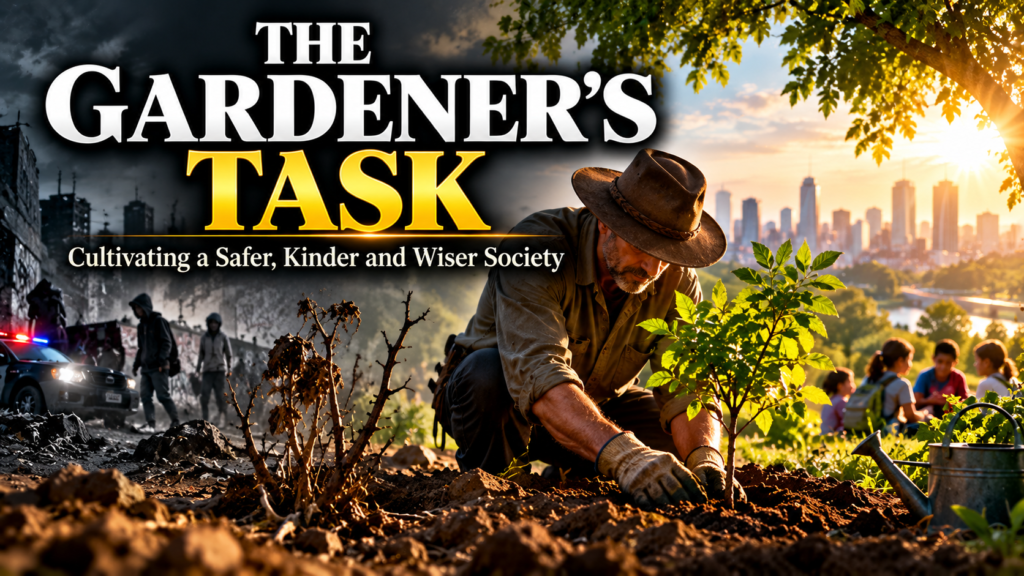
Why a Healthy Society Must Cultivate What It Hopes to Protect
We often think of safety in terms of what happens after something goes wrong.
A crime is committed, so someone is arrested.
Violence erupts, so force is deployed.
A community fractures, so authorities intervene.
Nations enter conflict, and diplomacy begins only after lives have already been lost.
These responses may sometimes be necessary.
But they raise a deeper question:
What if we have misunderstood the task?
A gardener does not wait until a branch breaks before caring for the tree.
The gardener works much earlier.
The soil is examined. The roots are nourished. Water arrives before drought. Diseased growth is noticed before it spreads. Young branches are guided while they can still be guided.
Perhaps societies require the same wisdom.
Punishment Is Pruning
Law is necessary. Accountability matters. People must be protected from those who harm them.
But punishment is largely corrective. It deals with consequences after a harmful decision has already traveled from thought into action.
In that sense, punishment resembles pruning.
Sometimes pruning is necessary to protect the garden.
But no gardener would imagine that pruning alone could produce a healthy ecosystem.
A society concerned only with punishment may therefore be asking its institutions to arrive too late.
Before violence there may have been anger.
Before hatred there may have been prejudice.
Before prejudice there may have been misinformation, humiliation, fear, isolation, inherited hostility, or a failure to understand another human being.
Before the crime, there was often a chain of thoughts, experiences, choices, and circumstances.
If we want safer societies, we must become interested in that chain before its final link appears.
The Guardian as Gardener
This suggests a broader understanding of public safety.
The guardian of society should not merely ask:
“How do we respond when someone causes harm?”
The guardian should also ask:
“What conditions make harm more likely, and what conditions help human beings flourish?”
That changes the conversation.
Schools can teach young people how rumors, prejudice, manipulation, and emotional reactions influence judgment.
Communities can create places where grievances are heard before they become hostility.
Families can teach children disagreement without dehumanization.
Religious and civic institutions can cultivate dignity, responsibility, restraint, and respect.
Public institutions can build trust before they desperately need it.
Law enforcement can remain responsible for enforcing law while also participating, where appropriate, in prevention, community relationships, education, and early intervention.
The objective is not to replace accountability with idealism.
It is to recognize that prevention and accountability perform different tasks—and a healthy society needs both.
Leaders Must Understand the Ecosystem
The metaphor becomes even more important when we consider leadership.
A poor gardener sees individual plants.
A good gardener sees relationships.
Soil affects roots. Roots affect plants. Water affects soil. Insects affect vegetation. Shade affects moisture. One intervention can produce consequences somewhere else in the system.
Societies operate similarly.
Housing, education, employment, family stability, public safety, economic opportunity, social trust, information, technology, health, culture, and law do not exist as isolated systems.
They interact.
And nations themselves exist within larger economic, environmental, technological, diplomatic, and security systems.
This means that leadership requires more than reacting to the problem immediately visible in front of us.
It requires systems thinking.
A policy intended to solve one problem can create another. A decision that appears beneficial today can produce consequences years later. An action within one nation can generate effects far beyond its borders.
Leadership therefore requires the discipline to ask:
What else will this decision touch?
What incentives will it create?
What might happen next?
Who experiences consequences that I cannot immediately see?
What happens if others respond to my action in ways I did not anticipate?
A gardener who understands only the flower but not the soil may destroy the very thing they are trying to save.
So can a leader.
When Emotion Governs the Gardener
Power makes this responsibility greater.
Leaders are human. They experience fear, anger, pride, loyalty, humiliation, ambition, and prejudice like everyone else.
But when ordinary people think poorly, the consequences may remain relatively contained.
When powerful institutions think poorly, the consequences can spread through entire societies.
Decisions made from incomplete information, selective evidence, prejudice, ideological rigidity, or emotional reaction can create chains of consequences far beyond the original intention.
That is why right thinking is not merely an intellectual virtue for leadership. It is a public responsibility.
The greater the power to affect the ecosystem, the greater the obligation to understand it.
Safety Is More Than the Absence of Crime
We often measure safety by what is missing.
No violence.
No theft.
No disorder.
But perhaps genuine safety should also be measured by what is present.
Trust.
Dignity.
Belonging.
Opportunity.
Fairness.
Understanding.
The ability to disagree without hatred.
The confidence to walk through one’s neighborhood without fear.
The expectation that institutions will treat people fairly.
A society may suppress disorder through force and still fail to create genuine security.
Because order can be imposed. Trust must be cultivated.
And cultivation takes time.
The Gardener’s Task
The gardener cannot command a seed to become a tree.
The gardener can only create conditions in which healthy growth becomes more possible.
Perhaps this is also the task of good governance.
Not merely controlling people.
Not merely punishing failure.
Not imagining that every social problem can be solved through force.
But cultivating conditions in which dignity, responsibility, trust, opportunity, reason, and peaceful coexistence have room to grow.
There will still be weeds.
There will still be diseased branches.
There will still be storms.
And sometimes pruning will still be necessary.
But pruning should never be confused with gardening.
Because the deepest work happens long before the branch breaks.
Punishment responds to what has already happened.
Prevention asks why it happened.
Wisdom asks what must be cultivated so that it becomes less likely to happen again.
That is the gardener’s task.
And perhaps the measure of a healthy society is not simply how effectively it punishes what went wrong—
but how wisely it cultivates what must go right.