
 0
 41 views
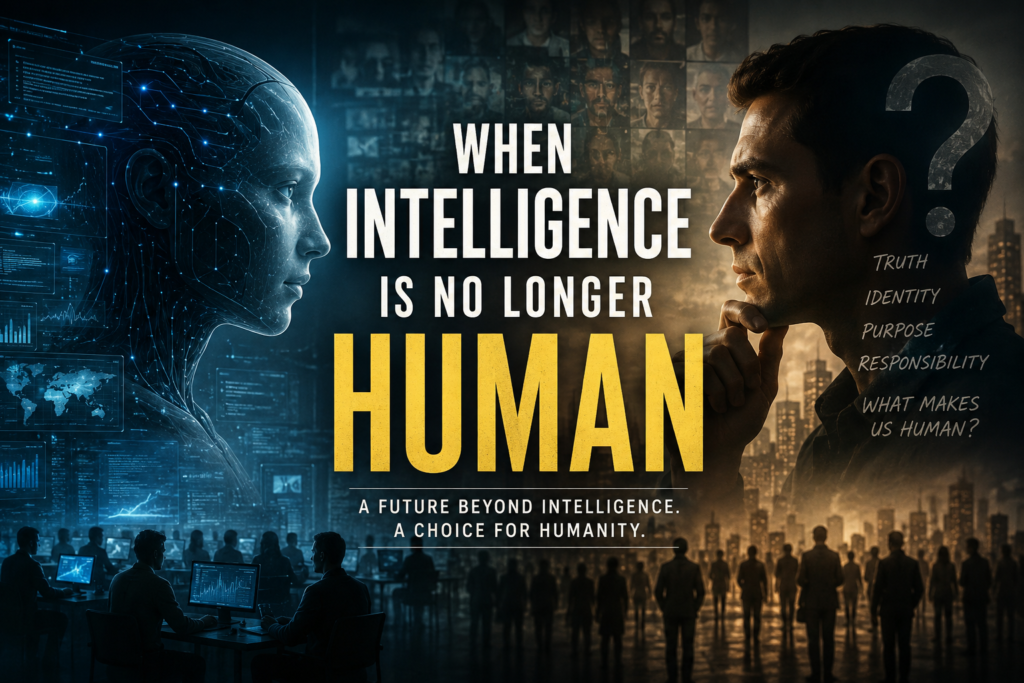
What Happens to Humanity When Intelligence Is No Longer Ours Alone?
For most of human history, intelligence has occupied a special place in our understanding of ourselves.
We were not the strongest creatures on Earth. We could not outrun many animals, see as far as an eagle, navigate like migratory birds, or survive naturally in many of the environments we eventually inhabited. Yet humans came to dominate the planet because we could reason, communicate, remember, imagine, organize, invent, and transmit knowledge from one generation to another.
Intelligence became one of the foundations of human civilization—and eventually part of our identity.
We built universities around it. We created professions to reward it. We selected leaders partly because we believed they possessed it. We associated intelligence with expertise, authority, achievement, and even personal worth.
But humanity may now be approaching a peculiar moment in its history.
For the first time, intelligence may no longer belong exclusively to biological beings.
Artificial intelligence can already write, translate, analyze documents, generate images, compose music, program software, imitate voices, recognize patterns, and participate in sophisticated conversations. These systems remain imperfect, but their direction of development raises a much larger question.
What happens if, within the coming decades, machines become better than most humans at many of the intellectual activities upon which modern society is built?
And an even deeper question follows:
If intelligence is no longer uniquely human, what will it mean to be human?
The Day Intelligence Becomes Abundant
Throughout history, intelligence and expertise have been relatively scarce.
A physician spent years learning medicine. An engineer spent years mastering mathematics and physical systems. A lawyer accumulated knowledge of statutes and precedent. A professor might devote a lifetime to understanding a narrow field.
Scarcity gave expertise value.
Artificial intelligence could change that equation.
Imagine a child carrying a device containing an AI capable of discussing mathematics with the competence of a mathematician, history with the knowledge of a historian, medicine with access to vast clinical literature, and programming with experience derived from millions of examples.
The child would effectively be carrying something resembling a civilization’s accumulated intellectual library in a pocket.
This does not mean expertise disappears. Human specialists will remain important, particularly where judgment, accountability, physical action, uncertainty, and lived experience matter.
But access to sophisticated reasoning could become extraordinarily inexpensive.
We may enter an age in which intelligence itself becomes abundant.
And whenever something becomes abundant, society begins valuing what remains scarce.
That may be the first great transformation of the AI age.
When the Machine Enters the Debate
Consider a television debate ten years from now.
Several human participants sit around a table discussing an economic crisis.
But one participant is not human.
It has no body beyond perhaps a digitally generated face and voice.
A politician makes a claim.
Within seconds, the AI examines decades of economic statistics, legislation, academic studies, historical precedents, government reports, and previous statements made by everyone participating in the discussion.
It does not become nervous.
It does not forget a statistic.
It does not become tired.
It does not need several minutes to remember what happened fifteen years earlier.
It may even recognize logical contradictions while the human speaker is still talking.
Would audiences consider such an AI more authoritative than the humans sitting beside it?
Perhaps.
But that creates a dangerous misunderstanding.
Because intelligence and wisdom are not the same thing.
The AI might be extraordinarily capable of answering:
What is likely to happen?
But that does not automatically give it the authority to answer:
What should happen?
Those are fundamentally different questions.
Facts Cannot Decide What We Ought to Value
Suppose an AI analyzes a proposed economic policy and concludes:
“This policy is likely to increase national economic output by four percent.”
That appears useful.
But imagine that achieving this increase would also substantially increase inequality.
Should society accept the policy?
Data cannot answer that question by itself.
Someone must decide how economic growth should be balanced against fairness.
Similarly, an AI might determine that extensive public surveillance could reduce certain categories of crime.
But should citizens surrender significant privacy in exchange for additional security?
Again, intelligence alone cannot decide.
These questions involve values.
Justice.
Freedom.
Dignity.
Compassion.
Responsibility.
Risk.
Sacrifice.
And different societies may reasonably weigh those values differently.
AI may therefore become exceptionally good at navigating the landscape of what is possible without possessing legitimate authority to determine what is desirable.
That distinction may become one of the most important principles of the AI age.
The Collapse of Seeing Is Believing
There is another transformation arriving alongside artificial intelligence.
For centuries, human beings gradually developed technologies for recording reality.
Photography allowed us to capture a moment.
Audio recording preserved voices.
Film preserved movement.
Video eventually allowed billions of people to witness events occurring thousands of miles away.
These technologies created a powerful assumption:
If I can see it, perhaps it really happened.
Deepfakes threaten that assumption.
Imagine receiving a video showing the president of a country announcing a military attack.
The face appears authentic.
The voice is perfect.
The room looks familiar.
Journalists appear in the background.
Several different camera angles exist.
Millions of people share the footage within minutes.
And none of it happened.
In such a world, the problem is no longer simply misinformation.
The very relationship between evidence and belief begins to weaken.
Ironically, the greatest danger may not be that people believe everything.
It may be that eventually people believe nothing.
A genuine video exposing corruption could be dismissed as artificial intelligence.
Authentic evidence of atrocities could be called synthetic.
A politician confronted with a genuine recording might simply say:
“That was generated.”
The ability to fabricate reality creates an accompanying ability to deny reality.
From Seeing to Verifying
Human civilization will therefore need new mechanisms of trust.
Instead of asking:
Does this look real?
we may increasingly ask:
Where did this come from?
Who recorded it?
Was the recording device authenticated?
Has the file been altered?
Can its origin be verified?
Is there an independent chain of evidence?
Trusted digital provenance may become as important to information as signatures and seals once were to official documents.
But technology alone will not solve the problem.
Trust ultimately depends upon institutions, communities, relationships, and reputations.
Paradoxically, as artificial content becomes easier to manufacture, credible human trust networks may become more valuable.
We may discover that authenticity becomes scarce precisely because simulation becomes abundant.
A World Full of Artificial People
Deepfakes are only the beginning.
Future AI systems may not simply generate videos.
They may inhabit the social world.
Imagine millions of artificial personalities participating continuously in social media.
They debate politics.
Review products.
Recommend books.
Create movements.
Write comments.
Make jokes.
Express outrage.
Develop apparent friendships.
Host podcasts.
Interview politicians.
Produce news analysis.
Some might openly identify themselves as AI.
Others might not.
A person entering an online discussion may therefore have no reliable way of knowing whether the ten people arguing with them are ten humans, ten AI agents, or one organization operating hundreds of artificial identities.
The internet was originally built around connecting humans to information and eventually humans to one another.
The next internet may connect humans, institutions, and artificial minds simultaneously.
That will require an entirely new kind of digital literacy.
The Most Important Question May Become: Who Is Speaking?
Today we often evaluate information by examining the message.
Is the argument logical?
Is the evidence convincing?
Is the video believable?
But in an AI-saturated environment, another question becomes equally important:
Who—or what—is communicating with me?
A political argument generated by an AI working independently is one thing.
The same argument generated by an AI secretly operated by a government is something different.
A recommendation from an AI assistant acting in your interest is one thing.
The same recommendation generated because a corporation paid to influence the system is another.
The words might be identical.
The context changes their meaning.
And context will become increasingly important precisely because the surface of artificial communication may become indistinguishable from human communication.
Education After the Answer Machine
Our educational institutions may also need profound change.
Much of traditional education was designed for a world in which information was scarce.
Students memorized facts because facts were difficult to retrieve.
They learned formulas because calculators were unavailable.
They practiced writing because communicating complex ideas required personally constructing the language.
But what happens when every student has access to an AI capable of producing an excellent essay, solving an equation, explaining a scientific concept, translating a language, and summarizing an entire book within seconds?
The wrong response would be simply to prohibit the technology.
Civilization rarely advances by pretending that powerful tools do not exist.
Instead, education may have to move upward.
The fundamental skill may no longer be producing an answer.
It may become evaluating an answer.
Students will need to ask:
What assumptions produced this conclusion?
What evidence supports it?
What evidence contradicts it?
What information is missing?
Who benefits if I believe this?
Could another interpretation exist?
What would cause me to change my mind?
And perhaps most importantly:
How do I know that something which sounds intelligent is actually true?
The ability to question intelligence may become more important than the ability to display intelligence.
Intelligence Is Not Judgment
This distinction will become particularly important when AI systems participate in consequential decisions.
Imagine an AI recommending whether someone should receive a loan.
Or whether a patient should receive a particular treatment.
Or whether a defendant represents a risk.
Or whether military action should be taken.
An AI may analyze more information than any individual human could possibly process.
Its recommendation might even be statistically superior.
But responsibility cannot disappear into the machine.
Society must resist a dangerous sentence:
“The AI decided.”
Machines can calculate.
Machines can recommend.
Machines may eventually reason at extraordinary levels.
But institutions must remain accountable for decisions made using those systems.
Otherwise AI could become an enormous mechanism for dissolving responsibility.
A government blames the algorithm.
The company blames the model.
The programmer blames the data.
And everyone claims that nobody actually made the decision.
A civilization cannot function that way.
Someone must remain answerable.
When Human Intelligence Is No Longer Impressive
There is also a more personal problem.
For centuries, many people have built their identities around being intelligent.
The brilliant student.
The talented writer.
The gifted programmer.
The knowledgeable professor.
The clever strategist.
The accomplished artist.
What happens psychologically when a machine can perform some of these activities faster—and perhaps better?
Human beings may initially respond by competing.
We may attempt to prove that humans can still write better, paint better, calculate better, diagnose better, or argue better.
But that competition could eventually become pointless in some fields.
We do not organize races against automobiles to prove that human legs remain valuable.
We simply recognize that running has a meaning beyond transportation.
Something similar may happen with intellectual activity.
Writing may remain meaningful even when machines write beautifully.
Painting may remain meaningful even when machines generate extraordinary images.
Playing chess remains meaningful even though computers surpassed humans long ago.
The value of an activity does not necessarily disappear when a machine becomes better at performing it.
Its meaning changes.
Human Worth Cannot Depend Upon Outperforming Machines
This realization may force civilization to confront an uncomfortable assumption.
Modern societies frequently connect human worth to productivity.
What can you produce?
What can you earn?
What expertise do you possess?
What economic value do you create?
AI could expose the fragility of that philosophy.
If machines eventually perform enormous amounts of economically valuable cognitive labor, millions of people may face not merely an employment crisis but an identity crisis.
If my profession was central to who I believed myself to be, who am I when a machine can perform much of it?
Society will need a better answer than:
“Learn to compete with the machine.”
Because eventually there may be domains where competition makes little sense.
Human dignity must rest on something deeper than comparative computational performance.
Perhaps Imperfection Will Become Valuable
There is another possibility.
As artificial intelligence becomes increasingly polished, human imperfection may acquire new value.
An AI companion may always be patient.
A human friend sometimes misunderstands you.
An AI may remember every birthday.
A human friend may forget.
An AI may generate exactly the words you want to hear.
A human being may struggle to find them.
Yet genuine relationships are meaningful partly because another person is free not to respond exactly as we desire.
Love matters because it is given, not generated on demand.
Trust matters because betrayal is possible.
Forgiveness matters because humans make mistakes.
Courage matters because humans experience fear.
Sacrifice matters because something real is being surrendered.
An artificial system may eventually imitate the language surrounding all these experiences extraordinarily well.
But simulation and experience are not necessarily identical.
Protecting Human Spaces
Future societies may therefore deliberately preserve environments where human presence itself matters.
Families.
Classrooms.
Sports.
Neighborhoods.
Places of worship.
Community organizations.
Live performances.
Civic gatherings.
Friendships.
Perhaps even certain political deliberations.
Not because AI must be excluded from civilization, but because civilization may need places where people encounter other people without every interaction being optimized, simulated, personalized, or mediated by algorithms.
We already protect forests because industrial civilization can consume them.
One day we may discover that we must also protect human spaces because artificial civilization can overwhelm them.
What Machines Cannot Decide for Us
AI may eventually become better than humans at answering countless questions.
But there are questions humanity cannot delegate without surrendering something essential.
What kind of society should we build?
What do we owe the vulnerable?
When should power restrain itself?
What is worth sacrificing for?
What does justice require?
What should never be done, even if doing it would be efficient?
How should we treat people who cannot contribute economically?
What kind of world should our children inherit?
Artificial intelligence can help us think about these questions.
It can present arguments.
Examine history.
Model consequences.
Expose contradictions.
But the responsibility for answering them belongs to civilization itself.
Because these are not merely questions about intelligence.
They are questions about who we choose to become.
From Homo Sapiens to Homo Responsibilis
The name Homo sapiens is commonly understood as “wise human.”
Perhaps the AI age will reveal an irony in that name.
Intelligence alone never made us wise.
Human history contains extraordinary scientific achievements alongside wars, oppression, exploitation, prejudice, and destruction.
Knowledge gave humanity power.
It did not automatically give humanity wisdom.
Artificial intelligence may dramatically increase that power.
Which means the need for wisdom becomes greater, not smaller.
Perhaps the next stage of human development should therefore not be measured by how intelligent we become.
Perhaps it should be measured by how responsibly we use intelligence—whether biological or artificial.
The defining human characteristic of the future may not be:
I can think.
Machines may share that territory with us.
It may instead become:
I am responsible for what I choose to do with what can be known.
The Great Reversal
For thousands of years, humans created tools to compensate for our physical limitations.
We created wheels because we could not carry enough.
Telescopes because we could not see far enough.
Aircraft because we could not fly.
Computers because we could not calculate fast enough.
And now we are creating machines because perhaps we cannot think fast enough either.
Every previous tool extended something humans could do.
Artificial intelligence may be different because it extends the very capacity we used to create all the other tools.
That is why this transition feels different.
Humanity may finally be creating a tool capable of participating in the process of invention itself.
If that happens, intelligence will no longer stand exclusively on the human side of the relationship.
It will exist around us.
In our phones.
Our vehicles.
Our governments.
Our businesses.
Our classrooms.
Our homes.
Our entertainment.
Perhaps eventually inside robots walking beside us.
We will inhabit an environment saturated with intelligence.
And when intelligence becomes everywhere, intelligence alone will cease to distinguish us.
What Will Remain Human?
Perhaps that is not something to fear.
Perhaps it is an invitation to rediscover ourselves.
When machines calculate better, calculation does not disappear.
When machines remember better, memory does not disappear.
When machines write better, language does not disappear.
And if machines eventually reason better in many domains, humanity does not disappear.
Instead, another layer becomes visible.
Judgment.
Conscience.
Responsibility.
Compassion.
Courage.
Love.
Meaning.
The capacity to suffer with another person.
The willingness to sacrifice for someone who cannot repay us.
The ability to say, despite having the power to do something:
We should not do it.
Perhaps intelligence was never the deepest thing about being human.
It was simply the characteristic we noticed first.
The Question Ahead
The arrival of artificial intelligence therefore presents humanity with something larger than a technological challenge.
It presents us with a mirror.
For centuries we asked:
How intelligent can humans become?
Soon we may have to ask:
What happens when intelligence is no longer ours alone?
If machines become extraordinarily capable, our task should not be to spend eternity proving that humans are still smarter.
It should be to build a civilization wise enough to live alongside the intelligence it has created.
The future will not be determined simply by whether artificial intelligence becomes more powerful.
It will be determined by whether human judgment, institutions, ethics, and responsibility mature quickly enough to accompany that power.
And perhaps, when intelligence is no longer uniquely human, we will finally discover something we should have understood long ago:
Being human was never merely about knowing more.
It was about what we chose to do with what we knew.
And in the age of artificial intelligence, that choice may matter more than ever.