
 0
0
 160 views
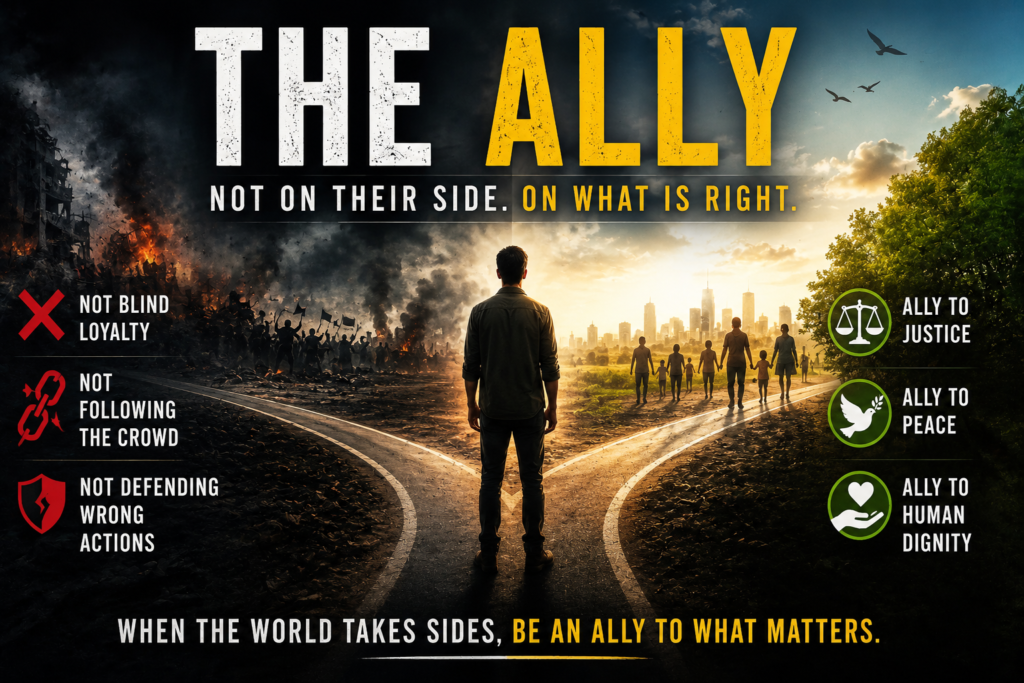
When Principles Matter More Than Sides
When conflict erupts—between individuals, communities, political movements, or nations—we are often immediately asked:
Which side are you on?
But perhaps this is the wrong question.
The more important question is:
What are you on the side of?
There is a profound difference between the two.
Choosing a side attaches our judgment to a group. Choosing a principle allows us to judge every group by the same moral standard.
The Trap of “Us vs. Them”
Conflict naturally divides the world into opposing camps. Each side develops its own story, its own grievances, its own heroes, and its own justification for what it does.
Once we emotionally enter one of these camps, something dangerous can happen: we begin evaluating actions according to who committed them rather than whether they were right or wrong.
An injustice committed by an opponent becomes intolerable.
The same injustice committed by an ally becomes explainable.
This is where moral judgment begins to collapse.
The alternative is not indifference. It is principled independence.
Be an ally to human dignity, regardless of whose dignity is threatened.
Be an ally to truth, regardless of whom the truth embarrasses.
Be an ally to justice, regardless of who committed the injustice.
Be an ally to innocent people, regardless of which flag flies above them.
And be an ally to peace, even when anger makes peace unpopular.
Understanding Is Not Justification
Violence rarely appears from nowhere. Beneath it may lie fear, humiliation, trauma, historical grievances, insecurity, injustice, or the desire for revenge.
Understanding these forces does not mean excusing violence.
A doctor studies the cause of a disease without approving of the disease. Likewise, anyone genuinely interested in peace must examine what continually produces conflict.
If we only condemn the visible explosion while refusing to investigate its causes, the conditions that created it remain.
Eventually, another explosion follows.
The purpose of understanding, therefore, is not to justify wrongdoing.
It is to prevent its repetition.
Justice Must Not Become Revenge
One of the greatest dangers during conflict is the transformation of justice into vengeance.
When punishment expands beyond those responsible and begins consuming civilians, families, communities, or future generations, justice has lost its purpose.
A principled person must therefore be willing to condemn wrongdoing even when it is committed by those they otherwise support.
Moral principles have meaning precisely because they apply when applying them is inconvenient.
If our principles disappear whenever our allies violate them, they were never principles.
They were preferences.
The Dangerous Cost of Choosing an Ally
There is also a practical danger in attaching ourselves unconditionally to another person, movement, government, or nation.
When you choose an ally, you do not inherit only their strength.
You may also inherit their mistakes.
If their actions are later exposed as unjust, destructive, or criminal, your reputation can become connected to actions you never personally committed.
For individuals, this can damage credibility.
For national leaders, the consequences can be far greater.
A government that binds itself unconditionally to another government’s actions may unintentionally bind the reputation of an entire population to decisions those citizens never made.
This is why alliances should never replace moral judgment.
Today’s strategic partner can become tomorrow’s historical embarrassment.
Principles provide a more durable foundation.
Neutrality Is Not the Answer
Refusing tribal allegiance does not mean standing silently while injustice occurs.
There is an enormous difference between neutrality toward injustice and independence from factions.
One can refuse to join either camp while actively defending civilians, documenting abuses, providing humanitarian assistance, protecting truth, encouraging negotiation, supporting legitimate rights, and creating spaces where dialogue remains possible.
The goal is not to withdraw from conflict.
It is to enter it differently.
Instead of becoming another participant feeding the fire, become part of the effort to extinguish it.
Become an Ally to the Future
Wars eventually end.
Political movements change.
Governments fall.
Leaders disappear.
Flags may change.
But people who once fought must somehow continue living in the world that remains.
That is why the most valuable ally during conflict may not be the person shouting most passionately for one camp.
It may be the person protecting the possibility of what comes afterward.
Protect the wounded.
Protect civilians.
Protect truth.
Protect human dignity.
Protect the possibility of reconciliation.
Protect the space in which negotiation may someday become possible.
Choosing a side requires passion.
Choosing a principle requires wisdom.
The greatest allegiance, therefore, may not be allegiance to a flag, faction, ideology, or political camp.
It is allegiance to the principles that should survive them all:
Truth.
Justice.
Human dignity.
Mercy.
Peace.
Do not simply ask:
“Whose side am I on?”
Ask the harder question:
“What am I an ally to?”
And when conflict demands that you become another source of fire,
become a source of water instead.