
 0
0
 152 views
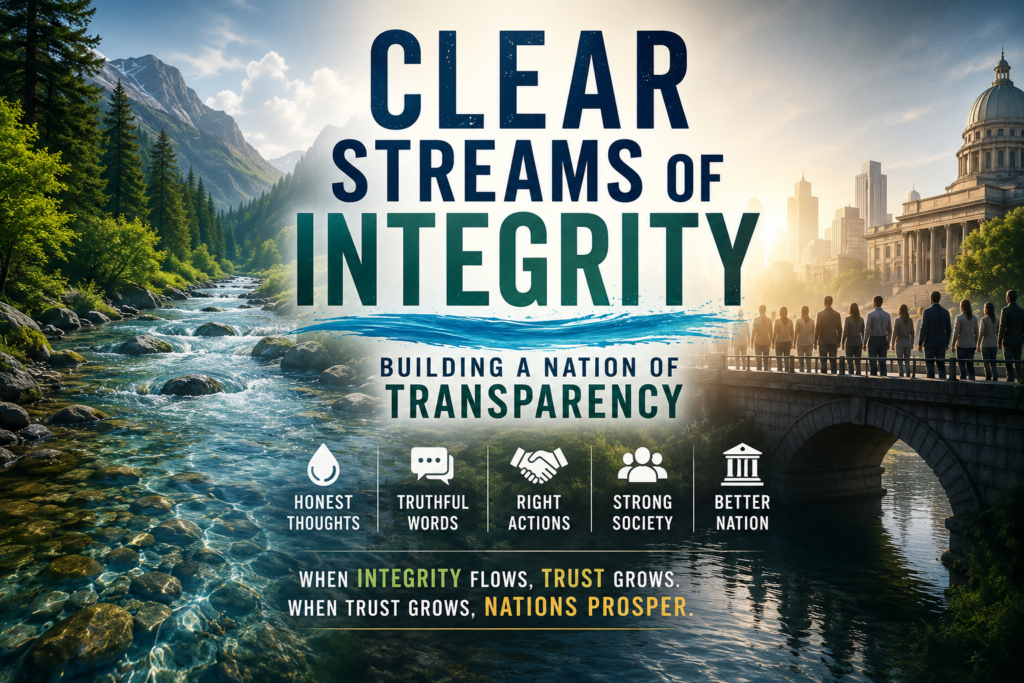
(Building a Nation of Transparency)
A person who places conscience above self-interest develops a certain clarity of character. Their beliefs, words, and actions are less likely to pull in different directions because personal advantage is not always determining what they are willing to accept as true.
Such clarity is like a well-tuned compass in the fog. It does not remove every uncertainty, but it helps a person remain oriented when circumstances become difficult.
When people learn to examine their own interests, loyalties, prejudices, and assumptions, they become better able to see reality as it is rather than merely as they would like it to be. Their thinking becomes more grounded in reason and less dependent upon convenience.
This intellectual honesty also changes the way they communicate.
Truth expressed with clarity possesses a language that can travel beyond political, cultural, religious, and social boundaries. Like a river finding its way across different landscapes, a sincere and well-reasoned idea can move from one mind to another because it appeals not merely to identity or allegiance, but to the human capacity for reason and moral understanding.
Such people do not necessarily claim to be free from bias. No human being completely is. Instead, they develop the habit of recognizing bias within themselves.
They ask difficult questions:
Am I defending this position because it is right—or because it benefits me?
Would I apply the same principle if my opponent had done the same thing?
Would I condemn this action if it were committed by someone outside my political, religious, national, or social group?
Would I still believe this argument if accepting it cost me something?
These questions form an internal discipline of integrity.
Without that discipline, hypocrisy quietly enters public life. People begin applying one standard to themselves and another to others. Actions they condemn in opponents become acceptable when performed by allies. Facts are welcomed when convenient and rejected when uncomfortable.
Eventually, truth itself becomes subordinate to loyalty.
A healthy society requires the opposite.
It requires citizens, journalists, scholars, judges, officials, business leaders, religious leaders, and political leaders who are willing, as far as humanly possible, to apply the same standards to themselves that they apply to others.
Transparency begins here—not merely with laws, reports, audits, or institutions, but with the individual willingness to allow one’s own beliefs and actions to be examined.
Imagine such individuals as clear streams.
A clear stream does not conceal what flows beneath its surface. Light enters it. The riverbed remains visible. What enters the water can be seen, questioned, and examined.
Integrity works in much the same way.
When thoughts, words, intentions, and actions remain reasonably aligned, there is less that must be hidden. A person does not need one explanation for friends and another for strangers. Their principles do not have to change whenever circumstances change.
Now imagine thousands—and eventually millions—of such streams flowing through a society.
Some flow through government.
Others through universities, businesses, courts, newsrooms, schools, families, communities, and places of worship.
Each contributes something to the larger river of national life.
When these streams remain relatively clear, institutions themselves become healthier. Decisions can be questioned without automatically being treated as acts of disloyalty. Mistakes can be acknowledged rather than concealed. Leaders can be criticized without critics becoming enemies. Evidence can challenge ideology. Principles can be applied consistently even when doing so is inconvenient.
But when enough streams become polluted by self-interest, tribal loyalty, corruption, propaganda, or hypocrisy, the larger river eventually becomes polluted as well.
A nation rarely becomes corrupt only because corruption suddenly appears at the top.
It becomes corrupt when double standards gradually become normal throughout society.
When people excuse dishonesty because their side benefits.
When loyalty becomes more important than truth.
When institutions protect reputation rather than acknowledge mistakes.
When citizens demand accountability from opponents but silence when the same conduct comes from allies.
The quality of the national river therefore depends partly upon the quality of the streams feeding it.
This is why integrity should not be understood merely as a private virtue.
It is a form of civic infrastructure.
Roads connect cities. Bridges connect communities. Institutions organize society.
But trust allows all of them to function.
And trust grows where people believe that rules are visible, decisions can be questioned, evidence matters, and similar actions will be judged by similar standards.
Transparency does not mean that everyone will agree.
A transparent society may contain intense disagreement.
But disagreement becomes healthier when people can examine one another’s reasoning rather than merely suspect hidden motives. Citizens may reach different conclusions while still sharing a commitment to intellectual honesty and consistent standards.
This may be one of the most important foundations of a mature civilization:
Do not ask only whether a principle protects your interests. Ask whether you would still defend that principle if it protected someone with whom you disagree.
That is where fairness begins.
And perhaps that is how nations become transparent—not through the unrealistic expectation that every person will become perfectly unbiased, but through millions of individuals repeatedly attempting to clear their own small portion of the stream.
A nation is ultimately nourished by what its people pour into it.
If they contribute resentment, deception, hypocrisy, and selective morality, those elements eventually enter its institutions.
But if enough people contribute intellectual honesty, fairness, self-examination, courage, and integrity, something different becomes possible.
The streams begin to clear.
And when enough clear streams converge, they can become a river powerful enough to nourish an entire nation.