
 0
0
 165 views
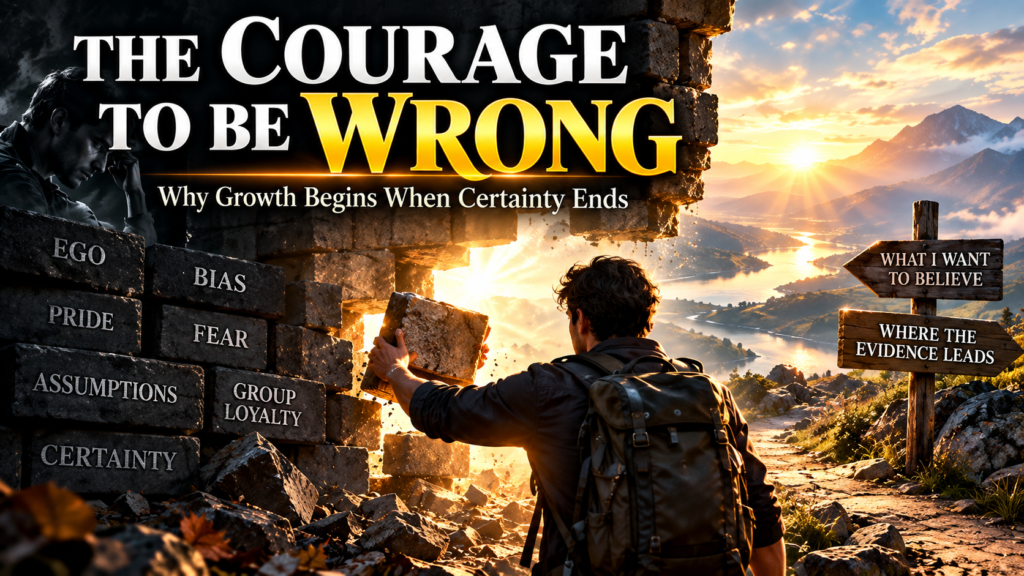
Why Growth Begins When Certainty Ends
There is a peculiar prison the human mind can build for itself. It has no walls, no guards, and no locked doors. Yet once we enter it, escape can become remarkably difficult.
Its foundation is a simple conviction:
“I cannot be wrong.”
We usually associate confidence with strength. We admire people who know what they believe, defend their convictions, and remain steady when challenged. There is value in such firmness. A mind that changes direction with every passing opinion is hardly a reliable guide.
But there is another kind of strength—quieter, more difficult, and perhaps more important.
It is the courage to look at something we have believed for years and ask:
“What if I am wrong?”
That question does not weaken the intellect. It may be one of the highest expressions of intellectual maturity.
When Beliefs Become Part of Us
We like to imagine that human reasoning follows a simple process: we gather evidence, examine it objectively, and then arrive at a conclusion.
Sometimes it does.
But human beings are not detached reasoning machines. We have histories, loyalties, fears, ambitions, relationships, identities, and emotional investments. Consequently, we sometimes reverse the process: we reach a conclusion first and then begin noticing the evidence that protects it.
Once a belief survives long enough, something even more interesting can happen.
“This is what I believe” gradually becomes “This is who I am.”
At that point, challenging the belief may feel like challenging the person.
An argument is no longer merely an argument. It becomes a defense of identity.
Contradictory evidence feels threatening. Questions feel disrespectful. Changing one’s mind begins to feel like surrender.
And so the intellect quietly changes jobs.
Instead of investigating whether our belief is true, it begins constructing increasingly sophisticated arguments for why we must already be right.
Intelligence itself can then become an instrument of self-deception.
A clever person is not necessarily immune to error. Sometimes greater intellectual ability simply provides more sophisticated tools with which to defend an error.
The Mirror That Always Agrees
Imagine living in a room filled entirely with mirrors.
Every time you smile, every reflection smiles.
Every time you nod, every reflection nods.
Every direction you turn, you encounter another version of yourself agreeing with you.
Eventually, you might mistake repetition for confirmation.
Something similar can happen intellectually.
We naturally prefer people, books, commentators, communities, and information that make sense within our existing understanding of the world. There is nothing inherently wrong with that. The danger begins when disagreement disappears entirely.
A mind surrounded only by agreement gradually loses an important instrument of correction.
A mirror that only flatters us cannot help us see clearly.
This is why disagreement, although uncomfortable, can sometimes be intellectually valuable. The person challenging us may be mistaken—but the challenge itself gives us an opportunity to examine the foundations of what we believe.
Instead of immediately asking, “How do I prove this person wrong?”, we might occasionally ask:
“Is there something here that I have failed to consider?”
That small change transforms disagreement from combat into investigation.
Three of the Heaviest Words
There are three remarkably simple words that many people struggle to say:
“I was wrong.”
Why are they so difficult?
Because admitting error can feel like losing something.
We may fear losing authority.
We may fear losing respect.
We may fear appearing unintelligent.
A leader may fear appearing weak. A parent may fear losing authority before a child. A scholar may fear contradicting something taught for decades. An expert may have built an entire professional reputation around an idea.
The longer we defend something publicly, the more expensive changing our minds can feel.
But there is another way of understanding the admission of error.
Suppose someone believed something at age twenty, encountered better evidence at forty, yet continued defending the original belief merely because admitting error was uncomfortable.
Would consistency in that situation really be a virtue?
There is an important difference between consistency of principle and attachment to conclusion.
Principles such as honesty, fairness, evidence, and truth may remain constant precisely because particular conclusions are allowed to change.
“I was wrong” therefore does not necessarily mean that thinking has failed.
Sometimes it means thinking has finally succeeded.
Where Does the Evidence Lead?
Imagine arriving at a fork in the road.
One path is smooth and familiar. Its sign reads:
WHAT I WANT TO BELIEVE
The other path is rocky and disappears into fog:
WHERE THE EVIDENCE LEADS
Much of intellectual life takes place at this intersection.
Right thinking requires us to separate two questions that easily become confused:
What do I want to be true?
and
What do I have sufficient reason to believe is true?
Sometimes the answers coincide.
Sometimes they do not.
The courage to be wrong begins when we are willing to walk the second road even when we hoped it would lead somewhere else.
Truth has no obligation to protect our preferences.
When Error Acquires Power
Being wrong is part of being human. No individual can completely escape error.
But the consequences of error change dramatically when a person’s decisions affect others.
Consider a religious scholar.
A scholar may influence how thousands of people understand morality, scripture, family, community, or their relationship with God. If interpretation becomes inseparable from tradition, institutional loyalty, personal preference, or fear of admitting previous mistakes, an intellectual error can travel through generations.
The responsibility of scholarship therefore includes more than accumulating knowledge. It includes continually examining interpretation, context, assumptions, evidence, and one’s own capacity for error.
Consider political leadership.
A political leader’s conclusions may influence laws, conflict, public resources, institutions, and millions of lives. A leader surrounded only by people who confirm existing assumptions becomes increasingly vulnerable to distorted judgment. In such environments, the person willing to say, “Our assumption may be wrong,” may be providing a valuable service rather than demonstrating disloyalty.
And consider the family.
Here the consequences may appear smaller, but they can be deeply personal.
A parent misunderstands a child.
A spouse assumes an intention that was never present.
A sibling remembers an argument differently.
Pride prevents someone from reconsidering.
One incorrect assumption becomes another, and eventually people may begin reacting not to one another but to the stories they have constructed about one another.
In every case, the principle is similar:
The greater our influence over others, the greater our responsibility to examine the possibility that we may be mistaken.
Conviction and Humility Are Not Opposites
Intellectual humility is sometimes misunderstood as permanent uncertainty.
It is not.
A person can hold strong convictions while remaining intellectually humble.
The distinction is subtle but important.
Intellectual humility does not say:
“Nothing can be known.”
It says:
“Based on what I currently understand, I have good reason to believe this—but I remain willing to examine evidence that challenges my conclusion.”
This allows conviction and openness to coexist.
Without conviction, thinking becomes directionless.
Without humility, conviction can become blindness.
Mature reasoning requires both.
The Discipline of Self-Correction
There are several questions worth carrying into any serious disagreement:
What evidence supports what I believe?
What evidence challenges it?
Have I seriously examined the strongest argument against my position—or only its weakest version?
Would I evaluate the same evidence differently if it supported the opposite conclusion?
What evidence would actually cause me to change my mind?
And perhaps most importantly:
Am I trying to discover the truth—or am I trying to win?
That final question reaches beyond logic.
It examines intention.
Because two people can look at exactly the same evidence while pursuing entirely different objectives. One may be searching for understanding. The other may be searching for ammunition.
Critical thinking requires more than intelligence.
It requires intellectual character.
Truth Must Become More Important Than Victory
Imagine two people arguing across a table.
Each brings another fact, another quotation, another argument.
Brick by brick, an invisible wall rises between them.
One brick is labeled ego.
Another certainty.
Another fear of looking weak.
Another group loyalty.
Another pride.
Eventually, they can no longer see the person sitting opposite them.
The wall may disappear only when someone becomes courageous enough to remove the first brick.
Perhaps by saying:
“Explain why you see it differently.”
Or:
“I hadn’t considered that.”
Or even:
“You may be right.”
None of these sentences guarantees that the other person is correct.
They simply reopen the door to inquiry.
The Blank Page
Wisdom is not possessing a notebook in which every page has already been filled.
Perhaps wisdom requires leaving some pages blank.
One page contains:
What I know.
Another:
What I think I know.
Another:
What I do not know.
And perhaps the most important page says:
What I am still willing to learn.
A growing intellect continually moves ideas between these pages.
Some convictions become stronger.
Some become more nuanced.
Some are abandoned.
And entirely new understandings emerge.
There is no shame in this movement.
It is the architecture of learning itself.
The real intellectual failure is not being wrong.
Every human being will be wrong—many times.
The greater danger is constructing an identity so dependent upon being right that correction becomes impossible.
Because an error discovered can become knowledge.
An error admitted can become wisdom.
An error corrected can become growth.
But an error protected by ego can survive for a lifetime—and, when accompanied by authority, sometimes much longer.
So perhaps intellectual maturity begins not with the declaration:
“I know I am right.”
But with the quieter and more courageous possibility:
“This is what I currently believe. I have reasons for believing it. But if truth shows me otherwise, I am willing to change.”
It takes confidence to defend what we believe.
It takes intelligence to examine why we believe it.
But sometimes it takes something greater to change it.
It takes the courage to be wrong.
And perhaps one of the most important questions we can periodically ask ourselves is not:
“What if they are wrong?”
but: