
 0
0
 70 views
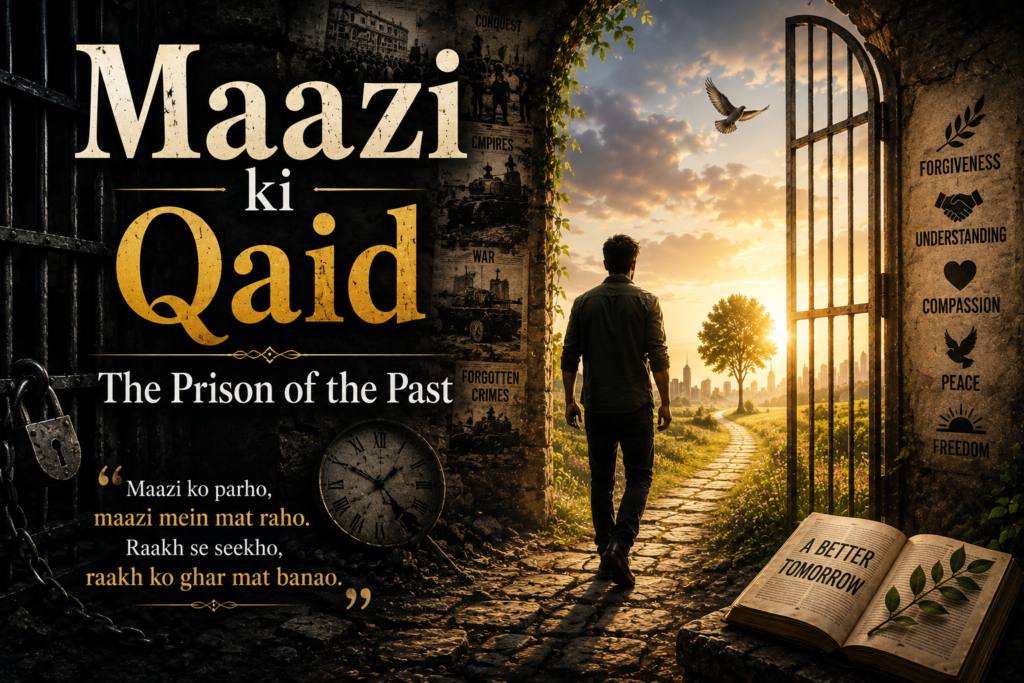
“Maazi ki Qaid” (The Prison of the Past) is a philosophical Urdu song about one of the great contradictions of our time: humanity has developed the tools of the future, yet our thinking can remain imprisoned in the past.
We have reached beyond the skies, connected voices across the world, created artificial intelligence, and developed extraordinary technological power. Yet old ideas of conquest, domination, revenge, inherited hostility, and the belief that power itself creates legitimacy continue to survive.
The song asks a difficult question: If our weapons belong to the twenty-first century, but our thinking belongs to centuries past, can we truly call that progress?
At its heart is a simple message:
“Maazi ko parho, maazi mein mat raho.
Raakh se seekho, raakh ko ghar mat banao.”
Study the past, but don’t live there.
Learn from the ashes, but don’t build your home in them.
Maazi ki Qaid does not ask us to forget history. It asks us to understand history deeply enough that we inherit its lessons without inheriting its hatreds. The wounds of yesterday should help us prevent new wounds—not become reasons to recreate them.
Perhaps strength is not merely having the power to unleash destruction, but possessing that power and choosing restraint. Perhaps victory is not simply making an enemy surrender, but creating a future in which the next generation can walk the same roads without fear.
Technology alone cannot make civilization civilized. Our wisdom must advance with our capabilities.
We have taught our machines to reach the future.
Now we must teach ourselves to leave the past.
We have built the tools of tomorrow.
Can we become the humans tomorrow needs?
Line by line translation
————————
[Intro]
Zamana aage nikal gaya,
Magar kuch zehan ab bhi
The world has moved ahead,
yet some minds still remain behind.
Un faseelon mein muqayyad hain
Jahan taaqat hi daleel thi,
Imprisoned within those ancient walls
where power itself was the only argument,
Aur fatah—har jurm ka jawab.
and victory was the answer to every crime.
[Verse 1]
Naye shehar hain, nayi sadi,
Naye hunar, naya safar,
New cities, a new century,
new abilities, a new journey.
Sitaron tak nigaah pahunchi,
Magar soch kahan gayi?
Our vision has reached the stars—
but how far has our thinking gone?
Wohi lashkar, wohi darbar,
Wohi sarhad, wohi khumaar—
The same armies, the same courts of power,
the same borders, the same intoxication.
Haathon mein ahd-e-nau ki taaqat,
Dil mein ahd-e-qadeem ka khwaab.
The power of the modern age in our hands,
but the dream of an ancient age in our hearts.
Ye kaisa waqt hai
Jo aage bhi hai,
What kind of age is this—
one that moves forward,
Aur peechhe bhi?
yet remains behind?
[Verse 2]
Kabhi qabza fatah kehlata tha,
Kabhi jalta shehar saltanat ki shaan.
There was a time when occupation was called victory,
and a burning city was considered an empire’s glory.
Faateh hi likhta tha
Ki haq kis taraf tha,
The conqueror himself would write
which side supposedly stood for truth.
Raakh se poochhne wala
Koi na tha.
There was no one
to ask the ashes what had happened.
Phir insaan ne
Apni hi banayi aag mein
Then humanity looked
into the fire of its own making,
Apna chehra dekha—
Aur laraz utha.
and saw its own face there—
and trembled.
[Chorus]
Maazi ko parho,
Maazi mein mat raho.
Study the past,
but do not live there.
Raakh se seekho,
Raakh ko ghar mat banao.
Learn from the ashes,
but do not build your home in them.
Jo kal tha,
Zaroori nahin ki haq tha—
What belonged to yesterday
was not necessarily right.
Jo dafn ho chuka,
Use mustaqbil mat banao.
What history has already buried,
do not turn into our future.
[Verse 3]
Phir kuch lafz likhe gaye—
Then humanity began to write down certain principles—
Jang ki bhi had hogi,
Taaqat haq nahin hogi,
Even war must have limits.
Power will not itself become right.
Fatah insaaf nahin hogi,
Begunaah bhi insaan hain.
Victory will not automatically mean justice,
and the innocent are human too.
Waade kaamil na the,
Duniya aadil na thi—
The promises were not perfect,
nor had the world become just.
Phir bhi insaan ne
Apni wahshat ke saamne
And yet humanity stood
before its own capacity for brutality,
Ek lakeer kheenchhi—
and drew a line.
Yahan se aage
Hum kuch behtar honge.
From this point onward,
we will try to become something better.
[Verse 4]
Magar kuch haath aaj bhi
Woh lakeer mitaate hain,
Yet even today, some hands
try to erase that line.
Purani azmat ke naam par
Naye shehar jalaate hain.
In the name of ancient glory,
they burn the cities of the present.
Khauf se amn,
Raakh se iqtidaar,
Peace through fear,
power through ashes,
Zakhmon se wafadaari—
Ye kaisa gumaan hai?
loyalty through wounds—
what kind of illusion is this?
Tareekh aaj bhi poochhti hai—
History still asks us today—
Jis zameen ko jeet liya,
Uske dil ko kaise jeetoge?
You may have conquered the land,
but how will you conquer its heart?
[Verse 5]
Ab aasman bhi dekhta hai,
Zameen bhi yaad rakhti hai.
Now even the sky bears witness,
and the earth remembers.
Ek gumnaam aankh
Ek chhote se phone mein
An unknown witness,
through a small phone,
Saltanat se zyada
Gawaahi bacha sakti hai.
may preserve more testimony
than an empire ever could.
Shehar mit sakte hain,
Imaratein gir sakti hain—
Cities can disappear,
buildings can fall—
Magar tasveer rehti hai,
Aawaaz rehti hai,
but the image remains,
the voice remains,
Naam rehte hain.
and the names remain.
Aur kabhi ek bachche ki
Khamosh aankhein
And sometimes,
the silent eyes of a child
Faateh ki poori taqreer se
Zyada der zinda rehti hain.
remain alive in human memory
longer than the conqueror’s entire speech.
[Verse 6]
Taaqat sirf ye nahin
Ki kitni door tak
Power is not merely measured
by how far
Aag bhej sakte ho.
you can send your fire.
Taaqat ye bhi hai—
Aag hote hue
Power is also this:
having the fire,
Use rok sako.
and still being able to restrain it.
Fatah sirf ye nahin
Ki dushman jhuk jaaye—
Victory is not simply
making your enemy bow.
Fatah shayad ye bhi hai
Ki jang ke baad
Perhaps victory is also this:
that after the war,
Do dushmanon ke bachche
Ek hi raaste se
the children of two former enemies
can walk along the same road,
Be-khauf guzar sakein.
without fear.
[Bridge — Rising]
Humne machine ko
Aasman tak pahuncha diya,
We have sent our machines
into the heavens.
Aawaaz ko duniya tak,
Nigaah ko sitaron ke paar,
Our voices across the world,
our vision beyond the stars.
Aur aql-e-masnooi ko
Apne sawaalon tak.
And artificial intelligence
into the realm of our deepest questions.
Magar insaan—
But humanity—
Kya humne apne shuoor ko bhi
Utni hi door pahunchaya?
Have we carried our wisdom
equally far?
Agar hathiyaar
Ikkeesveen sadi ke hon,
If our weapons belong
to the twenty-first century,
Aur soch
Sadiyon purani—
while our thinking
belongs to centuries past—
To taraqqi kahan hui?
then where, exactly, is the progress?
Sirf tabaahi
Zyada muassar hui.
Perhaps only destruction
has become more efficient.
[Final Verse]
Mustaqbil
Nayi machine ka naam nahin—
The future
is not simply the name of a new machine—
Naye insaan ka imtihaan hai.
it is the test of a new kind of human being.
Tareekh ko saath rakho,
Zanjeer na banao.
Carry history with you,
but do not turn it into a chain.
Uske zakhm yaad rakho,
Uski nafratein nahin.
Remember its wounds,
not its hatreds.
Maazi ka ehteraam
Use dohrana nahin—
To respect the past
does not mean repeating it—
Usse aage nikal jaana hai.
It means learning enough to move beyond it.
[Final Chorus]
Maazi ko parho,
Maazi mein mat raho.
Study the past,
but do not live there.
Raakh se seekho,
Raakh ko ghar mat banao.
Learn from the ashes,
but do not build your home in them.
Jo kal tha,
Zaroori nahin ki haq tha—
What belonged to yesterday
was not necessarily right.
Jo dafn ho chuka,
Use mustaqbil mat banao.
What history has already buried,
do not make it our future.
Humne kal ke auzaar to bana liye—
We have already built the tools of tomorrow—
Ab sawaal ye hai—
Now the question is—
Kya hum
Kal ka insaan bhi
Can we also become
the human beings
Bana sakenge?
that tomorrow needs?
[End]