
 0
 11 views
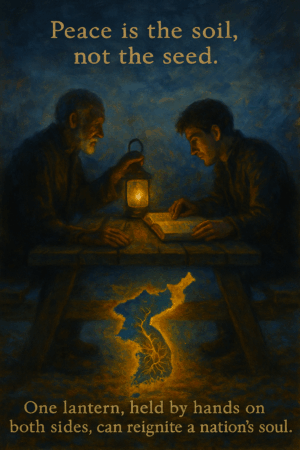
The courtyard still held the hush of Christmas night. Frost had thinned to a silver sheen, and the lantern’s glow breathed gold into the turned soil where the seedling trembled. Emil sat beside Grandfather Tomas on the weathered bench, the ledger open across his knees, its pages catching the first gray seam of dawn.
“Grandfather,” Emil said, “you told me peace is the soil, not the seed. Show me how to use our framework on a war I did not live—the one that split Korea. I need to learn to see a whole forest, not only our little garden. If I can do this with you, I’ll be ready for what’s ahead.”
Grandfather’s hands warmed the teacup. “Then we will practice comprehension, seed by seed,” he said. “Not to take sides, but to see how the absences multiply harm. Begin with the ground itself.”
Emil sketched a thin line down the page. “Background,” he murmured. “1945—division at the 38th parallel by outside powers. 1950–1953—war, millions dead, families torn, armistice but no peace treaty. Today—one side isolated and armed, hungry for safety; the other wealthy and allied, hungry for certainty. One culture, split.”
Grandfather nodded. “Good. Now walk the absences in order, and watch how one starves the next.”
Absence of Wisdom — forgetting life’s sacred design.
Emil wrote: “Leaders came to treat division as permanent; citizens began to take separation as fate. In the North, self-reliance framed isolation as ordained. In the South, rapid growth tolerated division as the price of prosperity.”
Grandfather tapped the margin. “Name the harm plainly: suffering—starvation, alienation—accepted as weather, not a call to heal.” He looked at Emil. “We often misread suffering as cosmic injustice or someone else’s fault, not a summons to mend.”
Absence of Values — erosion of justice, mercy, trust, dignity.
They moved slowly. “On one side,” Emil said, “prisons without due process, aid weaponized, neighbors compelled to inform. On the other, laws that once jailed ‘sympathizers,’ defectors shamed, the poor and elderly left behind by a sprinting economy.”
Grandfather’s voice softened. “When foundational values erode, the vulnerable suffer silently. And power profits from the stalemate.”
Absence of Humanity — reducing kin to caricatures.
“Language turns people into labels,” Emil continued. “Puppets, invaders, zombies, burdens. The shared inheritance—history, festivals, even lullabies—gets muffled. Families die apart. Land itself is militarized; memory is commodified.”
Grandfather traced the ledger’s spine. “When we forget who people are, we reduce them to what we fear.”
Absence of Awareness — instincts distorted.
Emil drew four small icons: a shield, a laurel, a tool, a heart. “Safety turns to arms races. Recognition becomes parades and prestige or pride that hides inequality. Purpose hardens into slogans—‘protect the revolution,’ ‘outcompete forever.’ Love is redirected—toward the leader or toward oneself alone.”
Grandfather’s eyes held the lanternlight. “Ignored instincts become shadows. Honored, they become lanterns.”
He let the quiet settle. “Now, show me the cycle of harm.”
Emil mapped it: walls of earth (DMZ, skirmishes), walls of thought (reunion painted as contamination or as economic burden), and turning seasons of trauma (grandparents starved or silenced; grandchildren inherit suspicion). He underlined a soldier’s imagined thought at the fence: They’re not like us. Reunion would ruin what we built. Then four arrows back to the start—wisdom forgotten, values frayed, humanity thinned, instincts twisted—round and round.
Grandfather closed his eyes a moment, as if listening for roots beneath stone. “You have seen the rooms unlit,” he said. “Now light them. A gardener never ends with diagnosis.”
Emil turned the page and wrote a second table, this time pairing each absence with its Root.
-
Wisdom → Impermanence & Shared Roots.
Teach that borders are human-made. Put grandmothers’ songs into curricula. Publicly remember unity across five thousand years. -
Values → Mercy & Dignity First.
Open humanitarian corridors. Fund family reunions before summits. Reform laws that criminalize kinship. -
Humanity → Recognition & Kinship.
Twin-city exchanges—music, food, crafts. Restore heritage sites together. Honor defectors’ stories as bridges, not burdens. -
Awareness → Resonance & Redirection.
Pilot joint economic/cultural zones. Stepwise de-escalation: fewer drills, fewer broadcasts, more classrooms. Replace propaganda hours with peace education on both sides.
“Peace as soil,” Emil whispered, circling the words. “Unconditional ground first—no attached bargains pretending to be peace. Then guard the soil from interference so justice can grow of its own season.” He added small checkboxes: Non-interference pledges, time-boxed de-escalation, metrics of dignity (family reunions completed, joint classes held, cross-border letters exchanged), listening circles at the fence with elders’ testimonies archived and shared.
Grandfather smiled. “Now you are not prescribing victory. You are preparing weather—soil, water, shade—so that justice has a place to sprout.” He tapped the lantern. “A nation is not its flags or fences. It is grandmothers who remember the same lullabies.”
Emil closed the ledger gently. “Then the path is not a treaty alone,” he said, “but a thousand tended tasks that make reunion imaginable again.”
“And that,” Grandfather answered, “is how you will carry yourself in Ukraine—or anywhere war has left its shadow. Not with answers, but with conditions in which answers can take root.”
They sat until the lantern dimmed and dawn pressed softly through the glass. The seedling did not move, but somehow looked steadier.
Ledger Entry — Lighting the Rooms (Korea)
Date: January 10, 2026
Symptom: Need to scale comprehension before Kyiv; practice applying the Four Absences to a long, frozen conflict.
Disease — The Four Absences (Global):
-
Absence 1 (Exclusion/Wisdom): Division treated as destiny; suffering normalized as fate rather than a call to heal.
-
Absence 2 (Vengeance/Values): Justice, mercy, trust, dignity eroded by prisons, punitive laws, and profit from stalemate.
-
Absence 3 (Dehumanization/Humanity): Kin reduced to enemies; families die apart; heritage erased or commodified.
-
Absence 4 (Unheard Cry/Awareness): Safety, recognition, purpose, love distorted into arms races, prestige, slogans, and isolation.
Investigator’s Response:
Built a Comprehension Protocol: (1) set shared background; (2) map Absence→Absence→Absence→Absence→Cycle; (3) pair each Absence with its Root—Inclusion, Restoration, Recognition, Resonance; (4) design “peace as soil” pilots—humanitarian corridors, funded reunions, shared heritage work, twin-city exchanges, joint learning zones; (5) define dignity metrics; (6) pledge non-interference while the soil sets.
Outcome:
Framework tested on a global case without side-taking; concrete, tenderable steps identified. Team readiness for Kyiv strengthened; Winter Ledger to include the protocol.
Note:
No peace paper outlasts unlit rooms. But one lantern—held by hands on both sides—can show the floorboards again. Peace is the soil; justice is the harvest. Guard the soil.