
 0
0
 103 views
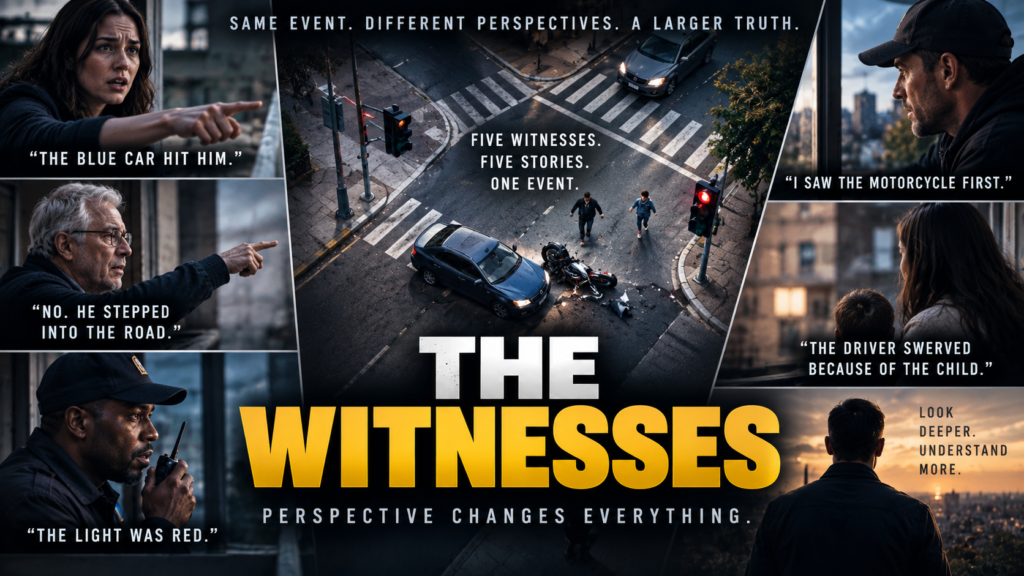
(How perspective shapes what we know—and why disagreement does not always require deception)
Five people stand at five different windows overlooking the same intersection.
An accident happens below.
A pedestrian falls. A blue car stops abruptly. A motorcycle skids across the road. People begin running toward the scene.
Later, investigators question the witnesses separately.
The first says:
“The blue car hit him.”
The second insists:
“No. The pedestrian stepped into the road.”
The third remembers:
“The traffic light was red.”
The fourth says:
“The motorcycle caused everything.”
The fifth adds something nobody else noticed:
“The driver swerved because there was a child in the road.”
Their accounts appear contradictory.
Perhaps someone is lying.
Perhaps someone is protecting the driver.
Perhaps someone’s memory is unreliable.
But then imagine that we rise above the intersection.
Higher.
Higher.
Until, for the first time, we can see the entire event.
Something surprising becomes visible:
Each witness saw something real.
And yet none of them saw everything.
This presents one of the most important problems in human understanding:
We often mistake the part of reality available from where we stand for reality itself.
The Window Through Which We See
Every human being encounters reality from somewhere.
There is no ordinary human perspective from nowhere.
We occupy a particular physical location. We were born at a particular time. We speak particular languages. We inherit histories. We acquire knowledge through particular experiences. We belong to families, communities, professions and cultures.
These things do not necessarily make our observations false.
But they influence which parts of reality become visible to us first.
Imagine standing on the north side of a mountain.
You accurately describe steep cliffs and snow.
Someone standing on the southern side describes green forests.
If neither can see the other side, each may conclude:
“The other person is wrong. I can see the mountain with my own eyes.”
Both observations may be accurate.
The mistake begins when either person silently changes:
“This is what I can see”
into:
“This is all there is to see.”
That small intellectual transition—from observation to totalization—is responsible for a surprising amount of human disagreement.
Perspective Is Not the Same as Truth
We should make an important distinction.
Saying that people observe reality from different perspectives does not mean that truth itself changes depending upon who observes it.
If a traffic light was red, it does not become green because another witness remembers it differently.
If someone committed a crime, perspective does not transform the crime into innocence.
If an historical event occurred, disagreement about it does not create several equally valid histories.
Reality places limits upon interpretation.
The witnesses therefore teach us something more subtle than:
“Everyone has their own truth.”
A better principle is:
There may be one reality while different observers possess different portions of information about it.
Some perspectives may be better informed than others.
Some witnesses may have been closer.
Some may have seen the beginning but missed the end.
Some may have been distracted.
Some may possess expertise that allows them to recognize something others missed.
And some may simply be mistaken.
Perspective should therefore produce intellectual humility, not intellectual relativism.
The Difference Between Lying and Being Wrong
Human beings often make another mistake during disagreement.
We move too quickly from:
“I think your conclusion is wrong”
to:
“You must be dishonest.”
But error does not require deception.
A witness can sincerely report what they remember and still be mistaken.
A historian can interpret incomplete evidence incorrectly without fabricating anything.
A scientist can propose an explanation that later evidence overturns.
A journalist can emphasize one genuine dimension of an event while overlooking another.
Two citizens can observe the same government policy and experience its effects differently.
Two members of the same family can remember the same argument differently.
Their disagreement alone does not prove bad faith.
This matters because once we interpret disagreement as evidence of moral corruption, dialogue becomes much more difficult.
We stop asking:
“What are they seeing that I am not?”
and begin asking:
“What is wrong with them?”
At that moment, an intellectual disagreement starts becoming an identity conflict.
Where You Stand Determines What Becomes Visible
Consider a new government policy.
A policymaker sees national statistics.
An economist sees incentives and long-term fiscal effects.
A small-business owner sees payroll and compliance costs.
A worker sees wages and job security.
A family sees its monthly expenses.
A local official sees implementation problems.
They are all looking at the same policy.
But they encounter it through different windows.
A national average may reveal something important that an individual experience cannot.
An individual experience may reveal something important that a national average hides.
Wisdom requires the ability to move between these scales.
The policymaker who sees only statistics can become detached from human consequences.
The individual who sees only personal experience can mistake one case for an entire society.
Neither window should become the whole building.
The Witnesses of History
The problem becomes even more complicated when we study history.
Historical events are rarely preserved through one perfectly positioned observer.
We inherit letters.
Government records.
Newspapers.
Memoirs.
Military reports.
Religious texts.
Photographs.
Archaeological evidence.
Testimonies from winners.
Testimonies from victims.
Accounts written decades later.
Each source may illuminate one portion of what happened.
But every source also has a location.
A general sees a battle differently from a soldier.
A ruler records a rebellion differently from those rebelling.
An occupying power may describe “restoring order” where the occupied population remembers repression.
A revolutionary may describe “liberation” where another community remembers violence.
The responsible historian therefore does not merely collect quotations.
The historian asks:
Who produced this account?
Where were they positioned?
What could they know?
What could they not know?
What interests might they have had?
What other independent evidence exists?
Where do different accounts converge?
Where do they contradict one another?
Historical understanding becomes stronger when multiple windows are examined together.
The Danger of the Single Witness
Modern technology has created a strange paradox.
We have more witnesses than any civilization before us.
Almost everyone carries a camera.
Wars, protests, crimes, political speeches and disasters can appear on our phones within minutes.
Yet this abundance can create an illusion:
because we saw the video, we believe we saw the event.
But a camera is also a witness.
It stands somewhere.
It points somewhere.
It begins recording at some moment.
It stops at another.
Something remains behind it.
Something happened before recording began.
Something may happen after it ends.
The image can be completely authentic while still representing only one vantage point.
This is where The Witnesses naturally meets The Missing Frame.
The Missing Frame asks:
What wasn’t included?
The Witnesses asks:
Where was the observer standing?
These are related questions—but they are not identical.
When Perspective Becomes Identity
There is an even deeper problem.
Sometimes we become emotionally attached to our window.
A political identity, religious community, nation, profession or social group can become so closely connected with our interpretation of events that questioning our perspective begins to feel like questioning who we are.
Then evidence from another window becomes threatening.
We stop examining it.
We defend our view before understanding theirs.
Eventually, we may surround ourselves with witnesses standing at approximately the same window.
Everyone confirms what everyone else sees.
The view becomes familiar.
The familiar becomes obvious.
And the obvious becomes:
“How could any reasonable person see this differently?”
Perhaps because they are standing somewhere else.
This does not mean their conclusion must be correct.
It means their perspective deserves examination before their character is condemned.
The View From Above
Return to our intersection.
The five witnesses continue arguing.
Now imagine that an investigator gathers:
the witnesses’ accounts,
traffic-camera footage,
vehicle data,
road markings,
medical evidence,
photographs,
and the sequence of events.
No single witness is treated as the whole truth.
Instead, their observations become pieces of a larger reconstruction.
This is what good reasoning attempts to do.
We cannot literally rise above every human disagreement and acquire a God’s-eye view of reality.
But we can approximate a wider view by deliberately combining perspectives, evidence and context.
Science does this through replication, peer review and competing hypotheses.
Courts do it through evidence, witnesses, cross-examination and procedural safeguards.
Responsible journalism seeks multiple sources.
Historical scholarship compares documents and evidence.
Healthy organizations invite dissenting expertise.
Good conversation can do something similar.
The principle is remarkably simple:
When the view matters, change windows.
But Not Every Window Is Equally Reliable
Intellectual humility must not become gullibility.
If five people witnessed an event, we should not automatically average their accounts and call the result truth.
One witness may have been fifty meters away.
Another may have been intoxicated.
One may possess video evidence.
Another may have arrived afterward.
One may have a financial interest in the outcome.
Another may have directly observed the entire sequence.
Perspective explains why accounts can differ.
Evidence helps determine which account is better supported.
This distinction protects us from a dangerous misunderstanding of pluralism.
Listening to every perspective does not require accepting every conclusion.
Understanding is not agreement.
Empathy is not endorsement.
Context is not excuse.
And humility is not surrendering the possibility of truth.
The Missing Witness
Sometimes the most important perspective is not among the people already arguing.
Imagine a courtroom hearing testimony from everyone except the person most directly affected.
Imagine writing the history of a war entirely from military records while never reading civilian accounts.
Imagine designing a public service without speaking to the people who use it.
Imagine debating poverty without hearing anyone experiencing it.
Imagine interpreting another religious community entirely through the writings of its opponents.
The problem is no longer simply that existing witnesses disagree.
Someone’s window is missing altogether.
A powerful question therefore becomes:
Whose perspective is absent from this conversation?
That question does not determine the answer.
But it can reveal why our answer may still be incomplete.
———————————
The Witnesses belongs to a larger NextWisdom exploration that I call The Architecture of Judgment—the invisible intellectual process through which human beings move from information to interpretation and finally to judgment.
Context asks:
What surrounds this statement or event?
See https://nextwisdom.net/blog/seeing-problems-in-context/ and
https://youtu.be/beTtSC8p3lo?si=-61R-GzEEpeZ8EKe and another song in Urdu
https://youtu.be/WIT7oD0skrU?si=oZYMgbRRt9fUeCcJ
The Missing Frame asks:
What might have been excluded from what I was shown?
See https://nextwisdom.net/blog/the-missing-frame-what-you-saw-was-real-but-was-it-the-whole-story/
The Same Sentence asks:
How can the same words carry different meanings because their contexts differ?
See https://nextwisdom.net/blog/the-same-sentence-why-words-alone-are-not-always-enough/
The Witnesses adds another question:
From where am I seeing this—and what becomes visible from somewhere else?
The Footnote can take us deeper:
What history and evidence lie behind the statement before us?
When Words Lose Their World asks:
What happens when we preserve a word while separating it from the conceptual world that gave it meaning?
And The Invisible Scale eventually asks:
After gathering all of this, am I weighing it fairly?
See https://nextwisdom.net/blog/the-invisible-scale/
Together, they create a discipline:
Recover the context.
Look beyond the frame.
Understand the language.
Change windows.
Investigate the history.
Then weigh the evidence fairly.
Only after that should certainty become comfortable.
Becoming a Better Witness
Perhaps wisdom does not require us to stop trusting what we see.
It requires us to understand the limits of seeing.
When someone sincerely disagrees with us, before assuming ignorance, dishonesty or malice, we might ask:
What can they see from where they stand that I cannot see from where I stand?
And then ask the equally important reverse question:
What can I see that their position may be hiding from them?
Neither question requires abandoning our judgment.
They require strengthening it.
The goal is not to have no perspective.
That is impossible.
The goal is to prevent our perspective from becoming a prison.
Return one final time to the five windows.
Each witness looks outward.
Then, instead of shouting across the building, they leave their rooms.
They walk downstairs.
They meet at the intersection.
For the first time, they stand together at the place where the event actually occurred.
Perhaps that is what genuine dialogue ultimately asks of us:
not that we surrender our window,
but that occasionally…
we leave it.
The Witnesses
**You may be seeing something real.
So may the person who disagrees with you.
Truth does not require us to close our window.
Wisdom asks us to look through more than one.**