
 0
0
 34 views
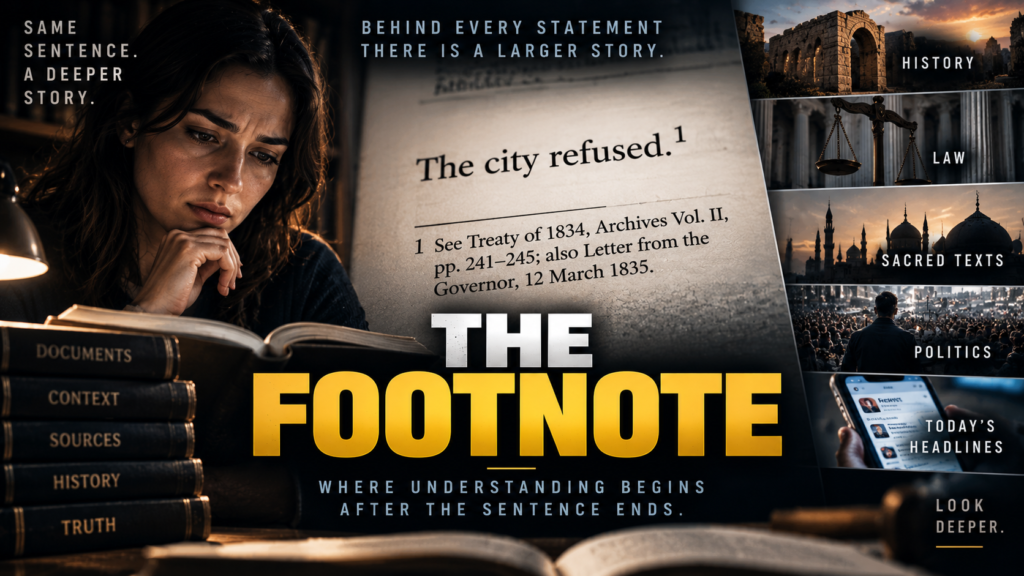
(Why serious thinking requires us to follow ideas beyond the words immediately before us)
A researcher sits alone in an old library.
Before her lies a historical document.
One sentence has been underlined:
“The city refused.”
The statement appears straightforward.
The city refused.
But refused what?
She continues reading and notices a tiny number beside the sentence:
¹
At the bottom of the page is a footnote.
The footnote refers to an earlier document.
She retrieves it.
That document mentions a treaty.
The treaty refers to a conflict.
The conflict emerged from an older political dispute.
The dispute leads her to a map.
The map reveals a border that no longer exists.
Another document identifies communities whose names have since changed.
A letter reveals what one side feared.
A court record explains what the other side demanded.
Hours later, the researcher returns to the original sentence:
“The city refused.”
The words have not changed.
But now they sit inside an entire world.
What initially looked like a sentence has become the visible tip of an enormous intellectual architecture.
Perhaps this is one of the differences between simply reading information and genuinely understanding it.
Certainty reads the sentence.
Curiosity reads the footnote.
Wisdom asks why it was written.
The Smallest Mark on the Page
—————————
A footnote is easy to ignore.
It sits beneath the main text in smaller type, often separated from the argument we came to read.
Yet intellectually, the footnote represents something much larger.
It says:
There is more behind this statement.
There is another source.
Another argument.
Another event.
Another piece of evidence.
Another historical layer.
The sentence before us did not emerge from nowhere.
That tiny superscript number is therefore almost a symbol of intellectual humility.
It reminds us that what appears self-contained may depend upon something beyond itself.
And this principle extends far beyond academic writing.
Human civilization itself is filled with invisible footnotes.
Our laws have histories.
Our political institutions have histories.
Religious concepts have histories.
Scientific theories have histories.
National borders have histories.
Words have histories.
Conflicts have histories.
Even many of our personal beliefs have histories we have never investigated.
We encounter the conclusion.
But rarely do we ask:
What is its footnote?
The World Behind a Claim
——————
Consider a statement such as:
“This territory belongs to us.”
It appears to make one claim.
Follow its footnotes, however, and an entire intellectual landscape may emerge.
Which period of history?
Which boundary?
Which empire?
Which treaty?
Which migration?
Which war?
Which legal system?
Which population?
Which archaeological evidence?
Which international agreement?
Which historical narrative?
Different people may begin their stories at different dates—and the date at which a story begins can dramatically influence the conclusion toward which it seems to point.
The footnote does not automatically tell us which claim is correct.
It does something more fundamental.
It reveals what must be investigated before certainty becomes responsible.
Conclusions Have Genealogies
Ideas have ancestors.
A modern political argument may depend upon a principle developed centuries earlier.
A legal judgment may depend upon an older precedent.
A religious interpretation may depend upon a commentary written in another historical environment.
A scientific proposition may rest upon decades of experiments.
A social custom may originate in circumstances that no longer exist.
When we encounter only the final conclusion, we see the latest branch of a tree.
The footnote takes us toward the roots.
This gives us an important intellectual principle:
Every conclusion has a genealogy.
Understanding that genealogy does not necessarily invalidate the conclusion.
Sometimes following the evidence makes the conclusion stronger.
Sometimes it reveals qualifications.
Sometimes it exposes an assumption that no longer holds.
Sometimes it shows that a claim repeated thousands of times ultimately rests upon remarkably weak evidence.
But until we follow the trail, we may not know which is true.
When Repetition Replaces Evidence
—————
Imagine encountering a claim online.
Article A cites Article B.
Article B cites a news report.
The news report cites an unnamed secondary source.
Another website cites Article A.
Ten social-media accounts then cite those websites.
Soon a search engine displays hundreds of references to the claim.
It begins to look overwhelmingly established.
But follow the citations backward.
Hundreds become twenty.
Twenty become five.
Five become two.
And eventually—
everything points toward one original statement.
Perhaps that source is excellent.
Perhaps it is mistaken.
Perhaps it was speculative.
Perhaps it never said what later writers claimed it said.
The apparent abundance of evidence was partly an illusion created by repetition.
This is why counting how many times something has been repeated is not the same as examining how well it is supported.
A thousand echoes do not necessarily mean there were a thousand voices.
Sometimes they all began with one.
The Footnote in the Age of the Screenshot
———————————–
Our information environment increasingly encourages the opposite intellectual habit.
We encounter screenshots instead of documents.
Headlines instead of articles.
Quotations instead of conversations.
Clips instead of interviews.
Summaries instead of studies.
Posts instead of arguments.
And increasingly, AI systems can provide concise answers without requiring us to encounter the chain of reasoning or evidence behind them.
This convenience is extraordinary.
But convenience creates a new responsibility.
The easier it becomes to obtain an answer, the more important it becomes to know when an answer deserves investigation.
Not every statement requires hours of research.
We could not function that way.
But the importance of verification should rise with the importance of the conclusion.
Before sharing an amusing fact, little may be at stake.
Before damaging someone’s reputation, voting on a consequential policy, interpreting a sacred command, supporting military action, making a medical decision, or condemning an entire population, much more is at stake.
A useful principle might therefore be:
The greater the consequence of the conclusion, the deeper our responsibility to follow its footnotes.
History Has Footnotes
——————-
Historical events are particularly vulnerable to shallow interpretation because the past cannot step into the room and explain itself.
We encounter fragments:
a speech,
a treaty,
a battle,
a photograph,
a government decree,
a religious text,
a memoir,
a newspaper report.
Each may be authentic.
Yet each belongs to something larger.
Suppose we read:
“The army entered the city.”
Was it invading?
Returning?
Liberating?
Occupying?
Responding to an attack?
Suppressing a rebellion?
Breaking a treaty?
Enforcing one?
Those labels themselves may reflect different perspectives.
To understand the event, we must move outward.
What happened the previous week?
The previous year?
Who governed the territory?
What agreements existed?
What did each side claim?
What did independent observers report?
What happened afterward?
History rarely fits comfortably inside a single sentence.
The footnote is where the sentence begins reconnecting with time.
Sacred Texts Have Historical Worlds
———————————————–
This responsibility becomes even more important when approaching sacred texts.
A verse can be only a few lines long.
The historical world surrounding it may span generations.
Who was being addressed?
What circumstances prompted the passage?
Was it expressing a universal moral principle?
Was it addressing a particular community?
Was it establishing a law?
Was it describing a conflict?
Was it connected with the mission of a messenger?
Was it a warning?
Was it describing a punishment associated with a particular historical event?
What appears before the passage?
What follows it?
How does the broader scripture treat the same subject elsewhere?
These questions are not attempts to escape the text.
They are attempts to enter its world more carefully.
A description of what occurred is not automatically an instruction to reproduce it.
A command associated with a particular historical conflict is not automatically an unlimited command against people centuries later.
A divine judgment described in scripture is not automatically human authorization to repeat that judgment.
The more authority someone attributes to sacred words, the more serious the responsibility should become to investigate the circumstances in which those words appear.
A verse without its historical world can become extraordinarily powerful—and extraordinarily vulnerable to misuse.
The Footnote Is Not a Weapon
—————————————
There is another danger.
Once we learn the importance of context and sources, we can use complexity dishonestly.
Whenever evidence supports our position, we say:
“The facts are clear.”
Whenever evidence challenges us, we demand another source.
Another footnote.
Another qualification.
Another historical layer.
Eventually, no amount of evidence becomes sufficient.
This is not intellectual humility.
It is motivated skepticism.
The purpose of following the footnote is not to postpone conclusions indefinitely.
It is to make our confidence proportional to the evidence.
Sometimes the trail genuinely remains uncertain.
Sometimes it leads to a strong conclusion.
Wisdom requires being able to say both:
“I don’t yet know enough.”
and, when justified:
“The available evidence now strongly supports this conclusion.”
Sources Also Need Footnotes
———————————-
Finding a source does not end the investigation.
Sources themselves must be evaluated.
Who produced it?
When?
For what purpose?
Was the author in a position to know?
Is it a firsthand account or a later retelling?
Does independent evidence support it?
Was important information unavailable to the author?
Could the source have an institutional, political, financial, ideological, or personal interest?
This does not mean biased people automatically produce false information.
Nor does it mean institutions with interests cannot be trusted.
It means provenance matters.
A document is evidence.
Its existence is not necessarily proof of every claim made inside it.
Sometimes the footnote itself requires another footnote.
The Courage to Discover That We Were Wrong
————————————————-
There is also a psychological reason we sometimes avoid following the trail.
We may already like the conclusion.
It supports our political position.
It validates our religious interpretation.
It confirms what we believe about another group.
It makes our country look righteous.
It makes our opponent look corrupt.
Why investigate something that already tells us what we want to hear?
Because intellectual integrity becomes meaningful precisely when investigation carries the possibility of disappointment.
Following a source only when we expect it to vindicate us is not inquiry.
The deeper question is:
Would I still want to know where this claim came from if I suspected the answer might weaken my own position?
At that point, The Footnote meets The Invisible Scale.
One teaches us to investigate the evidence.
The other asks whether we will weigh what we discover fairly.
Sometimes the Footnote Changes Everything
————————————————
Return to our researcher.
She began with:
“The city refused.”
At first, perhaps she assumed stubbornness.
Then she followed the reference.
She discovered what had been demanded.
She discovered an earlier agreement.
She discovered why the inhabitants feared accepting the demand.
She discovered what the opposing side believed.
She discovered that some records contradicted one another.
The sentence did not disappear.
The city still refused.
But the intellectual meaning of that refusal became richer.
Perhaps her original judgment was correct.
Perhaps it changed.
Perhaps certainty became uncertainty.
Perhaps uncertainty became stronger certainty.
The purpose of the footnote was never to predetermine which outcome she should reach.
It was to make sure she understood why she reached it.
The Architecture of Judgment
—————
The Footnote belongs naturally within NextWisdom’s Architecture of Judgment because it explores another stage between receiving information and forming conclusions.
Siyaq (Context) asks:
What surrounds this statement?
The Missing Frame asks:
What might have been excluded?
The Same Sentence asks:
How does context participate in meaning?
The Witnesses asks:
What can another vantage point reveal that mine cannot?
And then The Footnote asks:
What lies behind the claim—and am I willing to follow it?
Later, When Words Lose Their World can examine what happens when concepts become detached from the historical and intellectual frameworks that once gave them meaning.
And The Invisible Scale confronts the final problem:
After gathering the evidence, will I weigh it by the same standard regardless of whose interests it serves?
Together, these works suggest that responsible judgment is not a moment.
It is a process:
Encounter the claim.
Restore its context.
Look beyond the frame.
Change perspectives.
Follow the evidence.
Understand the history.
Weigh everything fairly.
Then conclude.
Intellectual Humility Is Not Intellectual Weakness
———————————————
We sometimes mistake certainty for strength.
The person who answers immediately appears confident.
The person who says, “I need to investigate that,” may appear less knowledgeable.
But civilization depends upon people willing to delay certainty long enough to examine its foundations.
Scientists follow references.
Judges examine precedents.
Historians inspect archives.
Investigators reconstruct events.
Scholars compare texts.
Responsible citizens verify consequential claims.
They are all practicing versions of the same intellectual habit:
Do not stop where the sentence stops.
Follow what lies behind it.
The Footnote
———————–
Return once more to the old library.
The researcher closes the final document.
Morning sunlight now enters through the windows.
She returns to the first page.
The tiny superscript ¹ is still there.
It looks insignificant.
But behind that tiny mark she has discovered treaties, conflicts, people, intentions, competing accounts and an entire forgotten world.
She smiles slightly.
Not because she now knows everything.
But because she knows more than the sentence alone could tell her.
Perhaps wisdom often begins this way.
Not with another declaration.
Not with louder certainty.
But with enough curiosity to notice the smallest mark on the page…
and ask:
Where does this lead?
The Footnote
**Certainty reads the sentence.
Curiosity reads the footnote.
Wisdom follows the evidence.
Integrity accepts where it leads.**