
 0
0
 293 views
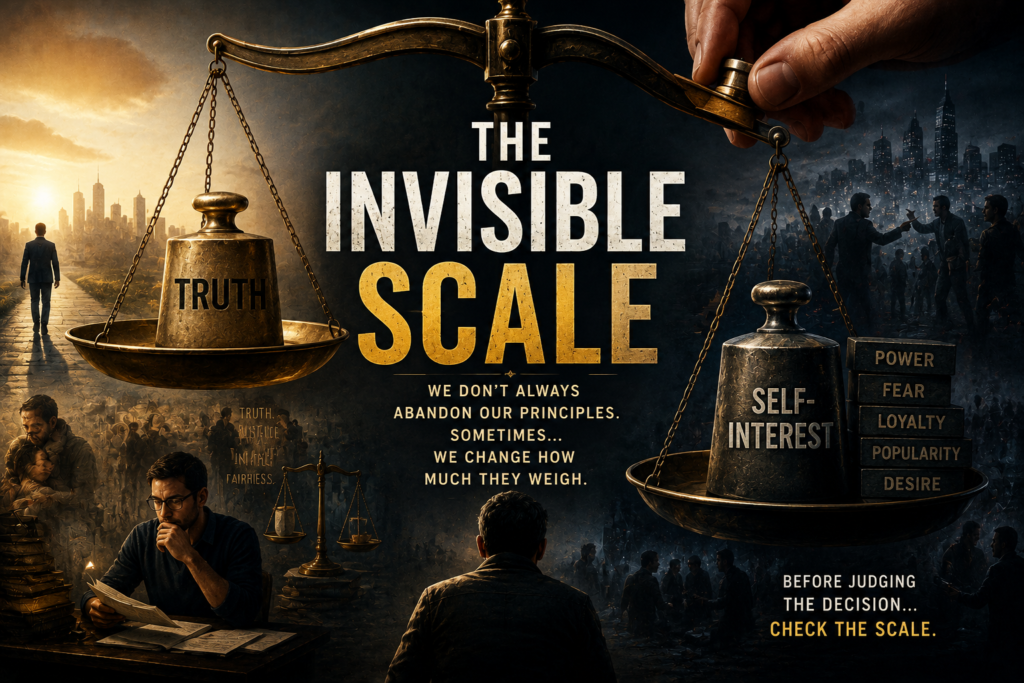
How We Quietly Change the Weight of Our Principles
Most of us like to believe that our principles are stable.
Truth is truth. Fairness is fairness. Justice is justice. If something is wrong, we imagine that we will recognize it as wrong regardless of who does it, whom it benefits, or what it costs us.
But human beings rarely make moral decisions in such clean conditions.
Every day, an invisible scale operates within us. On that scale we weigh truth against loyalty, fairness against self-interest, principle against convenience, long-term consequences against immediate rewards, and what is right against what we deeply want to be right.
The greatest danger is not always that we abandon our principles.
Sometimes, without realizing it, we simply change how much they weigh.
The Scale We Carry Within
Imagine that every important decision is placed on a balance scale.
On one side is truth.
On the other might be ambition, fear, loyalty, money, reputation, anger, ideology, family, friendship, or personal interest.
When nothing important is at stake, maintaining balance is relatively easy. We can speak passionately about honesty when honesty costs us nothing. We can defend fairness when the outcome does not affect us. We can condemn corruption when the person accused is someone we dislike.
The real test begins when the scale turns toward us.
What happens when telling the truth damages our reputation?
What happens when fairness benefits an opponent?
What happens when justice requires us to criticize a friend?
What happens when evidence contradicts a political, religious, or social position with which we have identified ourselves?
What happens when admitting a mistake threatens years of arguments we have made publicly?
At such moments, we discover whether our principles have fixed weights—or adjustable ones.
We Rarely Tell Ourselves We Are Being Unfair
One of the fascinating characteristics of human reasoning is our ability to justify ourselves.
Most people do not wake up in the morning and consciously decide:
“Today I will become dishonest.”
Instead, dishonesty often arrives wearing respectable clothes.
Self-interest becomes necessity.
Favoritism becomes loyalty.
Fear becomes caution.
Revenge becomes justice.
Ambition becomes responsibility.
Silencing criticism becomes protecting unity.
Refusing inconvenient evidence becomes standing firm in our beliefs.
This is how the invisible scale becomes distorted.
The labels on the weights remain unchanged. We may continue speaking about truth, justice, freedom, morality, loyalty, or principle.
But somewhere underneath the scale, the calibration has changed.
The Same Act, Two Different Judgments
A useful way to discover the invisible scale is to observe how our judgment changes when the identities of the people involved change.
Suppose a politician bypasses an important institutional norm.
If we oppose that politician, we may call it authoritarian.
If we support the politician, we may call it decisive leadership.
Suppose someone criticizes a belief we strongly hold.
When our opponents do it, we may describe it as disrespect.
When our allies criticize beliefs we disagree with, we may celebrate their courage.
Suppose one country violates a principle of international conduct.
If it is an adversary, we demand accountability.
If it is an ally, we begin searching for exceptional circumstances.
The underlying action may be remarkably similar.
What changed?
Sometimes, not the principle.
The weight we assigned to it changed.
This does not mean every apparently similar situation is morally identical. Context genuinely matters. Circumstances, intentions, consequences, responsibilities, and available alternatives can change moral judgments.
But context should explain the difference—not merely provide a convenient excuse for the side we already prefer.
Loyalty Is One of the Heaviest Weights
Loyalty is a valuable human quality. Families, friendships, institutions, communities, and nations could hardly function without it.
But loyalty becomes dangerous when it is placed above truth.
A parent may excuse behavior in their own child that they would condemn in another.
A political supporter may defend conduct they once denounced when performed by the opposing party.
A member of a community may remain silent about wrongdoing because exposing it could damage the group’s reputation.
A manager may favor a friend while sincerely convincing themselves that the friend was simply the better candidate.
In each case, the person may still believe deeply in fairness.
The problem is subtler.
Their scale has been recalibrated by belonging.
True loyalty should not require us to corrupt the scale. Sometimes the greatest loyalty we can show a person, institution, community, or country is refusing to help it hide from truth.
When Desire Becomes Evidence
The invisible scale also affects what we believe.
We often imagine that we first examine evidence and then reach conclusions. In reality, human reasoning can work in the opposite direction.
We desire a particular conclusion.
Then we begin weighing evidence.
Evidence supporting our preferred conclusion feels powerful and convincing. Contradictory evidence suddenly requires extraordinary proof. We investigate the motives of people presenting it. We search for exceptions. We question sources. We reinterpret uncomfortable facts.
Critical thinking itself can therefore become selective.
We are extremely critical toward information we dislike and remarkably generous toward information we want to believe.
The question is no longer merely:
“What does the evidence say?”
A deeper question is:
“Would I evaluate this evidence the same way if it supported the opposite conclusion?”
That question is one of the best tools for checking the calibration of our invisible scale.
Power Makes the Scale More Important
The more power a person possesses, the more consequential this internal calibration becomes.
When an ordinary individual distorts the scale, a few people may suffer.
When a business leader does it, employees, customers, or investors may suffer.
When a religious leader does it, communities may be influenced.
When political leaders do it, millions of lives can be affected.
This is why societies cannot depend solely upon the personal virtue of leaders.
Healthy institutions create external scales: constitutions, courts, independent oversight, transparent procedures, free inquiry, evidence requirements, audits, ethical rules, and mechanisms of accountability.
These structures exist partly because civilization has learned an uncomfortable truth:
No human being should be expected to calibrate their own scale perfectly when they also benefit from the outcome.
Accountability is therefore not necessarily an expression of distrust.
It is recognition of human nature.
The Collective Invisible Scale
The problem becomes even more serious when entire groups begin adjusting their scales together.
People naturally form communities around shared identities, beliefs, histories, interests, and experiences. Within these communities, certain assumptions can gradually become unquestionable.
The group begins reinforcing its own moral measurements.
“When they do it, it proves their character.”
“When we do it, circumstances forced us.”
“Their violence is aggression.”
“Ours is defense.”
“Their propaganda is manipulation.”
“Ours is education.”
“Their silence proves guilt.”
“Our silence is strategic.”
Eventually two groups can observe the same event and reach completely different moral conclusions—not because either side lacks intelligence, but because they are weighing the evidence on differently calibrated scales.
At that point, disagreement becomes extraordinarily difficult to resolve.
Each side believes its scale is neutral.
How Do We Recalibrate the Scale?
Integrity begins with self-examination.
Instead of asking only:
“Am I right?”
we can ask:
“Am I weighing this fairly?”
Several questions can help:
Would I make the same judgment if the identities were reversed?
Am I demanding evidence from others that I do not demand from my own side?
Am I calling something a principle only when it benefits me?
Have I changed my definition because the consequences became uncomfortable?
Am I defending an action today that I condemned when someone else did it?
What evidence would genuinely cause me to change my mind?
If nobody knew which side I belonged to, would my judgment remain the same?
These questions do not guarantee perfect objectivity.
Human beings may never become completely free of bias.
But they force us to look underneath the scale.
And sometimes that is enough to discover that someone has been adjusting the mechanism.
Sometimes that someone is us.
Integrity Has a Cost
Character is easiest to display when principle and interest point in the same direction.
The deeper test arrives when they separate.
Truth may cost reputation.
Fairness may cost advantage.
Justice may require opposing someone we love.
Intellectual honesty may require saying, “I was wrong.”
Compassion may require understanding someone we dislike.
Principle may require refusing something we desperately want.
These are the moments when the invisible scale reveals our character.
Integrity does not mean never having interests, loyalties, emotions, ambitions, or desires. These are legitimate parts of human life.
Integrity means refusing to secretly alter the weight of truth simply because truth has become expensive.
Before Judging Others, Check the Scale
We spend enormous amounts of time evaluating other people’s scales.
We accuse politicians of hypocrisy, institutions of bias, communities of double standards, and individuals of inconsistency.
Sometimes those criticisms are entirely justified.
But there is another scale much closer to us—and much harder to inspect.
Our own.
Perhaps wisdom begins not with asking whether the scale agrees with us, but with asking whether the scale is still honest.
Because the most dangerous moral distortion is not necessarily abandoning our principles altogether.
It is continuing to speak their names while quietly changing their weight.
We don’t always abandon our principles.
Sometimes, we simply change how much they weigh.
And perhaps one of the greatest tests of character is remarkably simple:
When truth costs us something, do we change our decision—or do we change the scale?
A Related Reflection: Listen to Siyaq (Context)
The idea behind The Invisible Scale is closely connected to another NextWisdom work, Siyaq (Context). If the Invisible Scale asks us whether we are weighing things fairly, Siyaq asks an equally important question: Are we weighing the whole thing—or only the part that supports the conclusion we already prefer?
A word, quotation, religious passage, political statement, historical event, or human action can appear to mean one thing when isolated and something very different when restored to its circumstances. Who said it? To whom? What happened before it? What followed? What problem was being addressed? What evidence is missing? Without these questions, even accurate words can produce inaccurate conclusions.
This is where context and the Invisible Scale meet. Bias does not always require us to invent false information. Sometimes we simply give enormous weight to one fact while ignoring ten others. We may highlight one sentence and forget the paragraph, remember one action and ignore the events surrounding it, or judge another person’s behavior without knowing the circumstances in which the decision was made. The information we selected may be true, yet the conclusion produced by that selection may still be deeply misleading.
That is why I invite you to also listen to Siyaq (Context). The song explores how meaning changes when words are separated from the circumstances in which they belong—and why understanding context is essential before interpretation becomes judgment.
Together, the two works offer a simple discipline for clearer thinking:
Siyaq asks: Have I understood the context?
The Invisible Scale asks: Have I weighed it fairly?
We need both.
Because fair judgment requires an honest scale—but an honest scale is of little use if we place only half the evidence upon it.
Urdu Song -Siyaq
English Song Context