
 0
0
 196 views
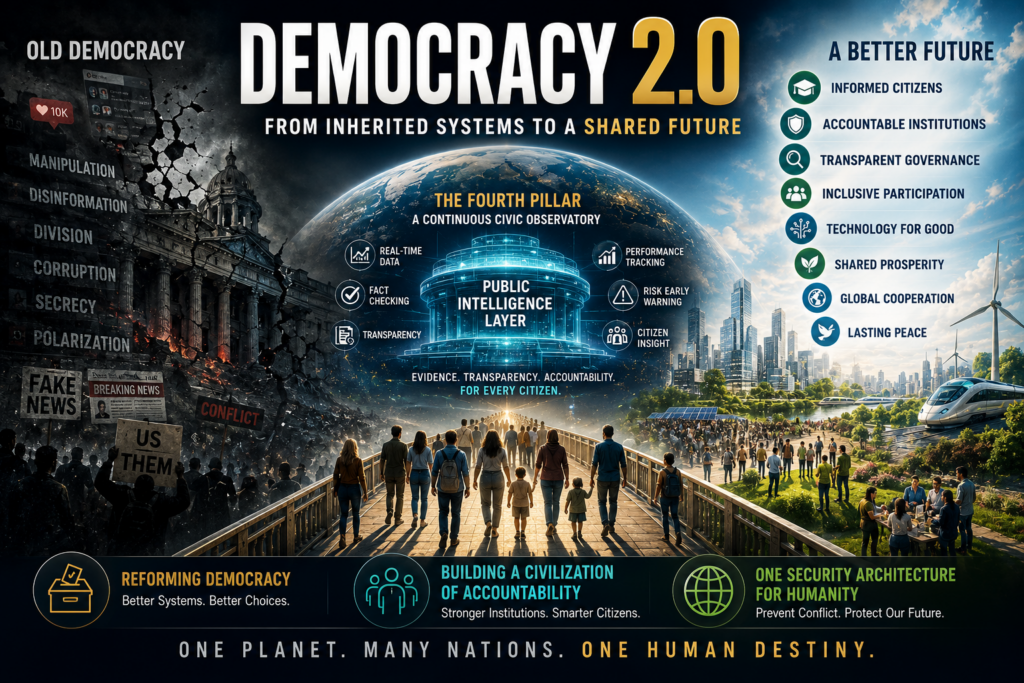
Our political systems were designed for an era of newspapers, local communities, and slower information flows. Today, democracies operate inside an environment of social media manipulation, AI-generated narratives, billion-dollar lobbying, psychological targeting, and information warfare.
The challenge is not merely “Who should govern?”
The challenge is:
“How do we build a system that remains healthy even when imperfect people participate in it?”
Our previous article, Building an Ecosystem of Accountability, and the song A Search for a Better System point in exactly that direction.
Principle #1: Stop Electing Personalities. Start Electing Performance.
Most elections today are popularity contests.
Citizens vote based on:
– Charisma
– Identity
– Religion
– Nationalism
– Fear
– Anger
– Party loyalty
instead of measurable outcomes.
Better System
Every elected official should have a public performance dashboard.
Examples:
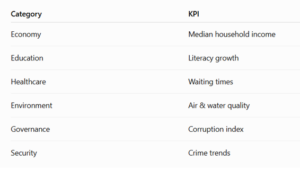
AI could automatically aggregate these metrics.
Citizens would see:
Promises vs Results
instead of speeches vs emotions.
Principle #2: AI-Powered Fact Checking During Campaigns
Imagine a public AI system.
Whenever a politician speaks:
Speech is transcribed
Claims extracted
Evidence checked
Sources displayed
in real time.
Example:
Candidate says:
“Crime doubled under my opponent.”
AI immediately displays:
True
False
Misleading
Context Needed
with links to evidence.
Not controlled by government.
Instead:
Universities
Journalists
Civic organizations
Citizens
jointly govern the system.
Principle #3: Replace Blind Voting With Informed Voting
Most citizens never read:
– Party platforms
– Budgets
– Policy proposals
– Better System
Before voting, citizens could receive an AI-generated briefing.
Example:
“You care most about healthcare, education, and housing.
Based on publicly available proposals:
Candidate A aligns 72%
Candidate B aligns 54%
Candidate C aligns 33%”
Similar to financial comparison tools.
The voter still decides.
But the decision becomes informed.
Principle #4: Continuous Accountability Instead of Election Accountability
Democracy currently works like this:
Vote
Wait 4–5 years
Vote again
That is too slow.
Better System
Digital citizen feedback systems.
Monthly scorecards.
Public sentiment tracking.
Citizens rate:
– Services
– Policies
– Government agencies
AI identifies:
– emerging problems
– corruption patterns
– failing programs
before crises occur.
Principle #5: Distributed Oversight
The founders of many democracies understood:
Power corrupts.
The modern version is:
Data and narrative power corrupt too.
Checks and balances should include:
Legislative Oversight
Parliament/Congress.
Judicial Oversight
Independent courts.
Citizen Oversight
Citizen review panels.
AI Oversight
Automated anomaly detection.
Media Oversight
Independent journalism.
No single actor should control all five.
Principle #6: Transparent Political Funding
One of the biggest weaknesses in modern democracies is money.
Imagine a blockchain-style public ledger.
Every political donation:
– visible
– searchable
– traceable
Citizens could instantly see:
– who funded whom
– how much
– when
AI could highlight unusual influence networks.
Principle #7: Citizen Assemblies
Many issues are too complex for slogans.
Examples:
– AI regulation
– Climate policy
– Immigration
– Healthcare reform
Randomly selected citizens could participate in deliberative assemblies.
Similar to jury duty.
After hearing experts from all sides, they provide recommendations.
Research consistently shows that informed citizen groups often reach more balanced conclusions than partisan political debates.
Principle #8: Create a Fourth Branch — The Public Intelligence Layer
This is where AI becomes transformative.
Current model:
– Executive
– Legislative
– Judicial
Potential future model:
– Executive
– Legislative
– Judicial
– Public Intelligence Layer
The Public Intelligence Layer would:
– Monitor government promises
– Monitor budgets
– Detect corruption
– Analyze legislation
– Simulate policy outcomes
– Provide plain-language summaries
Accessible to every citizen.
Not controlled by politicians.
Think of it as:
“An AI-powered public auditor.”
Principle #9: Competency Requirements for Leadership
This is controversial but worth discussing.
Pilots need licenses.
Doctors need qualifications.
Engineers need certifications.
Yet leaders governing millions often need none.
A future democracy might require candidates to publicly demonstrate competency in:
– Economics
– Constitutional law
– Public administration
– Ethics
– Critical thinking
Not to restrict democracy.
But to help voters evaluate capability.
Principle #10: Build Resilience Against Manipulation
Future democracies must assume:
– Deepfakes exist
– Foreign influence exists
– AI propaganda exists
– Social media amplification exists
Every citizen should learn:
– Logic
– Critical thinking
– Media literacy
– Cognitive bias awareness
starting in school.
A democracy is only as strong as the reasoning ability of its citizens.
A Possible Vision: Democracy 2.0
Instead of:
– Vote based on slogans
– Wait four years
– Argue on social media
– Repeat
A future system could become:
– AI fact checks
– Transparent funding
– Performance dashboards
– Citizen assemblies
– Continuous feedback
– Public intelligence layer
– Distributed oversight
– Evidence-based voting
The goal is not to find perfect leaders.
The goal is to build institutions where:
Good leaders can succeed, average leaders are constrained, and bad leaders cannot easily damage society.
Check out