
 0
0
 1,071 views
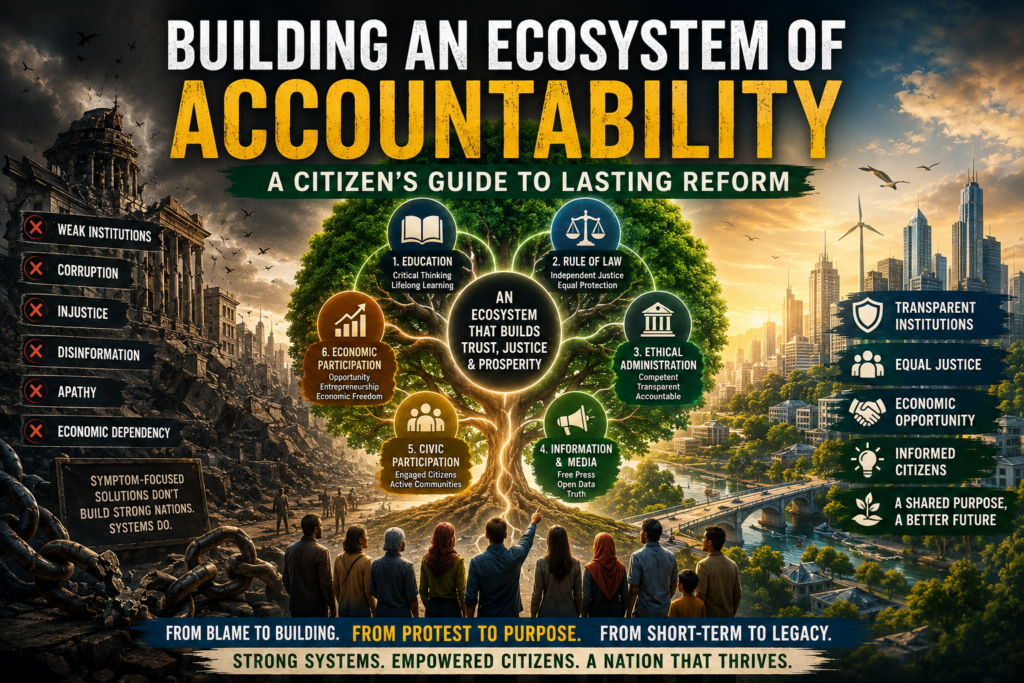
When citizens speak of accountability, they often focus on exposing corruption, punishing wrongdoing, or replacing leaders. While these actions may be necessary, they are not sufficient. True accountability is not an event; it is an ecosystem. Just as a healthy forest depends on the interaction of soil, water, sunlight, and countless living organisms, a healthy society depends on the interaction of strong institutions, informed citizens, ethical leadership, economic opportunity, and a culture that values truth and responsibility.
Yet we must be honest about the ground upon which we stand. In many nations, the very institutions meant to ensure accountability—courts, election commissions, anti-corruption agencies, regulatory bodies, and even segments of the media—may themselves be captured by powerful interests. Citizens are often encouraged to “trust the process” when the process has already been compromised. This is the problem of missing agency: attempting to repair a system using tools that have been deliberately weakened. Recognizing this reality is not cynicism; it is the beginning of strategic thinking.
Accountability Is Not the Goal
One of the most important misconceptions in political reform is the belief that accountability is the ultimate objective. It is not.
Accountability is a mechanism.
The true goals of a healthy society are justice, freedom, prosperity, innovation, trust, human dignity, and the opportunity for every citizen to flourish. Accountability exists to support these outcomes by ensuring that power remains aligned with the public good.
A nation can create numerous oversight agencies and anti-corruption bodies, yet still fail if it neglects education, economic opportunity, social cohesion, and institutional competence. The objective is not merely to punish wrongdoing. The objective is to build a civilization in which wrongdoing becomes increasingly difficult and ethical behavior becomes increasingly natural.
The Foundations of an Accountability Ecosystem
One of the greatest mistakes societies make is treating accountability as the responsibility of a single institution. An anti-corruption agency, a court, a police department, or an election commission cannot create accountability on its own. If the education system fails to cultivate critical thinking, if the media spreads misinformation, if the judiciary lacks independence, or if citizens tolerate dishonesty in everyday life, accountability will remain weak regardless of how many reforms are introduced.
Citizens who seek meaningful change must therefore think in systems rather than isolated institutions.
First Foundation: Education
Schools and universities must produce individuals capable of reasoning critically, evaluating evidence, and distinguishing truth from propaganda. Without an informed population, democratic institutions become vulnerable to manipulation, populism, and misinformation.
Education should not merely prepare people for employment. It should prepare them for citizenship.
Second Foundation: Rule of Law
Citizens should support judicial independence, transparent legal processes, and equal application of the law. Accountability flourishes when people trust that guilt and innocence will be determined through evidence rather than political influence, wealth, tribal affiliation, or public emotion.
Third Foundation: Professional Administration
Public institutions should be designed around competence, transparency, measurable outcomes, and service to the public. Citizens must demand not only honesty but also effectiveness. An honest but dysfunctional institution can be nearly as damaging as a corrupt one.
Fourth Foundation: Information and Media
A society cannot solve problems it cannot see. Independent journalism, transparent government data, open inquiry, and freedom of expression allow citizens to identify problems before they become crises.
Truth is the oxygen of accountability.
Fifth Foundation: Civic Participation
Accountability cannot be outsourced entirely to governments. Citizens must participate in local communities, professional associations, volunteer organizations, policy discussions, and civic initiatives. Strong societies emerge when people see themselves not merely as consumers of public services but as stewards of the public good.
Sixth Foundation: Economic Participation
Economic opportunity is often overlooked in discussions of accountability.
A society where citizens depend entirely upon political patronage, government favors, or elite networks for survival will struggle to maintain genuine accountability. Economic independence gives citizens the confidence to speak freely, challenge authority, and participate constructively in public life.
Entrepreneurship, fair markets, property rights, access to capital, workforce development, and economic mobility are therefore not merely economic concerns—they are accountability concerns.
A citizen who possesses economic agency is far more capable of exercising civic agency.
The Hard Truth About Technology
Technology can play a powerful role, but we must abandon the comforting illusion that technology is neutral.
Algorithms are increasingly becoming architectures of power. A digital platform that tracks public spending may improve transparency, yet the same infrastructure can be used to monitor dissent, manipulate information, or concentrate power.
Artificial intelligence, predictive systems, and digital platforms must therefore be governed by principles of transparency, accountability, auditability, and citizen oversight.
Citizens should not merely demand digital government.
They should demand transparent digital government.
Technology should strengthen accountability, not become a new source of unaccountable power.
Culture, Corruption, and Human Reality
Calls for personal responsibility remain important, but they must be approached with empathy.
In many struggling societies, ordinary citizens engage in petty corruption not because they lack moral character, but because institutional dysfunction leaves them with few alternatives. When obtaining a permit, accessing healthcare, or securing a basic service requires informal payments, individuals often act according to survival rather than preference.
The solution is not merely moral condemnation.
The solution is institutional redesign.
Simpler processes, transparent procedures, efficient service delivery, whistleblower protection, and accessible appeals mechanisms reduce the incentives that sustain corruption.
When institutions become fair and predictable, integrity becomes easier to practice and more socially rewarding.
Shared National Purpose
Even strong institutions are insufficient if a society lacks a common direction.
Nations do not prosper merely because they oppose corruption. They prosper because they unite around a compelling vision of what they wish to become.
A shared national purpose creates social cohesion across political, ethnic, religious, and economic differences. It allows citizens to see themselves as participants in a common project rather than competitors in a zero-sum struggle.
The most successful societies cultivate a sense of shared destiny. They ask:
What kind of future are we building?
What values will guide us?
What responsibilities do we owe one another?
What legacy will we leave for future generations?
Without a shared purpose, reforms often become fragmented and short-lived.
Accountability Beyond Borders
In the modern world, accountability ecosystems extend beyond national boundaries.
Global financial systems, multinational corporations, technology platforms, international institutions, trade networks, and media organizations all influence domestic governance.
A nation seeking reform cannot ignore these external forces. Citizens must understand how international incentives shape local outcomes and how global cooperation can strengthen transparency, anti-corruption efforts, and institutional resilience.
The ecosystem of accountability is now both national and international.
The Missing Agency Problem
When institutions become actively hostile to reform, citizens must adopt a different strategy.
Independent legal aid networks, civic education initiatives, community organizations, fact-checking coalitions, diaspora partnerships, and independent media can serve as temporary scaffolding while formal institutions are repaired.
These parallel structures are not replacements for government. They are protective mechanisms that preserve civic capacity until meaningful reform becomes possible.
They help ensure that citizens retain agency even when formal systems fail.
A Practical Path Forward
Meaningful reform requires more than ideals. It requires strategy.
Begin with diagnosis rather than outrage. Map institutions. Identify strengths and weaknesses. Understand incentives. Follow evidence rather than slogans.
Build local networks of trust. Develop civic skills. Invest in education. Support ethical leaders. Promote transparency. Encourage entrepreneurship. Protect truth.
Most importantly, think long term.
Civilizations are not built through moments of passion alone. They are built through generations of consistent effort.
From Blame to Building
The most successful nations did not become accountable by creating a single powerful institution. They built interconnected ecosystems in which education, justice, administration, economic opportunity, media, civil society, technology, and cultural values reinforced one another.
Each component strengthened the others.
Together they created societies where accountability became part of the national character rather than a periodic political slogan.
The question citizens should ask is not:
“Who should we blame?”
Nor even:
“How do we create accountability?”
The deeper question is:
“What kind of society do we hope to become, and what ecosystem must we build to get there?”
Because accountability flourishes when citizens stop thinking like protesters confronting a single problem and start thinking like architects designing a civilization.