
 0
0
 18 views
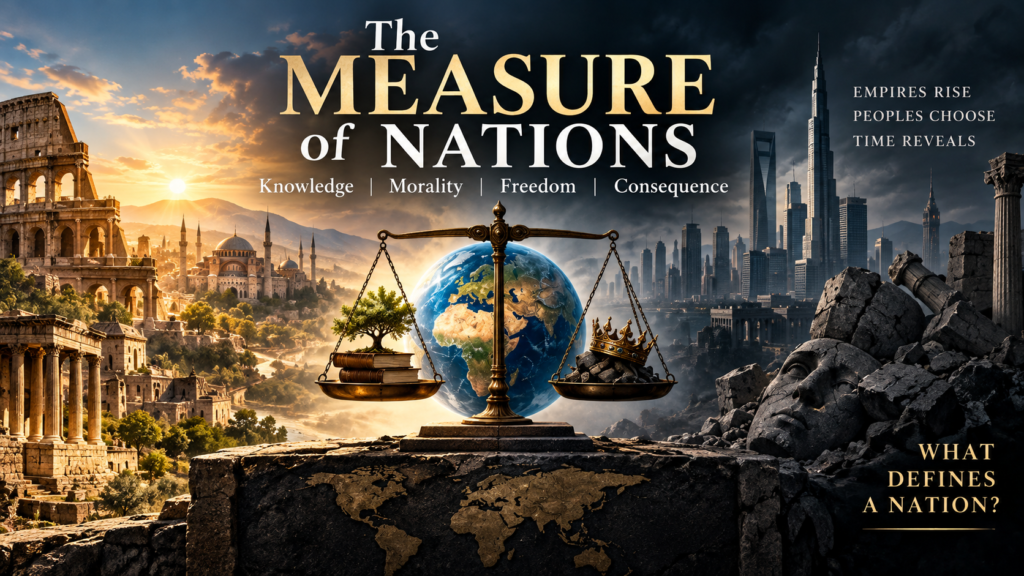
(Knowledge, Morality, Freedom, and the Rise and Fall of Civilizations)
Nations often behave as though permanence is one of the privileges of power.
A civilization reaches the height of its influence. Its armies appear unbeatable, its economy touches distant shores, its institutions command respect, its language travels beyond its borders, and its leaders begin to speak as though history has finally settled in their favor.
But history has never granted permanence to a civilization.
Empires rise. They dominate. They establish systems that appear immovable. Then, sometimes slowly and sometimes with astonishing speed, their influence recedes. Another society emerges, another center of knowledge develops, another political order takes shape, and people who once seemed destined to rule history become subjects of history themselves.
From a religious perspective, this recurring pattern raises a deeper question:
What determines the measure of a nation?
Nations Have Their Appointed Time
The Qur’an presents a striking principle:
“For every nation is a term. When their time comes, they cannot delay it for a single hour, nor can they advance it.”
— Qur’an 7:34
This changes how power should be understood.
Political power is not necessarily evidence of divine approval. Wealth is not proof of moral superiority. Military dominance is not a guarantee of permanence. A nation may possess extraordinary power and still be approaching decline.
Likewise, the fact that injustice is not immediately punished does not mean that injustice has escaped consequence.
This distinction is essential.
If every wrongdoing were immediately stopped by divine intervention, meaningful human freedom would disappear. This world would cease to function as a place of moral choice and responsibility. Human beings—and therefore the societies they construct—must be permitted to choose.
That freedom includes the possibility of choosing badly.
It includes the possibility of oppression.
It includes the possibility of electing deceptive leaders, accepting convenient falsehoods, exploiting weaker peoples, misusing technology, or constructing sophisticated arguments to justify injustice.
The absence of immediate intervention should therefore never be confused with approval.
A delay in consequence is not an exemption from consequence.
The Two Foundations of Civilizational Strength
When we examine civilizations across history, two broad foundations repeatedly emerge:
knowledge and morality.
Knowledge means considerably more than literacy or academic achievement. It includes a civilization’s ability to understand the world and organize itself effectively: science, engineering, medicine, technology, agriculture, economic systems, administration, education, institutions, and the intelligent use of natural resources.
A society that stops learning eventually becomes dependent upon societies that continue learning.
But knowledge alone cannot sustain civilization.
The second foundation is morality.
Here morality should not be reduced to private religious observance. Civilizational morality includes honesty in public life, respect for agreements, justice before law, protection of the vulnerable, responsible exercise of authority, restraint in the use of power, and the willingness to tell the truth even when truth is inconvenient.
Knowledge gives a civilization capacity.
Morality determines how that capacity is used.
A society possessing morality without sufficient knowledge may remain vulnerable.
A society possessing tremendous knowledge without morality may become tremendously dangerous.
The healthier civilization attempts to cultivate both.
When Strength Becomes the Beginning of Weakness
The greatest danger may therefore arrive not when a nation is weak, but when it becomes extremely powerful.
Success changes psychology.
A nation that struggled to survive remembers restraint. A nation accustomed to dominance can gradually begin to believe that the rules applying to others no longer apply to itself.
Its vocabulary begins changing.
Aggression becomes security.
Control becomes stability.
Exploitation becomes national interest.
Failure becomes someone else’s fault.
Exceptional power gradually produces a doctrine of exceptional entitlement.
At that point, decline may begin long before economic statistics reveal it.
The first collapse may not occur in the currency, the military, or the government.
It occurs in the moral imagination of the society.
A civilization begins losing the ability to judge itself by the same standards by which it judges others.
That is an extraordinarily dangerous stage in the life of a nation.
Old Chains Can Return in New Forms
Humanity has abolished or delegitimized many obvious forms of domination. Yet power does not disappear merely because its older instruments become unacceptable.
It changes form.
The physical chain can become economic dependency. Direct occupation can become political manipulation. The whip can become coercive leverage. Control of territory can become control of resources, technology, information, institutions, or opportunity.
The methods become more sophisticated while the underlying temptation remains ancient:
Can the powerful use their advantage to determine the choices available to the weak?
Every generation therefore has to rediscover the moral limits of power.
Technological progress does not automatically produce moral progress.
A civilization may possess satellites, artificial intelligence, biotechnology, nuclear weapons, and extraordinary scientific knowledge while remaining morally primitive in the way it treats human beings.
Advancement in tools is not necessarily advancement in wisdom.
Nations Age From Within
Civilizations can also be imagined as living organisms.
They are born into particular circumstances. They develop institutions. They acquire knowledge. They pass through periods of confidence and expansion. Eventually, complacency may replace curiosity and entitlement may replace gratitude.
The analogy should not be taken mechanically—societies do not have biological lifespans—but it reveals something important.
Decline often begins internally.
A society may still possess magnificent buildings, powerful weapons, prestigious universities, enormous corporations, and impressive technology while something beneath the surface is deteriorating.
Truth becomes negotiable.
Institutions lose trust.
Public discourse becomes theatrical.
Competence becomes secondary to loyalty.
Leaders discover that fear is easier to cultivate than wisdom.
Citizens begin preferring reassuring narratives to uncomfortable realities.
The civilization may still appear powerful from outside.
Its foundations, however, have begun to weaken.
Freedom Makes Citizens Responsible
This leads to perhaps the most uncomfortable implication of the idea.
A nation’s moral condition cannot always be blamed entirely upon its rulers.
Where people possess meaningful political freedom, citizens participate in shaping the character of the state. The leaders they reward, the lies they tolerate, the injustices they excuse, and the standards they demand eventually become part of the nation’s character.
Tyranny can be imposed.
But it can also be invited gradually through fear, tribal loyalty, indifference, or the desire for simple answers.
The health of a civilization therefore depends partly upon whether ordinary people remain capable of saying:
My side can also be wrong.
That sentence requires enormous moral maturity.
Without it, morality becomes tribal. Justice means justice for us. Truth means whatever benefits us. Wrongdoing becomes unacceptable only when committed by them.
Once a society reaches that point, knowledge itself can become dangerous because intelligence is increasingly employed not to discover truth but to manufacture sophisticated justifications for what people already wish to believe.
The Garden Cannot Be Forced
Yet recognizing these patterns should not lead to despair or coercion.
Truth cannot be forced into the human heart.
A seed cannot be commanded to grow.
A mirror cannot compel someone to look into it.
The responsibility of those who recognize injustice is therefore not to become another form of tyranny in the name of correcting tyranny. Their responsibility is to preserve knowledge, speak truth, build better institutions, demonstrate justice through conduct, educate patiently, and keep open the possibility of reform.
Some soil will reject the seed.
Some will receive it years later.
Some generations may plant trees beneath whose shade only their descendants will sit.
That does not make the planting meaningless.
The Measure of Nations
Perhaps, then, the true measure of a nation is not simply what it possesses.
It is what it does with what it possesses.
Not how powerful its military becomes, but how restrained that military remains when power could be abused.
Not how wealthy its economy becomes, but whether prosperity strengthens justice or merely concentrates privilege.
Not how advanced its technology becomes, but whether technology enlarges human dignity.
Not how loudly it proclaims its principles, but whether it applies those principles when doing so becomes costly.
And perhaps the greatest test arrives precisely when a civilization becomes powerful enough to violate its own principles without immediately suffering the consequences.
That is when character is revealed.
History repeatedly reminds humanity that no throne, empire, ideology, economic system, or geopolitical order possesses an eternal lease on power.
Knowledge may raise a civilization.
Morality may make it worthy of what it has been given.
Freedom allows it to choose what it will become.
And time eventually reveals what those choices were worth.
The measure of nations, therefore, may ultimately resemble the measure of individuals.
The question is not simply:
How high did they rise?
The deeper question is:
When they had the power to choose, what did they choose to become?