
 0
0
 71 views
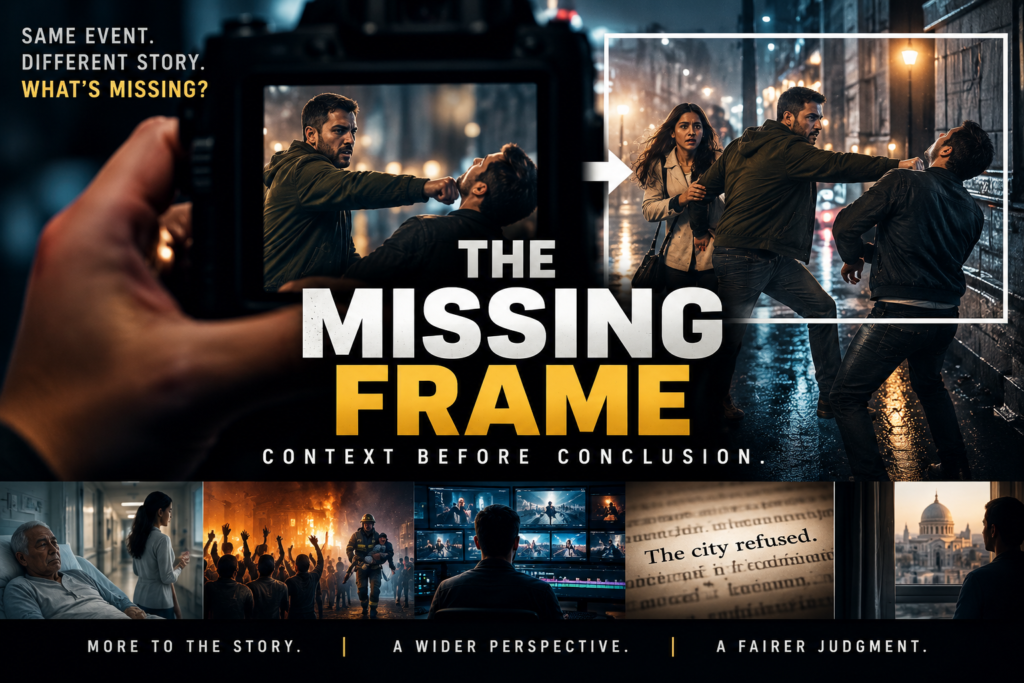
What if everything you were shown was true—and yet the conclusion you reached was wrong?
The Missing Frame is a cinematic exploration of one of the most subtle problems in human judgment: a fact does not have to be false to create a false understanding. Sometimes, it only has to be separated from the context that gives it meaning.
A man strikes another man. A woman walks away from her distressed father. A crowd cheers while a building burns.
Each image appears to tell us something obvious.
Then the frame widens.
What happened five seconds earlier? What happened immediately afterward? What was the intention? Who was speaking—and to whom? What circumstances surrounded the event? What information remained outside our field of view?
Suddenly, the facts have not changed—but our understanding of them has.
The Missing Frame explores the difference between four things we often treat as though they were identical: fact, frame, context, and judgment.
A fact is what happened.
A frame determines which part of what happened we are shown.
Context helps us understand what surrounds it.
Judgment is the conclusion we eventually draw.
This distinction matters far beyond photographs and videos. It matters when we interpret news, political speeches, historical events, social-media clips, legal arguments, philosophical ideas, and ancient or sacred texts. Words have audiences. Events have histories. Statements have circumstances. When those surroundings disappear, interpretation can quietly become invention.
But the film makes an equally important distinction: context is not an excuse.
Seeking context does not mean defending every action or suspending judgment forever. Sometimes the wider frame confirms exactly what we initially believed. The purpose of context is not to eliminate judgment—it is to make judgment more informed.
Perhaps the intellectual discipline we need is therefore not simply to ask:
“Is this true?”
but also:
“Is this enough?”
Because one of the most powerful forms of distortion may require no fabricated photograph, invented quotation, or false fact at all.
Sometimes…
selection is enough.
From Siyaq (Context) to The Missing Frame to The Invisible Scale
The Missing Frame creates a natural intellectual bridge between Siyaq (Context https://youtu.be/beTtSC8p3lo?si=g0nSrv3HRtYNl3pS ) and The Invisible Scale (https://youtu.be/s-_EFWktymw?si=whfHUiYP-lvhLS44). Context asks us to understand the surroundings of a statement or event—what came before it, what followed it, who was speaking, to whom, and under what circumstances. The Missing Frame takes the next step by asking: What if something necessary for that understanding has been excluded altogether? Once we have searched for the wider context and recovered what may be missing, The Invisible Scale asks the final question: Are we weighing all of that evidence fairly, or quietly changing its weight according to our loyalties, fears, interests, or assumptions?
Together, the three works form a simple discipline of judgment:
Siyaq — Understand the context.
The Missing Frame — Look for what may have been excluded.
The Invisible Scale — Weigh what you discover fairly
Or, more simply:
See more. Understand more. Weigh fairly. Then judge.
The Missing Frame is part of NextWisdom’s Invisible Architects of Human Experience series—cinematic explorations of the unseen forces that shape perception, belief, identity, reasoning, and judgment.
Before deciding what the picture means…
look beyond the frame.
#TheMissingFrame #NextWisdom #Siyaq #Context #TheInvisibleScale #CriticalThinking #MediaLiteracy #Perspective #Judgment #Truth #Wisdom #Philosophy #Bias #Reasoning #CinematicShortFilm