
 0
0
 180 views
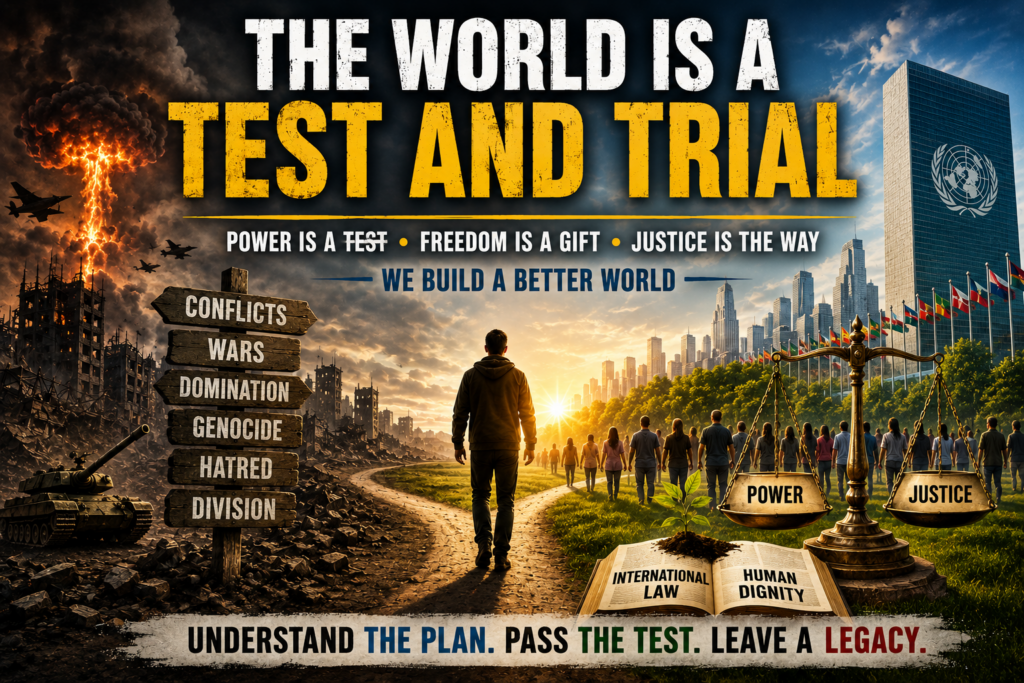
Freedom, Power, Human Progress, and the Moral Architecture of Civilization
Many of humanity’s greatest tragedies—wars, occupations, genocides, forced regime changes, persecution, and struggles for domination—may arise partly from a fundamental misunderstanding of our place in the world.
We often behave as though the Earth were humanity’s final destination and possessing more of it were therefore the ultimate victory. Nations compete for territory. Rulers compete for power. Communities compete for supremacy. Individuals compete for wealth, recognition, and status. We accumulate, conquer, dominate, and defend as though permanence could somehow be achieved through possession.
But what if the purpose of human existence is almost the opposite?
What if this world was never meant to be possessed permanently?
From a theistic perspective, human beings have been placed for a remarkably short period on a small planet within an unimaginably vast universe. We arrive with nothing, acquire things for a few decades, and eventually leave everything behind. Kings and laborers, billionaires and beggars, generals and ordinary citizens ultimately share the same destination.
If there is an eternal life beyond this temporary existence, then the central question changes.
The question is no longer:
How much of this world did I possess?
It becomes:
What did I become while I was here?
And perhaps even more importantly:
What did I do with what was temporarily entrusted to me?
Life as Test and Trial
If earthly life is understood as a test, then many things we normally regard simply as privileges become examinations.
Wealth is a test.
Poverty is a test.
Knowledge is a test.
Ignorance is a test.
Authority is a test.
Weakness is a test.
Victory is a test.
Defeat is a test.
Even intelligence is a test.
The powerful person is therefore not necessarily more favored than the powerless person. Power may simply mean that the examination has become more difficult.
A ruler is tested by authority.
A scholar is tested by knowledge.
A wealthy person is tested by wealth.
A nation possessing extraordinary military, technological, or economic power is tested by what it chooses to do with that power.
The greater the capability, the greater the moral responsibility.
This understanding completely changes our conception of success. If power is temporary, then acquiring power cannot itself constitute success. The real measure is how power is exercised.
Did it protect the weak or exploit them?
Did knowledge enlighten people or manipulate them?
Did wealth improve society or merely enlarge privilege?
Did military strength protect peace or become an instrument of domination?
These questions apply not merely to individuals but to civilizations.
Why Human Beings Were Given Reason
Human beings were not placed on Earth merely to survive.
We were given extraordinary faculties: intellect, imagination, language, memory, moral consciousness, creativity, and the ability to reason.
These gifts allow human beings to do something remarkable: we can improve the conditions into which we were born.
A generation does not have to leave the world exactly as it inherited it.
Human beings learned to cultivate land, build cities, develop medicine, establish universities, create legal systems, formulate scientific methods, abolish institutions once considered normal, recognize human rights, and develop mechanisms for resolving disputes without warfare.
Civilization itself can therefore be understood as an ongoing human experiment.
We try.
We fail.
We examine the consequences.
We learn.
And hopefully, we build something better.
There is an interesting parallel here.
The individual learns through trial and error, and civilization learns through trial and error.
A scientist experiments.
An engineer builds prototypes.
A physician learns from evidence.
A society experiments with institutions.
Human history itself becomes a vast laboratory of consequences.
The tragedy is that civilizations sometimes require catastrophes before accepting lessons that reason should have taught them earlier.
The Terrible Education of War
For thousands of years, conquest was treated as an ordinary instrument of statecraft.
A powerful kingdom invaded a weaker kingdom. Territory changed hands. Populations were displaced, enslaved, assimilated, or killed. The victorious ruler was often celebrated precisely because he had conquered others.
Humanity gradually discovered the terrible cost of this model.
The two world wars brought that lesson into the modern technological age with unprecedented force. Industrial civilization had developed extraordinary scientific capabilities, but humanity’s moral and political institutions had not developed quickly enough to control them.
The result was devastation on an enormous scale.
Out of those experiences emerged institutions and principles intended to prevent humanity from returning to an unrestricted age of conquest: the United Nations, the UN Charter, international humanitarian law, conventions concerning genocide, protections for civilians, international courts, and principles governing relations among sovereign states.
These institutions are imperfect.
Powerful countries sometimes apply international law selectively. Governments violate agreements. International organizations can become paralyzed. Political interests influence enforcement.
But imperfection does not make the achievement meaningless.
The principle humanity was struggling toward was revolutionary:
Military superiority does not by itself create a moral or legal right to conquer another people.
That principle represents centuries of painful civilizational learning.
Destroying it would not represent progress.
It would represent forgetting.
Freedom Is Part of the Human Experiment
There is another reason freedom matters.
If human beings possess moral responsibility, meaningful choice must exist.
Worship performed entirely through coercion loses much of its moral meaning. Faith imposed by force is fundamentally different from conviction reached through reflection.
The same principle operates beyond religion.
Creativity requires intellectual space.
Science requires questioning.
Philosophy requires disagreement.
Innovation requires the possibility of saying:
Perhaps the existing answer is wrong.
Nearly every major intellectual advance began when someone questioned an accepted assumption.
This is why freedom of thought, conscience, inquiry, expression, and peaceful disagreement are not merely political luxuries. They are among the mechanisms through which civilization corrects itself.
Societies that severely suppress questioning may sometimes achieve particular forms of technological or economic progress, but sustained restrictions on inquiry create a deeper vulnerability: errors become difficult to expose because challenging authority becomes dangerous.
A society that cannot criticize itself eventually loses one of its most important instruments of self-correction.
Disagreement Is Not Humanity’s Enemy
Human beings naturally disagree.
This is often treated as a problem, but disagreement itself is not necessarily destructive.
In fact, disagreement has been one of the engines of civilization.
One scientist challenges another.
One philosopher questions another.
One interpretation confronts another.
One generation reexamines assumptions inherited from the previous generation.
From those disagreements emerge new ideas.
Without disagreement, there would be little critical thinking. Without critical thinking, civilization might remain intellectually frozen.
The problem begins when we transform disagreement into identity and identity into hostility.
Religious history provides many examples.
A disagreement begins over interpretation. An intellectual school develops around it. Over generations the school becomes a community, the community becomes an identity, and eventually people inherit the identity without remembering the original question.
Then something extraordinary happens.
People who were originally disagreeing about how best to understand truth begin fighting one another over the identities produced by that disagreement.
The same phenomenon occurs in politics, nationalism, ethnicity, ideology, and even academic thought.
Human beings create categories to understand reality and eventually become prisoners of the categories they created.
The Second Danger: The Desire to Dominate
If disagreement can produce knowledge, another human tendency can produce catastrophe:
the desire for domination.
Power possesses a dangerous psychological characteristic.
The more of it we acquire, the easier it becomes to believe that the rules applying to others no longer apply to us.
This happens to individuals.
It happens to corporations.
It happens to governments.
And it happens to empires.
A weak country may passionately defend international law because the law protects it. A powerful country may begin viewing the same law as an inconvenience.
But this is precisely where the test of power begins.
The moral value of law is demonstrated not when it restrains our enemies, but when we accept its restraints upon ourselves.
If we demand sovereignty for ourselves while denying it to others, we do not believe in sovereignty.
If we demand protection for our civilians while treating another population’s civilians as expendable, we do not believe in civilian protection.
If we demand accountability for our enemies but immunity for our allies, we do not truly believe in accountability.
We believe in advantage.
And advantage is not justice.
No Nation Owns the Moral High Ground Forever
History repeatedly teaches another lesson:
civilizations should be extremely cautious about believing themselves permanently exceptional.
Power moves.
Empires rise and disappear.
Economic centers migrate.
Technologies redistribute influence.
Alliances change.
Peoples once considered peripheral become major powers.
And civilizations once convinced of their permanence become chapters in history books.
The catastrophes of the twentieth century demonstrated how ideologies of racial superiority, militarism, territorial expansion, and unchecked nationalism could lead entire societies toward destruction.
But it would be dangerous to conclude that those lessons belonged only to the defeated powers of that era.
The lesson belongs to everyone.
The moment another nation begins believing that its military superiority grants it privileges that international rules deny everyone else, the same moral danger returns wearing different clothes.
International law has meaning only if friend and enemy are judged according to substantially the same principles.
That standard must apply when allegations involve occupation, indiscriminate or disproportionate attacks, collective punishment, forced displacement, crimes against humanity, or genocide. Such grave legal terms should be determined through evidence and competent legal processes rather than used merely as political slogans—but no state should be considered inherently beyond investigation or accountability.
Otherwise, law becomes another language for power.
Does God Manage History?
Does God Manage History?
For a believer, there is an even deeper question.
If God governs creation, does that mean every political event should be interpreted as direct divine intervention?
We should be careful.
Human beings do not possess access to God’s complete judgment. We cannot confidently declare that every military defeat, revolution, economic collapse, natural disaster, or political victory represents God’s punishment or approval of a particular people.
But this does not mean that God is absent from history.
Perhaps we need to understand divine governance differently.
If God is ultimately the Creator of the laws of cause and effect, then history does not need to be managed through constant miraculous intervention. It can be governed through the very principles embedded within creation.
A seed grows because certain biological laws exist. A bridge collapses when physical limits are violated. A human body suffers consequences when its biological requirements are persistently ignored.
Civilizations, too, operate within systems of cause and effect.
Arrogance produces consequences.
Oppression produces resistance.
Corruption weakens institutions.
Extreme inequality creates instability.
Suppression of thought can eventually weaken intellectual vitality.
Unrestrained military expansion exhausts resources.
The abuse of power generates enemies.
And technological superiority creates incentives for competitors to develop alternatives.
From a religious perspective, these are not necessarily forces operating independently of God. The laws themselves are part of the order God created.
In this sense, divine governance does not require imagining God continually interrupting history. History may instead unfold through a moral and causal architecture already built into creation.
No Civilization Can Permanently Freeze History
This helps us understand another remarkable pattern.
No civilization remains permanently dominant.
No nation possesses technological superiority forever.
No empire maintains military supremacy indefinitely.
No economic center remains the center of the world for all time.
And no political order can permanently prevent other societies from learning, adapting, competing, and rising.
History demonstrates this repeatedly.
Ancient civilizations rose and declined. Great empires expanded and eventually contracted. Centers of scientific knowledge moved from one civilization to another. Trade routes changed. Technologies spread. New institutions appeared. Peoples once considered weak became powerful, while powers once considered invincible discovered the limits of their strength.
This should teach humanity profound humility.
When a nation becomes technologically advanced, other nations observe it.
They learn.
They imitate.
They improve.
When one country develops a military advantage, competitors search for countermeasures.
When one economic system becomes dominant, alternatives eventually emerge.
When power becomes excessively concentrated, those affected by that power begin cooperating to balance it.
Cause creates effect, and effect becomes the cause of another effect.
History continues moving.
From a theological perspective, this dynamism itself can be understood as part of the divine order.
God does not need to send an army of angels to remove an empire. The consequences produced by the empire’s own actions may eventually create the forces that limit it.
Its expansion may produce resistance.
Its arrogance may produce strategic mistakes.
Its domination may produce alliances among its rivals.
Its technological advantage may motivate others to innovate.
Its economic pressure may encourage alternative markets and institutions.
Its suppression of criticism may prevent it from recognizing its own errors.
And eventually the very instruments through which it established dominance may contribute to the conditions that weaken that dominance.
This does not mean every declining power was immoral, nor that every rising power possesses God’s approval. History is far too complex for such simplistic judgments.
Rather, the larger principle is:
No human civilization has been granted permanent ownership of power.
Power circulates.
Knowledge spreads.
Technology diffuses.
Civilizations learn from one another.
And history refuses to stand still.
The Moral Laws of History
There may therefore be two kinds of laws operating simultaneously.
There are the physical laws of creation—gravity, biology, chemistry, and the material principles governing the universe.
And there appear to be patterns of moral and social causation operating through human civilization.
A society that protects education increases its intellectual capacity.
A society that permits questioning improves its ability to correct mistakes.
A society that establishes trustworthy institutions makes cooperation easier.
A society consumed by corruption gradually damages those institutions.
A government that repeatedly humiliates a population may eventually produce resistance.
A powerful state that continually disregards the interests of weaker states may eventually encourage those states to cooperate against it.
None of these outcomes needs to occur immediately. That is important.
Cause and effect in history may unfold across decades or even centuries.
This delay sometimes creates an illusion.
A powerful person violates moral principles and appears successful.
A government commits injustice and remains powerful.
An empire dominates others and becomes wealthier.
People therefore conclude:
There are no consequences.
But perhaps they are examining too short a period of history.
The lifetime of an individual is short.
The lifetime of a civilization is much longer.
What appears successful over ten years may prove disastrous over fifty.
What appears permanent over fifty years may disappear within two hundred.
History must therefore be observed with a much longer lens.
Power Is Temporary by Design
This returns us to the central argument of this essay.
If life is a test, then permanent human domination would contradict the very nature of the examination.
Power must remain temporary because the possessor of power is temporary.
Technology is entrusted.
Wealth is entrusted.
Knowledge is entrusted.
Military capability is entrusted.
Political influence is entrusted.
The question is never merely whether a civilization acquired these things.
The question is:
What did it do with them while it possessed them?
A civilization that understands this will exercise power with humility.
A civilization that forgets it may begin imagining that temporary superiority represents permanent entitlement.
History repeatedly corrects that illusion.
And perhaps this is one of the deepest ways in which God manages history—not necessarily by suspending the laws of the world, but through the extraordinary network of cause, consequence, human freedom, moral responsibility, and corrective forces that He has already placed within it.
In that sense, history itself becomes part of the test.
Nations rise and are tested.
Nations become powerful and are tested.
Nations decline and are tested.
Other nations rise and receive the same examination.
The actors change.
The test remains.
Humanity Must Not Walk Backward
Some political movements promise to restore an imagined past.
But humanity cannot permanently return to earlier stages of civilization.
We cannot unknow what world wars taught us.
We cannot unknow what genocide taught us.
We cannot unknow what colonialism taught us.
We cannot unknow what slavery taught us.
We cannot unknow what authoritarianism taught us.
We cannot unknow what science has taught us about our shared humanity.
Previous generations paid extraordinary prices for many principles that we now take for granted.
Our responsibility is not merely to inherit those achievements.
It is to improve them.
The United Nations may require reform.
International law may require stronger and more impartial enforcement.
Global institutions may need to reflect today’s world rather than the geopolitical realities of 1945.
But reform should mean advancing civilization—not returning humanity to the principle that might makes right.
The Ultimate Test of Civilization
Perhaps humanity’s greatest misunderstanding is that the test of life concerns what happens to us.
Perhaps the greater test concerns what we do when something is placed in our hands.
When we receive wealth—what do we do?
When we receive knowledge—what do we do?
When we encounter disagreement—what do we do?
When another person becomes vulnerable—what do we do?
And most importantly:
When we acquire power—what do we do?
Do we become protectors?
Or do we become what earlier generations needed protection from?
The same question confronts nations.
Military superiority is not merely strength.
It is an examination.
Economic dominance is not merely success.
It is an examination.
Scientific knowledge is not merely achievement.
It is an examination.
And leadership is not ownership of society.
It is a temporary trust.
If humanity understood this principle more deeply, perhaps we would spend less energy attempting to dominate one another and more energy improving the brief world we share.
For if the Earth is ultimately a place of passage rather than possession, then conquering more of it is a strangely meaningless ambition.
We arrive here temporarily.
We inherit institutions built by people who came before us.
We add something—or damage something.
And then we leave.
The real measure of a civilization may therefore not be how much power it accumulated, but what it did when it had the power to choose between domination and justice.
And the real measure of humanity’s progress may not be whether we have become powerful enough to control the world, but whether we have become wise enough to understand that the world was never ours to own in the first place.