
 0
0
 102 views
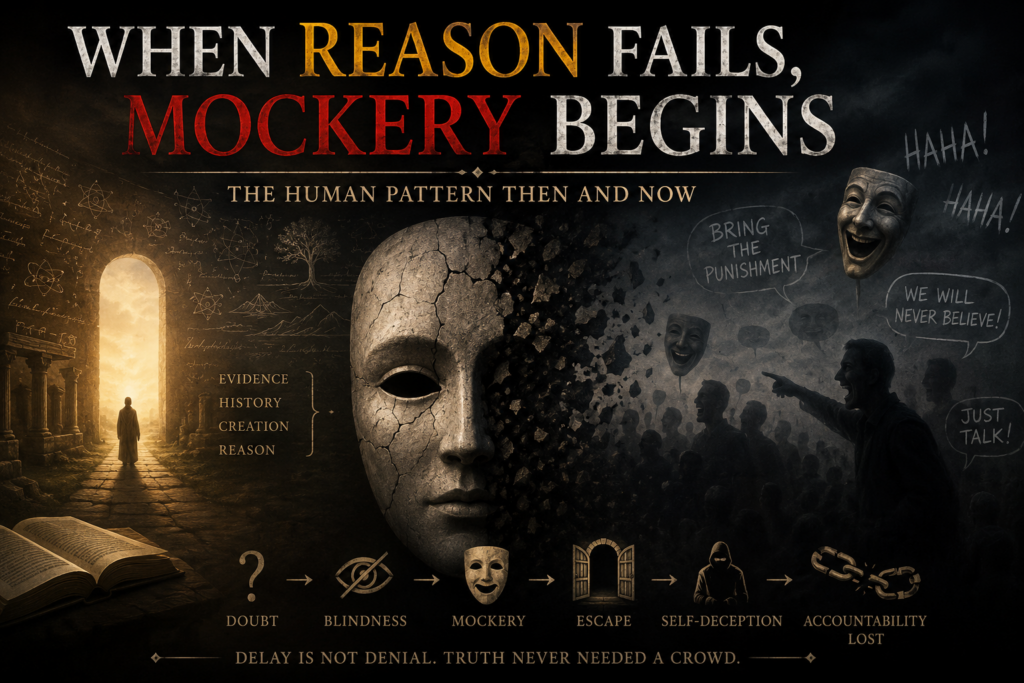
(A Qur’anic Reflection on Human Behavior from the Prophets to the Present)
One of the most profound psychological observations made by the Qur’an is not merely about ancient nations—it is about the recurring patterns of the human mind.
Across Surah Ash-Shu’ara (Chapter 26 in the Qur’an), God recounts the stories of Noah, Hud, Salih, Lot, Shu’ayb, and Moses. Different peoples. Different civilizations. Different eras. Yet they all display remarkably similar behavior.
The Qur’an is not simply preserving history.
It is teaching us how human beings respond when truth confronts their desires.
The messengers or Massiyah (Rasool in Arabic) did not merely ask people to believe in God.
They asked them to become accountable.
To acknowledge that every injustice, every deception, every abuse of power, and every hidden intention would one day be examined before a perfect Judge.
This is why belief in the Day of Resurrection occupies such a central place in the Qur’an.
Without accountability beyond death, power becomes its own morality.
Surah An-Naml (Chapter 27 in the Qur’an) deepens this argument.
After inviting people to reflect on creation itself—Who created the heavens and the earth? Who sends the rain? Who guides travelers through darkness? Who answers the desperate when they call? Who controls the winds and the seas? (27:60–65)—the Qur’an suddenly shifts from cosmology to psychology.
Instead of saying people reject these signs because the evidence is weak, it diagnoses the real problem.
“Rather, their knowledge about the Hereafter has failed them. Rather, they are in doubt about it. Rather, concerning it, they are blind.” (27:66)
This verse is extraordinary.
It does not describe a lack of intelligence.
It describes a disease of perception.
Their problem is not that they cannot understand.
Their problem is that doubt regarding the Hereafter has spread into every part of their thinking.
The Qur’an describes a progression.
First, knowledge about the Last Day becomes weak.
Then certainty turns into doubt.
Finally, doubt becomes blindness.
The issue is no longer evidence.
The issue is the inability—or unwillingness—to see.
Why would someone resist the idea of resurrection?
Because resurrection is not merely a future event.
It transforms the present.
If every action will be judged…
every lie matters.
every corruption matters.
every oppression matters.
every betrayal matters.
every abuse of authority matters.
Belief in the Last Day places a witness over every hidden act.
For those unwilling to change, this becomes deeply uncomfortable.
The easiest solution is not repentance.
It is denying the courtroom itself.
The Qur’an therefore exposes a timeless human tendency.
When responsibility becomes unbearable, the mind begins searching for escape routes.
Like a thief looking for an unlocked door, people begin searching for intellectual loopholes that allow them to continue living without accountability.
The arguments are often different.
The psychology is the same.
This explains another repeated pattern throughout the stories of the messengers.
When people could no longer defeat the messengers through reason, they changed the battlefield.
They turned to ridicule.
Again and again, nations mocked their messengers.
They called them magicians.
Poets.
Madmen.
Liars.
Dreamers.
Extremists.
Then came the sarcastic challenge:
“If what you say is true, then bring the punishment.”
This was never an honest question.
It was an attempt to transform delayed justice into evidence that justice would never come.
Since punishment had not yet arrived…
they concluded it never would.
Their mockery became proof—at least in their own minds—that they were safe.
This behavior has never disappeared.
It repeats throughout history.
Individuals, institutions, and even entire civilizations often behave as though delayed consequences are equivalent to no consequences.
Power creates an illusion of permanence.
Success creates an illusion of innocence.
Comfort creates an illusion of correctness.
When corruption goes unpunished for years…
people begin believing punishment does not exist.
When injustice continues…
people conclude justice is imaginary.
When lies are rewarded…
truth begins to appear naïve.
The absence of immediate accountability slowly becomes interpreted as the absence of accountability altogether.
This is why the Qur’an repeatedly reminds humanity that divine justice operates on a different timeline than human impatience.
Delay is not denial.
Mercy is not approval.
Patience is not weakness.
The prophets warned for years—sometimes decades—before consequences arrived.
The interval itself became a test.
Not only for those rejecting the message…
but also for those watching history unfold.
This insight extends far beyond religious history.
It applies to politics.
Economics.
Media.
Institutions.
Families.
Even our private lives.
Whenever people become convinced that no one will ultimately ask difficult questions…
accountability begins to disappear.
And when accountability disappears,
conscience gradually follows.
The Qur’an therefore identifies the deepest crisis of civilization as neither ignorance nor lack of information.
It is the loss of moral certainty that every human being is answerable.
Once that certainty weakens,
doubt expands.
Doubt becomes confusion.
Confusion becomes blindness.
Blindness eventually mistakes mockery for wisdom and arrogance for intelligence.
The stories of the messengers are therefore not simply about those who were destroyed.
They are mirrors.
Each generation is invited to ask itself:
When truth challenges my desires,
do I seek understanding…
or excuses?
When evidence becomes uncomfortable,
do I examine myself…
or attack the messenger?
When justice is delayed,
do I become more patient…
or more cynical?
The Qur’an suggests that these questions reveal far more about a person than the arguments they make.
For in the end, the greatest obstacle to truth is often not the absence of evidence.
It is the desire to escape responsibility.
And once that desire takes root,
even the clearest signs can become invisible.