
 0
0
 113 views
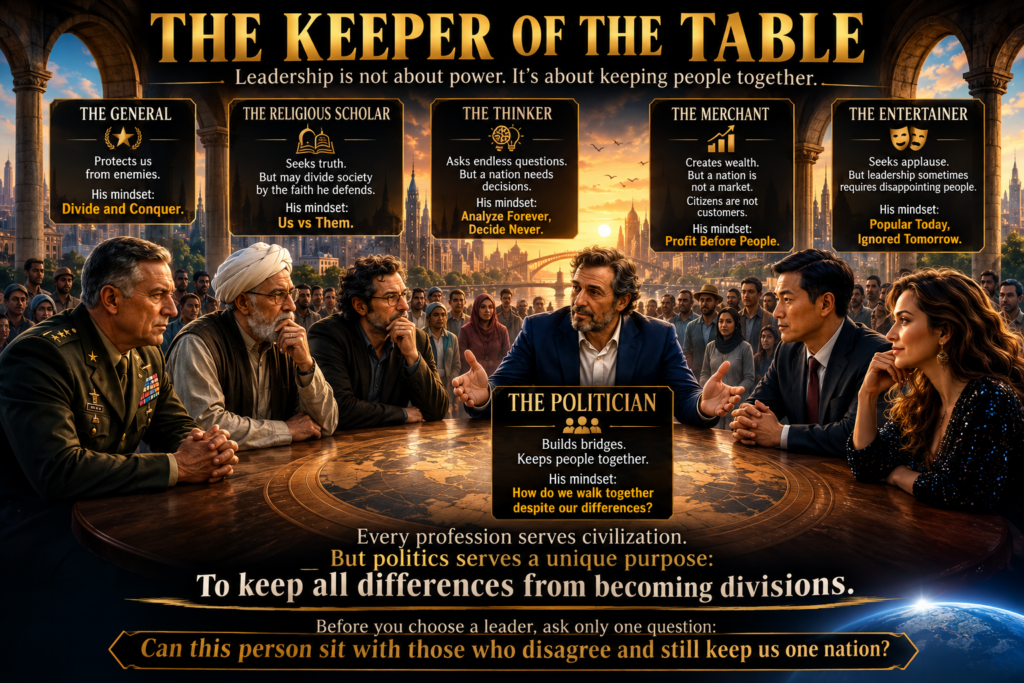
There was once a kingdom known not for its wealth or its armies, but for its diversity.
Its people spoke different languages. Some prayed in temples, others in mosques, churches, or beneath the open sky. Some were merchants who built great enterprises. Others were scholars who spent their lives in pursuit of truth. There were soldiers who defended the borders, artists who inspired the people, and thinkers who questioned everything.
For generations, the kingdom prospered because its differences were held together by a simple idea:
> “No single profession understands the whole of humanity.”
One day, the old king died.
As was tradition, the people gathered in the Great Hall to choose their next leader.
The General stood first.
“I have spent my life protecting this nation,” he declared. “I know how to identify threats, maintain discipline, and secure victory.”
The people applauded.
An old woman in the crowd rose and asked, “General, if two groups of your own people disagree, which one is the enemy?”
The General remained silent.
The Scholar stepped forward.
“I have dedicated my life to truth,” he said. “I know what is right and what is wrong.”
Again, the people applauded.
The old woman asked, “Scholar, in a nation of many beliefs, which truth shall everyone be required to follow?”
The Scholar lowered his eyes.
Then came the Merchant.
“I have created prosperity,” he said proudly. “I know how to make difficult decisions and build great institutions.”
The old woman smiled.
“And if helping the weakest among us costs the kingdom money, will you still do it?”
The Merchant hesitated.
The Entertainer approached next.
“The people love me,” she said. “They laugh with me, cry with me, and trust me.”
The old woman nodded.
“But when leadership requires you to disappoint them, will they still applaud?”
The hall grew quiet.
Finally, the Thinker rose from his seat.
“I have spent my life asking questions,” he said. “I seek understanding beneath every surface.”
“And when your questions have no end,” asked the old woman, “who will decide when it is time for the nation to move forward?”
The Thinker had no answer.
At last, a man who had remained silent throughout the day stood up.
“And what is your profession?” the people asked.
“I am a politician.”
The crowd murmured. Some laughed.
“Surely,” one man shouted, “that is the least honorable profession among us!”
The politician smiled.
“Perhaps,” he said. “But listen first.”
He walked to the center of the hall and placed a large wooden table before the people.
“This table,” he said, “is the nation.”
He pointed to the General.
“The General’s duty is to protect the people seated at this table.”
He pointed to the Scholar.
“The Scholar’s duty is to teach them.”
He pointed to the Merchant.
“The Merchant’s duty is to ensure they prosper.”
He pointed to the Entertainer.
“The Entertainer’s duty is to lift their spirits.”
He pointed to the Thinker.
“The Thinker’s duty is to ask whether the table itself could be built better.”
He paused.
“My duty is different.”
He slowly pulled out ten chairs and arranged them around the table.
“My duty is to ensure that all of them continue sitting together.”
The room fell silent.
“A soldier is trained to distinguish friend from enemy. A politician must remember that there are no enemies at the national table—only citizens.”
“A scholar seeks truth. A politician must create space for people who disagree about truth.”
“A merchant optimizes for value. A politician must sometimes choose what is necessary over what is profitable.”
“An entertainer seeks applause. A politician must occasionally accept criticism.”
“A thinker asks difficult questions. A politician must eventually make difficult decisions.”
He looked around the hall.
“Every profession serves civilization. But politics serves a unique purpose.”
“And what is that?” asked the old woman.
The politician smiled.
“Humility.”
He continued:
“Politics is the art of listening without surrendering your principles.”
“It is the art of disagreeing without hatred.”
“It is the art of carrying the fears of one group and the hopes of another.”
“It is the art of keeping people together long enough to build a shared future.”
The sun began to set beyond the windows of the Great Hall.
“Never ask whether your leader is the richest, the smartest, the strongest, or the most famous.”
“Ask instead:
Can this person sit at a table with ten people who fundamentally disagree and leave with all ten still willing to remain one nation?”
The old woman smiled.
For the first time that day, the people understood.
The purpose of a politician is not to defeat his people.
It is not to convert them.
It is not to entertain them.
It is not to optimize them.
It is not even to fully understand them.
It is to ensure that, despite all their differences, there remains a table at which they can continue to sit together tomorrow.
And from that day forward, every child in the kingdom learned the same lesson:
> A civilization is not judged by the strength of its armies, the wealth of its merchants, or the brilliance of its thinkers.
>
> It is judged by whether it can keep a seat at the table for everyone.