
 0
0
 257 views
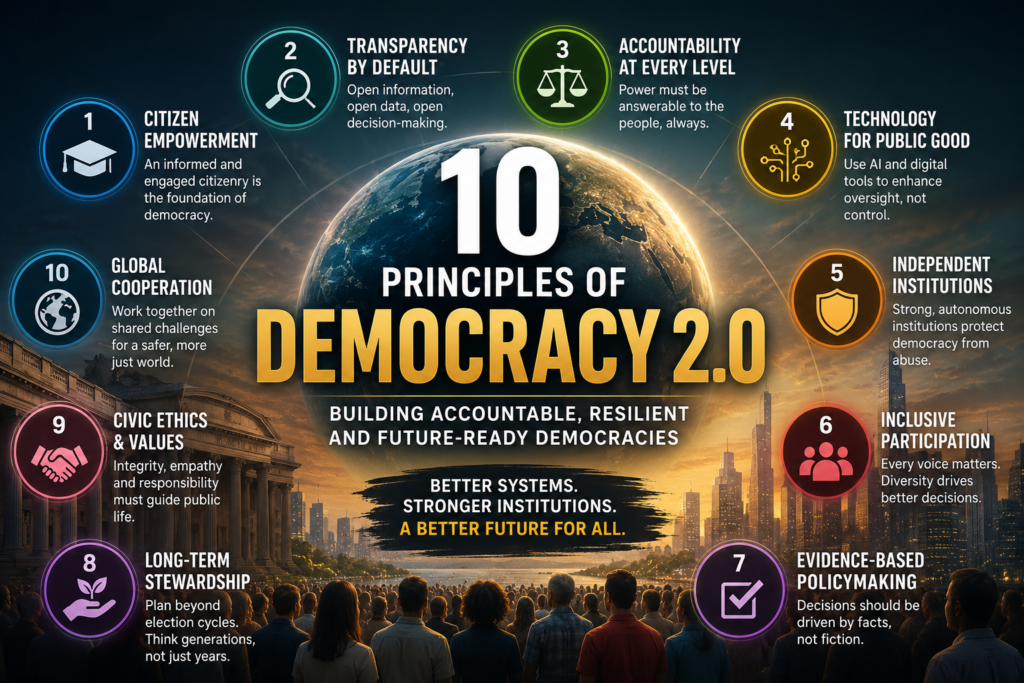
Our democracies were designed for an era of newspapers, local communities, and slower information flows. Today, we live in a world of social media manipulation, AI-generated narratives, billion-dollar lobbying, cyber warfare, and global challenges that ignore national borders.
Every generation inherits a system.
Not merely laws.
Not merely institutions.
But assumptions about how society should function.
For centuries democracy represented one of humanity’s greatest inventions.
It replaced kings with citizens.
Peaceful transfers of power replaced succession through violence.
Ordinary people gained a voice.
But every system is designed for the world that created it.
Our democracies were built for an age of newspapers.
For slower information.
For local communities.
For limited narratives.
For national challenges
However, the world for which democracy was designed no longer exists.
Today…
the world has changed. This world has :
Social Media
Global Networks
AI-Augmented Information
Infinite Narratives
Global Challenges
The question of our century is no longer simply:
❓ Who should govern?
The deeper question is:
❓ What kind of system makes good governance possible?
The question is not whether democracy succeeded.
The question is whether democracy has evolved alongside civilization itself.
The System Mismatch
Democracies increasingly face a mismatch between their design and their environment.
Citizens are expected to make informed decisions while navigating:
-
Information overload
AI-generated content
Deepfakes
Political polarization
Influence campaigns
Lobbying ecosystems
Cyber threats
Global crises
No citizen, journalist, or legislature can manually process the scale of modern public information.
This creates a new challenge:
How do we build systems that remain healthy even when imperfect people participate in them?
The Temptation of Yesterday
Throughout history, societies experiencing uncertainty have often looked backward for answers.
When institutions struggle to adapt, nostalgia becomes politically powerful.
Across the world, we increasingly hear variations of the same message:
“Make our nation great again.”
“Return to our former glory.”
“Restore the values of the past.”
Such sentiments are understandable. Periods of rapid change can leave citizens feeling disconnected, anxious, and uncertain about the future.
But history offers an important lesson:
Civilizations rarely solve the problems of a new age by attempting to recreate an old one.
The challenges of the twenty-first century are fundamentally different from those of previous generations.
-
Artificial intelligence.
Cyber warfare.
Climate change.
Global supply chains.
Pandemics.
Information warfare.
These are not problems our ancestors were asked to solve.
The question before us is therefore not:
“How do we return to the past?”
The question is:
“How do we build institutions worthy of the future?”
A healthy society remembers its history.
But it is ultimately built by those with the courage to imagine what does not yet exist.
The greatest civilizations did not become great by restoring yesterday.
They became great by building tomorrow.
In the video https://www.youtube.com/watch?v=9dprxGFNAjM , I have introduced an idea of creating a Fourth Pillar — a Public Intelligence Layer, a continuously operating civic observatory that helps societies distinguish appearance from reality and make better collective decisions.
Why Scandinavian countries work differently.
Why Singapore works differently.
Why Switzerland.
Why New Zealand.
Not because of one law.
Not because of one leader.
Not because of one agency.
Because
Education
Justice
Media
Economy
Culture
Technology
Civil Society
all reinforce one another.
Education
↓
Media
↓
Justice
↓
Technology
↓
Citizens
↓
Government
↓
Economy
↓
Trust
Democracy Needs A Fourth Pillar
Traditional Democracy
-
Legislature
Executive
Judiciary
Then
-
Legislature
Executive
Judiciary
↓
Public Intelligence Layer
Public Intelligence Layer
Think of the Public Intelligence Layer as a civic “truth infrastructure” — not a ministry of truth, not surveillance, and not AI replacing democracy. Its job is to make public reality more visible, measurable, explainable, and contestable.
Its purpose is not governance.
Its purpose is understanding.
Responsibilities:
-
Fact-check public claims
Track promises versus outcomes
Explain policies
Detect anomalies
Provide civic intelligence
Monitor emerging risks
Improve transparency
The Public Intelligence Layer acts as a continuously operating civic observatory.
Its mission is simple:
To help society see itself clearly.
Before building any system, we must first agree upon some core principles:
Principle #1: Stop Electing Personalities. Start Electing Performance.
Most elections today are popularity contests.
Citizens vote based on:
-
Charisma
Identity
Religion
Nationalism
Fear
Anger
Party loyalty
instead of measurable outcomes.
Better System
Every elected official should have a public performance dashboard.
Examples:
Category | KPI
Economy | Median household income
Education | Literacy growth
Healthcare | Waiting times
Environment | Air & water quality
Governance | Corruption index
Security | Crime trends
AI could automatically aggregate these metrics.
Citizens would see:
Promises vs Results
instead of speeches vs emotions.
Principle #2: AI-Powered Fact Checking During Campaigns
Imagine a public AI system.
Whenever a politician speaks:
-
Speech is transcribed
Claims extracted
Evidence checked
Sources displayed
in real time.
Example:
Candidate says:
“Crime doubled under my opponent.”
AI immediately displays:
True
False
Misleading
Context Needed
with links to evidence.
Not controlled by government.
Instead:
-
Universities
Journalists
Civic organizations
Citizens
jointly govern the system.
Principle #3: Replace Blind Voting With Informed Voting
Most citizens never read:
-
Party platforms
Budgets
Policy proposals
Better System
Before voting, citizens could receive an AI-generated briefing.
Example:
“You care most about healthcare, education, and housing.
Based on publicly available proposals:
-
Candidate A aligns 72%
Candidate B aligns 54%
Candidate C aligns 33%”
Similar to financial comparison tools.
The voter still decides.
But the decision becomes informed.
Principle #4: Continuous Accountability Instead of Election Accountability
Democracy currently works like this:
-
Vote
Wait 4–5 years
Vote again
That is too slow.
Better System
Digital citizen feedback systems.
Monthly scorecards.
Public sentiment tracking.
Citizens rate:
-
Services
Policies
Government agencies
AI identifies:
-
emerging problems
corruption patterns
failing programs
before crises occur.
Principle #5: Distributed Oversight
The founders of many democracies understood:
Power corrupts.
The modern version is:
Data and narrative power corrupt too.
Checks and balances should include:
Legislative Oversight
Parliament/Congress.
Judicial Oversight
Independent courts.
Citizen Oversight
Citizen review panels.
AI Oversight
Automated anomaly detection.
Media Oversight
Independent journalism.
No single actor should control all five.
Principle #6: Transparent Political Funding
One of the biggest weaknesses in modern democracies is money.
Imagine a blockchain-style public ledger.
Every political donation:
-
visible
searchable
traceable
Citizens could instantly see:
-
who funded whom
how much
when
AI could highlight unusual influence networks.
Principle #7: Citizen Assemblies
Many issues are too complex for slogans.
Examples:
-
AI regulation
Climate policy
Immigration
Healthcare reform
Randomly selected citizens could participate in deliberative assemblies.
Similar to jury duty.
After hearing experts from all sides, they provide recommendations.
Research consistently shows that informed citizen groups often reach more balanced conclusions than partisan political debates.
Principle #8: Create a Fourth Branch — The Public Intelligence Layer
This is where AI becomes transformative.
Current model:
-
Executive
Legislative
Judicial
Potential future model:
-
Executive
Legislative
Judicial
Public Intelligence Layer
The Public Intelligence Layer would:
-
Monitor government promises
Monitor budgets
Detect corruption
Analyze legislation
Simulate policy outcomes
Provide plain-language summaries
Accessible to every citizen.
Not controlled by politicians.
Think of it as:
“An AI-powered public auditor.”
Principle #9: Competency Requirements for Leadership
This is controversial but worth discussing.
Pilots need licenses.
Doctors need qualifications.
Engineers need certifications.
Yet leaders governing millions often need none.
A future democracy might require candidates to publicly demonstrate competency in:
-
Economics
Constitutional law
Public administration
Ethics
Critical thinking
Not to restrict democracy.
But to help voters evaluate capability.
Principle #10: Build Resilience Against Manipulation
Future democracies must assume:
-
Deepfakes exist
Foreign influence exists
AI propaganda exists
Social media amplification exists
Every citizen should learn:
-
Logic
Critical thinking
Media literacy
Cognitive bias awareness
starting in school.
A democracy is only as strong as the reasoning ability of its citizens.
A Possible Vision: Democracy 2.0
Instead of:
-
Vote based on slogans
Wait four years
Argue on social media
Repeat
A future system could become:
-
AI fact checks
Transparent funding
Performance dashboards
Citizen assemblies
Continuous feedback
Public intelligence layer
Distributed oversight
Evidence-based voting
The goal is not to find perfect leaders.
The goal is to build institutions where:
Good leaders can succeed, average leaders are constrained, and bad leaders cannot easily damage society.
Sustainable reform comes from improving the system of accountability, transparency, education, and collective reasoning that surrounds leadership.
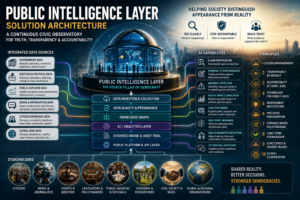
Public Intelligence Layer: Solution Architecture
1. Mission
A continuously operating civic observatory that helps citizens, institutions, media, courts, and policymakers answer:
What is happening?
What is true?
What is changing?
Who is responsible?
What evidence supports the claim?
What risks are emerging?
It should follow trustworthy AI principles: human rights, democratic values, transparency, accountability, safety, and risk management. The OECD AI Principles and NIST AI Risk Management Framework are useful foundations for this kind of design.
2. Core Data Sources
Government Data
Budgets, spending, contracts, procurement, grants, legislation, voting records, public service KPIs, audits, court decisions, agency performance reports.
Election and Political Data
Campaign promises, manifestos, debate transcripts, political donations, lobbying records, voting history, conflict-of-interest disclosures.
Public Outcome Data
Crime, education, healthcare, housing, employment, inflation, poverty, environment, infrastructure, disaster response, service delivery.
Media and Information Data
News articles, public speeches, press releases, social media trends, viral claims, misinformation alerts, fact-checking databases.
Citizen Experience Data
Surveys, complaints, service feedback, community reports, town hall transcripts, grievance portals.
Global Risk Data
Climate indicators, pandemics, migration, war-risk signals, food insecurity, cyber incidents, financial shocks.
3. Major AI Capabilities / Models
A. Claim Extraction and Fact-Checking Model
Extracts claims from speeches, debates, ads, and social media.
Example:
“Unemployment doubled under this government.”
The system checks trusted datasets and labels it:
True / False / Misleading / Needs Context / Not Enough Evidence
B. Promise-to-Performance Tracker
Converts campaign promises into measurable commitments.
Example:
“Build 100,000 affordable homes.”
Tracked against budget, permits, construction progress, delivery timelines, and actual occupancy.
C. Public Spending Anomaly Detection
Detects unusual patterns in contracts, procurement, grants, vendor concentration, repeated awards, inflated costs, or suspicious timing.
Open contracting data is especially important here; OGP notes that open contracting can improve service delivery, competition, and public scrutiny.
D. Policy Impact Simulator
Shows likely consequences of proposed policies.
Example:
“What happens if fuel taxes increase by 10%?”
Outputs possible impact on households, inflation, emissions, transport, and low-income communities.
E. Civic Explainer Model
Translates complex laws, budgets, court rulings, and policies into plain language.
Levels:
Simple explanation
Detailed explanation
Impact on citizens
Arguments for and against
Evidence sources
F. Risk Early Warning Model
Identifies emerging risks:
corruption patterns, social unrest, misinformation surges, hate speech escalation, public health warning signs, infrastructure failures, food insecurity, or conflict risk.
G. Bias and Narrative Detection Model
Detects when media, political campaigns, or social platforms are framing issues deceptively.
Not to censor speech, but to show:
What facts are missing?
What emotional triggers are being used?
What alternative interpretations exist?
H. Citizen Question-Answering Model
A public AI assistant where citizens can ask:
“Where did my city’s education budget go?”
“Which promises did this mayor keep?”
“What evidence supports this political claim?”
“Who benefits from this policy?”
4. High-Level Architecture
Public Data Sources
↓
Data Ingestion Layer
↓
Data Quality + Provenance Layer
↓
Knowledge Graph
↓
AI / Analytics Layer
↓
Public Intelligence Platform
↓
Citizens, Media, Courts, Legislators, Agencies, Civil Society
Key Technical Components
Data Lakehouse
Stores structured and unstructured public data.
Knowledge Graph
Connects people, policies, budgets, contracts, agencies, promises, outcomes, vendors, donors, and legislation.
Evidence Engine
Every AI answer must link back to sources.
Model Registry
Tracks all AI models, versions, training data, evaluation results, bias testing, and limitations.
Audit Trail
Every answer, dataset change, model update, and correction is logged.
Public API Layer
Allows journalists, universities, civic groups, and developers to build tools on top.
Citizen Portal
Dashboards, search, civic Q&A, policy explainers, alerts, and local performance scorecards.
5. Governance Model: Who Maintains It?
This cannot be controlled by one political party, one ministry, or one private company.
Recommended Ownership Model
Independent Public Trust / Civic Intelligence Commission
Governed by:
-
Judiciary-appointed representatives
Parliament/Congress-appointed members from multiple parties
Universities and research institutions
Civil society organizations
Data protection authority
Independent media representatives
Citizen assembly representatives
Technology and AI ethics experts
Auditor general / comptroller office
Human rights commission
The Open Government Partnership model is relevant because it emphasizes collaboration between governments and citizens to build open, inclusive, and accountable societies.
6. Stakeholders
Primary Stakeholders
Citizens, voters, public officials, legislators, courts, election commissions, auditors, anti-corruption agencies, journalists, universities, civil society, public service agencies.
Secondary Stakeholders
Technology companies, standards bodies, public unions, businesses, international organizations, NGOs, think tanks, watchdog groups.
Global Stakeholders
United Nations agencies, regional unions, democracy-monitoring bodies, human rights organizations, cyber-risk institutions, climate-risk organizations.
7. Accountability Controls
To avoid becoming dangerous, the Public Intelligence Layer must itself be accountable.
Required controls:
Open-source algorithms where possible
Public model cards
Independent audits
Bias testing
Appeal and correction process
Data privacy safeguards
No secret scoring of citizens
No law enforcement surveillance role
No censorship authority
Clear separation from ruling government
Human oversight for sensitive conclusions
NIST’s AI RMF is useful here because it focuses on governing, mapping, measuring, and managing AI risks across design, deployment, and monitoring.
8. What It Should Not Do
The Public Intelligence Layer should not:
decide what citizens are allowed to believe
censor political speech
become a surveillance system
secretly rank citizens
replace courts
replace elections
replace journalism
become controlled by the ruling party
hide model logic from the public
Its role is not control.
Its role is illumination.
9. Example Use Cases
During Elections
Real-time claim checking, promise comparison, funding transparency, candidate performance history.
During Governance
Budget tracking, service delivery dashboards, corruption-risk alerts, legislative explainers.
During Crisis
Pandemic signals, disaster response tracking, misinformation alerts, supply chain risks.
During Conflict
Hate speech escalation, refugee flows, arms movement signals, humanitarian risk indicators.
For Citizens
Plain-language civic assistant:
“Explain this policy and how it affects my family.”
10. Best Starting Point
Start small.
A city, state, or province can pilot it with five modules:
-
Public spending transparency
Promise-to-performance tracker
AI policy explainer
Real-time claim verification
Citizen feedback dashboard
Then expand into national and eventually international observatories.
The core idea is simple:
Democracy cannot survive only on votes.
It needs shared reality.
The Public Intelligence Layer is the civic infrastructure for shared reality.
Should you have any questions, please feel free to post here.
Solution Architecture Diagram
The Better System Manifesto
We believe
that accountability is stronger than authority.
That transparency is stronger than secrecy.
That evidence is stronger than slogans.
That institutions matter more than personalities.
That intelligence should serve citizens, not control them.
That democracy is more than elections.
That humanity’s greatest challenge is no longer technological.
It is institutional.
The future belongs to societies that learn to see themselves clearly.
And civilizations willing to build systems worthy of future generations.