
 0
0
 147 views
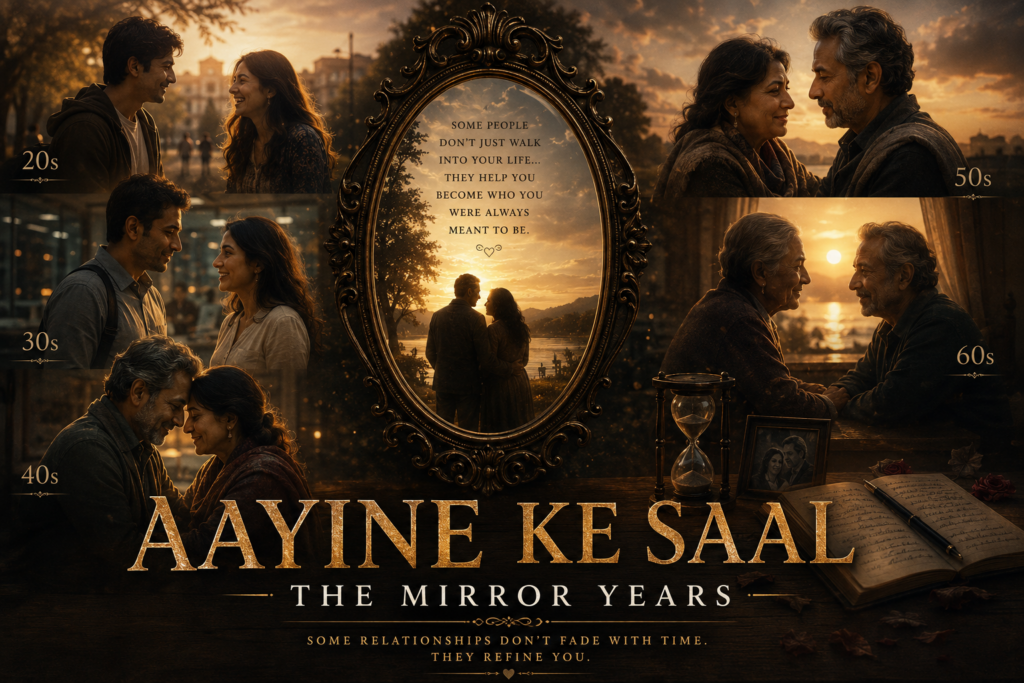
AAYINE KE SAAL (The Mirror Years) is not a song about falling in love. It is a song about growing up together.
Some relationships don’t fade with time.
They become mirrors.
At twenty, they awaken our hidden voice.
At thirty, they soften our exhaustion.
At forty, they hold us together when life becomes heavy.
At fifty, they share our grief.
At sixty, they remind us who we have been all along.
AAYINE KE SAAL (The Mirror Years) is a love song (Urdu) about growing older together and discovering that the deepest relationships do not merely change our lives—they gradually make us more fully human.
“Main tujhe dekh ke zara aur aadmi hota gaya.”
I looked at you, and little by little, I became more human.
AAYINE KE SAAL (The Mirror Years) is designed as a conversation across time.
Throughout the song, you will hear two versions of the same man: his younger self and his older self. They sing together, answer each other, and occasionally seem to remember the same moments from different ages.
The younger voice carries wonder, first love, and becoming. The older voice carries memory, responsibility, grief, and understanding.
As the decades pass—from twenty to sixty—the voices slowly converge until they feel like one person finally recognizing himself.
Because this song is not only about loving someone for a lifetime.
It is also about watching yourself become someone else because that person walked beside you.
The music intentionally evolves with each decade: youthful acoustic intimacy in the twenties, warmer textures and responsibilities in the thirties, deeper resonances in middle age, the fragility of grief in the fifties, and finally the quiet wisdom of old age.
By the end, the listener is left with a simple but profound realization:
Some people do not merely enter our lives. They become mirrors through which we witness our own becoming.
“Har umar mein tujhe dekha to kuch aur nazar aaya,
Main tujhe dekh ke zara aur aadmi hota gaya.”
In every age, I saw something new in you; and by looking at you, I slowly became more human.
Central Idea
———–
This is not a song about falling in love once. It is a song about becoming someone else—someone better, deeper, and more fully human—because another person walked beside you through the mirror years of life.
Line-by-Line English Translation
——————–
[Opening]
Jab bhi tujhe dekha to kuch aur nazar aaya
Every time I looked at you, I saw something new.
Main tujhe dekh ke zara aur aadmi hota gaya
And by looking at you, I became a little more human.
[Verse 1 — Age 20]
Bees saal ki umar mein jab hum pehli baar mile the
I was twenty when we first met.
Ek ajnabi se shakhs ko pehchaanta gaya
I slowly came to recognize a stranger.
Teri hansi ne meri khamoshi ko chhoo liya tha
Your laughter touched my silence.
Main apne andar ke sannate ko bolta gaya
And I gradually gave a voice to the quietness within me.
Tere saath meri pehli baar jab raat guzri thi
When I spent my first night beside you,
Main waqt ke dhaage ko kisi aur rang mein dhota gaya
I began washing the threads of time in entirely different colors.
[Verse 2 — Age 30]
Tees saal ki raat mein jab office se lauta
In my thirties, when I returned home from work at night,
Tera chehra meri thakaan ko dhota gaya
Your face seemed to wash away my weariness.
Tere saath meri khamoshi bhi guftagu thi
Even my silence became conversation with you.
Main lafzon ke saaye mein ek naya maani dhoondhta gaya
I kept discovering new meanings in the shadows of words.
Jab zindagi ne apni raftaar tez ki thi
When life suddenly gathered speed,
Tera saath meri aandhiyon ko thaamta gaya
Your presence held my storms together.
[Verse 3 — Age 40]
Chalees ke darwaaze pe jab rishte thakne lage
At the threshold of forty, when relationships began to grow weary,
Tera sahaara meri himmat ko jodta gaya
Your support slowly pieced my courage back together.
Tere haathon ki lakeeren meri lakeeron se
The lines in your hands and the lines in mine
Ek doosre ko pehchaan kar milti gayin
Met each other as though they had always known one another.
Jab duniya ne apne darwaaze band kar diye the
When the world closed its doors to me,
Tera wajood meri zindagi ka darwaaza kholta gaya
Your very presence kept opening the door to my life.
[Verse 4 — Age 50]
Pachaas ki subah mein jab maa-baap chale gaye
In my fifties, when my parents departed from this world,
Tera rona mere gham ko baantta gaya
Your tears shared the burden of my grief.
Tere saath meri zimmedari bhi mohabbat thi
With you, even responsibility became another form of love.
Main farz ki raahon mein aur gehra utarta gaya
And I descended more deeply into the paths of duty.
Jab maut ne pehli baar darwaaze pe dastak di thi
When death knocked at the door for the first time,
Tera haath meri bebasi ko thaamta gaya
Your hand gently held my helplessness.
[Bridge — The Mirror Speaks]
Aaina kya hai?
What is a mirror?
Aaina to woh hai
A mirror is that which…
Jo tujhe dekhe
Looks at you…
Aur mujhe dikhaye
And shows me…
Ki main kaun tha
Who I was…
Ki main kaun hoon
Who I am…
Ki main kaun ban gaya
And who I have become.
[Verse 5 — The Return | Age 60]
Saath saal ki shaam mein jab hum phir mile the
In the evening of sixty, when we met again,
Teri aankh meri aankh ko pehchaanti gayi
Your eyes kept recognizing mine.
Tere chehre pe meri zindagi ki lakeeren thin
Upon your face were the lines of my own life.
Main tujhe dekh ke apne aap se milta gaya
And by looking at you, I kept meeting myself again.
Jab sab kuch kehne ko tha aur lafz kam the
When there was so much left to say and too few words,
Teri saans ka lehja mujhe kuch sikhata gaya
The cadence of your breathing still kept teaching me something.
[Closing]
Har umar mein tujhe dekha to kuch aur nazar aaya
At every age, I saw something new in you.
Main tujhe dekh ke zara aur aadmi hota gaya
And by looking at you, I became a little more human.