
 0
0
 48 views
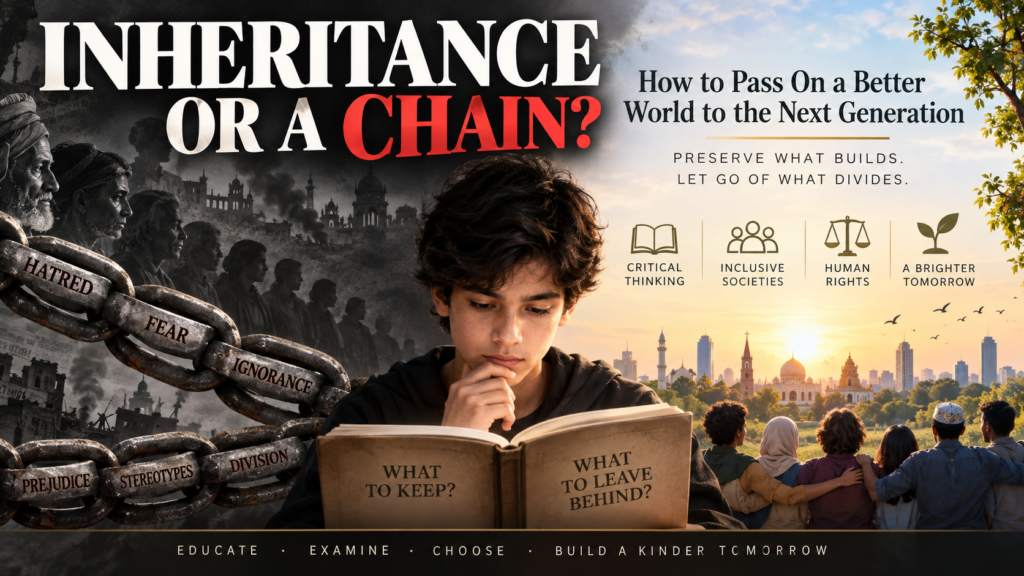
We teach children how to inherit a civilization. We must also teach them how to examine one.
Every generation receives an inheritance long before it is capable of deciding whether it wants it.
We inherit a language, family stories, religious and cultural traditions, collective memories, heroes, literature, customs, moral insights, institutions, and ways of understanding the world. Much of this inheritance is precious. Without it, every generation would have to begin civilization again from zero.
But inheritance does not arrive neatly separated into boxes marked wisdom, error, memory, fear, truth, and prejudice.
They often arrive together.
Alongside language may come labels for other people. Alongside historical memory may come an old grievance. Alongside legitimate remembrance of suffering may come suspicion of people who had nothing to do with that suffering. Alongside loyalty may come tribalism. Alongside identity may come a story explaining whom we should fear.
This is the question behind my song Virasat Ya Zanjeer? — Inheritance or a Chain?
Virasat rakho, zanjeer nahin.
Tareekh rakho, taassub nahin. ( https://youtu.be/iVhbcwmeGKs )Keep the inheritance, not the chains.
Keep the history, not the prejudice. ( https://youtu.be/BENsqBADV4Q )
But the song leaves us with a practical problem.
How does a society actually do that?
It is not enough to tell people, “Think critically.” A civilization must deliberately develop the capability to examine inheritance.
And that capability cannot be a lesson taught once in school. It has to become part of the intellectual infrastructure of society.
The Missing Human Capability: Inheritance Literacy
We teach literacy so people can read words.
We teach numeracy so people can understand numbers.
Increasingly, we teach digital literacy so people can navigate technology.
Perhaps modern societies also need something we might call Inheritance Literacy:
the ability to receive the beliefs, memories, identities, narratives and grievances of previous generations without automatically becoming captive to them.
Inheritance literacy would not teach people to reject tradition.
Quite the opposite.
It would teach them to understand tradition well enough to distinguish its enduring wisdom from its historical circumstances.
A mature society should produce citizens capable of saying:
I know what I inherited.
I know why my ancestors believed it.
I understand what happened to them.
I can honor their experience.
And I can still examine whether their conclusion should become mine.
That last sentence is crucial.
Respect and critical examination are not opposites.
Sometimes examining an inheritance carefully is the highest form of respect we can give it.
From Universal Rights to Equal Belonging
Humanity has already made remarkable intellectual progress in recognizing that rights should belong to people because they are human, not because they belong to the majority. The creation of the United Nations and the modern international human-rights framework gave institutional expression to that principle. The Universal Declaration of Human Rights begins from equal human dignity and states that rights belong to everyone without distinctions such as race, language, religion, or national or social origin https://www.un.org/en/node/12430 . Yet establishing the principle has not guaranteed its realization. The UN’s own work on minority rights acknowledges that, in practice, these rights remain far from fully realized and identifies continuing problems involving discrimination, unequal participation, and disparities in areas such as employment, health, and housing https://www.ohchr.org/sites/default/files/Documents/Publications/MinorityRights_en.pdf . In many societies, therefore, there remains a gap between equal citizenship in law and equal belonging in the human mind. Where one community forms the majority, members of minorities can still be viewed through inherited suspicions, stereotypes, historical grievances, or fears that individuals themselves never independently examined. Laws can prohibit discrimination, but laws alone cannot remove a prejudice quietly transmitted from one generation to another. This is why inheritance literacy is also a human-rights capability. A society must teach each generation to ask: Do I judge this person by what they have actually done, or by something I inherited about people with their name, faith, ethnicity, language, or background? Human-rights institutions can establish the principle of equality; ultimately, societies must also cultivate minds capable of practicing it.
From Inheritance to Wisdom
The unfinished human-rights project, therefore, is not only to place equality in constitutions and institutions, but to build the intellectual capacity for equality inside each new generation. We need to change the way we imagine cultural transmission.
Today, much inheritance follows an almost automatic path:
Previous Generation → Story → Child → Identity → Next Generation
Whatever enters the chain tends to travel forward.
A healthier civilization would introduce something between receiving and transmitting:
Receive → Understand → Examine → Verify → Contextualize → Choose → Transform → Pass Forward
That small conceptual change could have enormous consequences.
Every generation becomes not merely a carrier of civilization, but also its editor and custodian.
The question is no longer:
“What did my ancestors give me?”
It becomes:
“What did my ancestors give me, what does it mean, what have we learned since then, and what deserves to be given to my children?”
1. Schools Should Teach Children How Beliefs Are Formed
Critical thinking is often taught as an academic skill: analyze a paragraph, identify evidence, solve a problem.
That is useful, but insufficient.
Young people should also learn to examine the formation of their own beliefs.
When encountering an important claim, they should gradually develop the habit of asking:
- How do I know this?
- Who first told me this?
- What evidence supports it?
- What evidence might challenge it?
- Am I judging an individual or generalizing about a group?
- Have I heard the strongest account from another perspective?
- What would cause me to change my mind?
These should not be questions reserved for philosophers.
They should become ordinary mental habits.
The goal is not to produce children who distrust everything their parents or society tell them.
It is to produce adults who understand the difference between trust and intellectual surrender.
2. Teach History as Investigation, Not Only as Narrative
History becomes dangerous when it is reduced to a morality play in which our people are permanently virtuous and their people permanently guilty.
Historical education should preserve memory—including painful memory—but also expose students to historical complexity.
A mature history classroom can ask:
What happened?
What happened before that?
What did different participants believe was happening?
What evidence survives?
What remains disputed?
How did later generations interpret the event differently?
This does not require pretending every interpretation is equally supported by evidence.
Critical thinking is not relativism.
Some claims are demonstrably stronger than others.
But students should understand something profoundly important:
A historical event and the story later constructed around that event are not necessarily the same thing.
Once people understand this distinction, inherited narratives become examinable rather than sacred psychological territory.
3. Build Media Literacy Around Emotion, Not Just Misinformation
The challenge has become more difficult in the age of social media.
A person may possess enormous amounts of information and still be extraordinarily easy to manipulate.
Why?
Because manipulation does not always attack reason directly.
It often goes around reason through emotion.
Fear.
Humiliation.
Anger.
Belonging.
Outrage.
Pride.
A sophisticated media-literacy program therefore should not merely teach:
“Is this information true?”
It should also teach:
“What is this information trying to make me feel—and what does that feeling make me want to do?”
Before sharing emotionally provocative material, a citizen should learn to pause and ask:
Why was this particular image selected?
What happened before the clip began?
What happened after it ended?
Is one person’s behavior being presented as evidence about millions of people?
Would I accept this reasoning if the identities were reversed?
That last question is particularly powerful.
It tests whether our principle is actually a principle—or merely loyalty wearing the clothes of reasoning.
4. Teach the Difference Between a Person, an Action and an Identity
One of civilization’s most important intellectual safeguards should be the ability to keep three things separate:
Person → Action → Group Identity
A person commits an action.
The action can be judged.
But the person’s ethnicity, nationality, religion, language, race, culture, or other broad identity does not thereby become the action.
Without this distinction, societies make an extraordinarily dangerous conceptual leap:
Someone from Group X did something wrong → Group X is dangerous → members of Group X should be feared.
This is how individual wrongdoing becomes collective suspicion.
A society resistant to inherited hatred should repeatedly teach a simpler principle:
Judge actions as actions.
Judge individuals as individuals.
Do not turn identity itself into evidence.
5. Give Young People Meaningful Contact With People Outside Their Inherited Categories
There is another problem that education alone cannot solve.
You can teach someone intellectually that stereotypes are unreliable while their entire social world continues reinforcing those stereotypes.
People therefore need opportunities for meaningful encounter.
Schools, universities, community organizations, workplaces, cultural institutions and digital spaces can create environments where people who might otherwise know one another only through inherited narratives actually work together.
Not ceremonial diversity.
Shared problems.
Build something together.
Solve something together.
Play together.
Create music together.
Study together.
Serve a community together.
Human encounter can accomplish something argument sometimes cannot:
it gives an abstraction a face.
It becomes harder to maintain a simple theory about “those people” after those people include someone whose jokes you know, whose children you have met, whose kindness you have experienced, or whose grief you have witnessed.
6. Teach Intellectual Self-Defense
Modern societies spend enormous resources teaching physical safety and cybersecurity.
Perhaps we also need cognitive security.
Every citizen should understand some basic mechanisms through which human judgment can be manipulated:
confirmation bias, selective exposure, repetition, scapegoating, dehumanizing labels, emotional framing, group conformity, false binaries, algorithmic amplification and manufactured outrage.
The purpose is not to tell citizens what to believe.
That would merely replace one form of influence with another.
The purpose is to help them recognize how someone may be trying to influence what they believe.
A democratic intellectual culture should not manufacture the “correct” citizen.
It should develop the difficult-to-manipulate citizen.
7. Create a Social Habit of the Second Question
Perhaps one of the simplest interventions could also be one of the most powerful.
Teach people to ask one more question.
Someone says:
“They hate us.”
Ask:
“How do we know?”
Someone says:
“They have always been our enemies.”
Ask:
“Always?”
Someone shares a frightening video.
Ask:
“What happened before this?”
Someone attributes one person’s conduct to an entire population.
Ask:
“Would we apply that logic to ourselves?”
Someone invokes history to justify hostility toward people alive today.
Ask:
“What responsibility belongs to this individual?”
The first reaction is often inherited.
The second question may be where independent thought begins.
8. Do Not Make Critical Thinking a Childhood Vaccine
There is a major weakness in relying entirely on schools.
A person might graduate at twenty-two and live another sixty years.
During those decades, technologies change. Political environments change. Media ecosystems change. New fears emerge. New propaganda techniques develop. Artificial intelligence makes fabricated images, voices and narratives increasingly convincing.
So intellectual resilience must become a lifelong civic capability.
Libraries, universities, employers, professional associations, community organizations, religious institutions, media organizations and technology platforms can all contribute.
Public campaigns can teach reasoning techniques just as societies teach health or cybersecurity practices.
Community discussions can examine difficult historical narratives without requiring participants to surrender their identities.
Media organizations can make sourcing and uncertainty more visible.
Technology platforms can create friction before impulsive sharing rather than optimizing only for engagement.
The objective should be continuous:
Strengthen the population’s capacity to examine what enters its mind.
A Capability Model for an Intellectually Resilient Society
If we treated this almost as a societal capability architecture, the desired outcome would be Independent Moral and Intellectual Judgment.
Underneath it, society would continuously develop interconnected capabilities such as:
Historical Literacy → Critical Reasoning → Media Literacy → Emotional Awareness → Bias Recognition → Perspective Taking → Evidence Evaluation → Intergroup Encounter → Moral Reasoning → Civil Disagreement → Digital Literacy → Reflective Self-Correction
The final capability—self-correction—may be the most important.
Intelligence is not merely the ability to defend what we believe.
A higher intellectual capability is being able to discover:
“I may have been wrong.”
And then change.
A civilization that cannot correct inherited beliefs eventually becomes imprisoned by them.
Institutions Must Practice What Schools Teach
There is little value in teaching a sixteen-year-old not to stereotype if adults are rewarded for doing precisely that.
Schools cannot carry this responsibility alone.
Families matter.
Political and civic institutions matter.
Religious institutions matter.
Universities matter.
Journalism matters.
Entertainment matters.
Technology companies matter.
Community leaders matter.
The standard should be consistent:
Criticize ideas without dehumanizing people.
Condemn wrongdoing without assigning inherited guilt.
Remember suffering without manufacturing permanent enemies.
Protect identity without requiring hostility toward another identity.
Otherwise society teaches critical thinking in classrooms and emotional tribalism everywhere else.
The stronger environment usually wins.
The Inheritance Review
Perhaps every generation needs something analogous to an Inheritance Review.
Not a government committee deciding which traditions citizens may keep. That would be dangerous in its own way.
Rather, a cultural habit practiced by individuals, families, schools and institutions.
Take what we inherited and place it before four questions:
What should we preserve?
Wisdom, language, art, ethical principles, memory, knowledge, community, stories of courage.
What should we understand but contextualize?
Practices and assumptions that belonged to circumstances different from ours.
What should we transform?
Traditions containing genuine value but requiring adaptation to new knowledge or conditions.
What should we stop transmitting?
Inherited hatred, collective guilt, dehumanization, baseless fear, prejudice and grievances whose only purpose has become perpetuating another grievance.
This is not the destruction of inheritance.
It is stewardship of inheritance.
The Goal Is Not a Generation Without Roots
There is an opposite danger worth acknowledging.
In trying to free ourselves from harmful inheritance, we should not produce people disconnected from history, family, culture and memory.
A tree without roots does not become free.
It dies.
The objective is therefore not:
Roots or freedom.
It is:
Roots without chains.
Know where you came from.
Learn the language.
Preserve the stories.
Remember what happened.
Honor sacrifice.
Study injustice.
Celebrate what was beautiful.
Understand what went wrong.
But never surrender the moral agency of the living to the unresolved emotions of the dead.
Our ancestors deserve remembrance.
They do not require our obedience to every conclusion they reached.
What Should We Give the Next Generation?
Perhaps the greatest inheritance we can give our children is not a finished collection of answers.
Perhaps it is the ability to examine answers—including ours.
Imagine telling the next generation:
Here is our history. Study it.
Here is our culture. Understand it.
Here are our achievements. Build upon them.
Here are our wounds. Learn from them.
Here are our mistakes. Do not defend them merely because they were ours.
Here are the people we feared. Meet them before deciding whether you should fear them too.
Here are our beliefs. Ask why we believed them.
And finally:
We have given you an inheritance.
We have not given you a prison.
That may be how the chain is finally broken.
Not by forgetting the past.
Not by rejecting identity.
Not by erasing disagreement.
But by developing generations capable of receiving civilization with gratitude, examining it with courage, improving it with wisdom, and passing forward only what deserves another life.
That is the deeper meaning of:
Virasat rakho, zanjeer nahin.
Tareekh rakho, taassub nahin.Keep the inheritance, not the chains.
Keep the history, not the prejudice.
And perhaps this is the capability every civilization ultimately needs:
Do not merely teach the next generation what to inherit.
Teach them how to decide what is worthy of inheritance.