
 0
0
 85 views
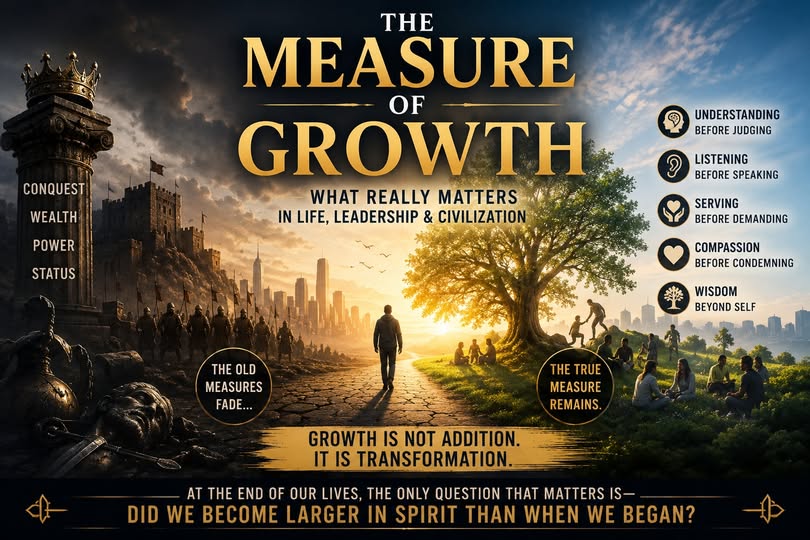
There was a time when humanity measured growth by conquest.
A king was considered great if his armies marched farther than those before him. A nation was admired for the size of its borders. A person was judged by the wealth he accumulated, the titles he carried, or the number of people who stood when he entered a room.
But history is a patient teacher.
Empires that once stretched across continents now survive only in books. Palaces have become museums. Statues have weathered beneath the rain. The applause of one generation is often forgotten by the next.
This raises a profound question:
What is the true measure of growth?
Is it found in what we possess, or in what we become?
Perhaps growth is not measured by how high we stand above others, but by how deeply we understand them.
Perhaps the measure of a civilization is not the height of its buildings, but the breadth of its compassion.
Perhaps the measure of a leader is not how many people obey him, but how many people flourish under his leadership.
Nature offers its own answer.
A tree does not spend its life comparing its height to the forest around it. It simply continues growing—extending its roots deeper into the earth and its branches farther toward the sky. Its greatness is ultimately measured not by its size, but by the shade it offers to those who rest beneath it.
Human beings are no different.
Growth is the gradual expansion of one’s capacity:
To understand before judging.
To listen before speaking.
To forgive before condemning.
To serve before demanding.
To think beyond oneself.
A child grows in height.
An adult grows in responsibility.
A civilization grows in wisdom.
And humanity grows whenever it learns to widen the circle of those it calls “us.”
Yet many mistake motion for growth.
They accumulate more possessions, yet become less content.
They gain more followers, yet become more isolated.
They acquire more knowledge, yet lose their curiosity.
They speak more loudly, yet listen less often.
Growth, then, is not merely addition.
It is transformation.
History itself is a record of this transformation. Humanity has moved—slowly and imperfectly—from tribes to cities, from kingdoms to nation-states, from conquest to cooperation. The arc is neither straight nor guaranteed, but it bends toward an expanding recognition of our shared humanity.
Those who understand the measure of growth understand something else as well:
Time only moves in one direction.
To resist this truth is to attempt to swim against the current of a mighty river. One may struggle for a moment, but eventually the river continues its journey to the sea.
Wisdom, therefore, is not found in longing for a vanished age.
It is found in asking:
“What is history inviting us to become?”
Because perhaps the greatest measure of growth is this:
At the end of our lives, are we larger in spirit than when we began?
Did our minds become more expansive?
Did our hearts become more generous?
Did our presence make the world—even in some small way—a better place for others?
For in the end, the measure of growth is not written in monuments, bank accounts, or headlines.
It is written in the invisible things:
The lives we touched.
The divisions we healed.
The wisdom we shared.
The burdens we carried for others.
And the humanity we helped preserve.
Everything else, history eventually returns to dust.
The true measure of growth is not how much of the world we managed to possess, but how much of our humanity we managed to discover.