
 0
0
 105 views
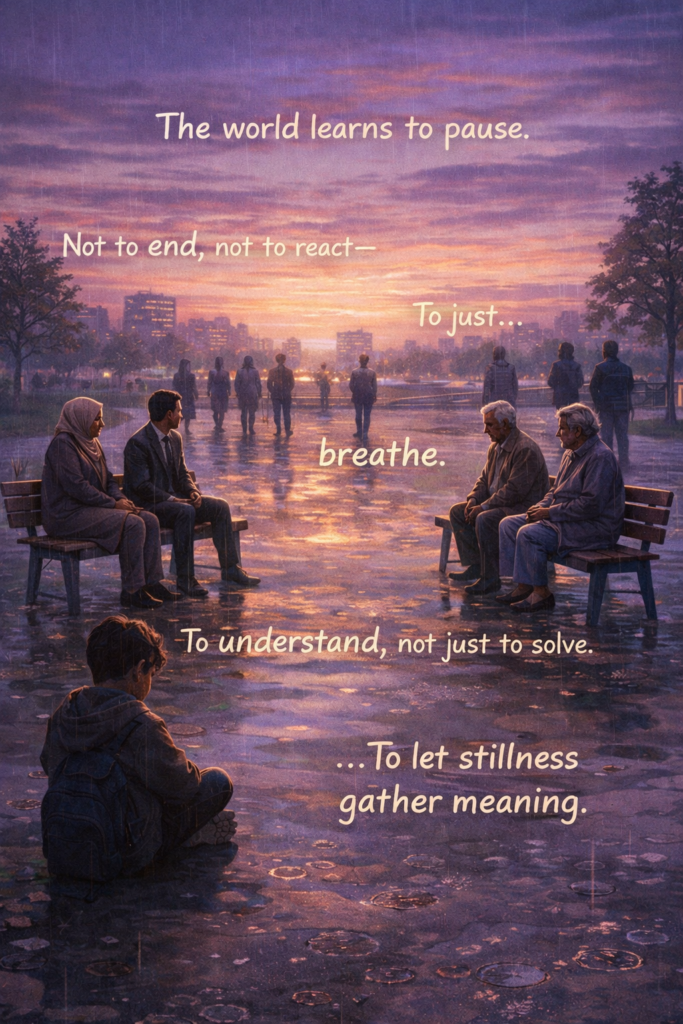
Date: 2036–2038
Location: Everywhere — especially where nothing urgent was happening
Weather: Long afternoons. Soft rain. Winters that arrived on time.
The pause was not announced.
No resolution passed.
No dashboard flashed.
No elder declared a new era.
People simply stopped rushing.
________________________________________
The Discovery
It began in small ways.
In Kyoto, city assemblies shortened their agendas and left the last hour unfilled.
In Accra, a breath circle ended early and no one stayed to debate.
In Reykjavík, a school experimented with a radical policy:
no objectives on Fridays.
Nothing broke.
That surprised everyone.
For centuries, governance had been motion — laws passed, borders enforced, crises managed. Stillness had always meant danger. A vacuum. A weakness.
But now, for the first time, stillness did not invite invasion.
It invited… reflection.
________________________________________
The End of Urgency Culture
The breath network had solved coordination.
What it had not solved was pace.
After the Age of Disappointment, people realized something quietly unsettling:
They had replaced emergency with optimization.
They were still rushing —
just toward better metrics.
Cities compared coherence curves.
Planners competed for smoother graphs.
Leaders spoke of “maintaining momentum.”
Momentum toward what?
No one could say.
________________________________________
The First Deliberate Pause
The first formal pause happened accidentally.
A UCCA session on river-sharing stalled when two delegations — both calm, both reasonable — realized they were arguing in circles.
No one was angry.
No one was wrong.
Finally, an elder from the Andes stood and said:
“We are breathing, but we are not listening.
Let us stop speaking for one day.”
The room hesitated.
Then Amara Okonkwo nodded.
The session adjourned — not postponed, not failed.
Paused.
For 24 hours, nothing happened.
No backroom deals.
No lobbying.
No spin.
Just delegates walking, sleeping, eating, thinking.
The next day, the agreement took ten minutes.
________________________________________
Pause as Practice
The idea spread.
Cities began instituting:
• Weekly Silence Hours — no governance decisions allowed
• Seasonal Pauses — weeks with no policy changes
• Right-to-Wait Clauses — any community could delay a decision without penalty
The old world would have called this inefficiency.
The new world called it respect.
________________________________________
Children Lead the Way
It was children who understood it first.
In a school in São Paulo, a teacher asked why students seemed calmer.
A girl answered:
“Because adults stopped acting like everything was on fire.”
In Nairobi, kids redesigned a playground and insisted on one rule:
No schedule.
Just space.
Parents watched, confused, then relieved.
________________________________________
Emil’s Pause
Emil took his first real pause in 2037.
No calls.
No feeds.
No emergency access.
He left the city and sat by a lake in upstate New York.
For three days, he did nothing useful.
On the fourth, he realized something terrifying:
The world did not miss him.
And something freeing:
It didn’t need to.
He returned lighter.
________________________________________
The Network Adapts
Priya quietly released an update.
No announcement.
The dashboards gained a new state:
Gray.
Not error.
Not danger.
Paused.
Gray zones indicated places that had chosen stillness — no scoring, no alerts, no optimization.
At first, analysts worried.
Then they noticed something strange:
After pauses, coherence didn’t just return.
It deepened.
________________________________________
The Old Fear Dies
For thousands of years, humanity had believed:
If we stop, we will fall.
But now they learned something harder:
If we never stop, we hollow out.
The pause became the antidote to false prophets, false urgency, false miracles.
You could not hijack a society that knew how to wait.
________________________________________
Grandfather’s Note
Thomas left Emil a handwritten note.
No call.
No explanation.
Just a line:
“Every war I lived through started because someone couldn’t wait.”
Emil kept it in his wallet.
________________________________________
Closing Scene
In a city square in Lisbon, a digital sign once used for alerts displayed a single message:
PAUSE IN EFFECT
Take care of each other.
Nothing is required today.
People sat.
Some talked.
Some didn’t.
The sky did not fall.
The world breathed.
And for the first time in its long, violent history,
it learned that doing nothing — together — could be an act of wisdom.