
 0
0
 160 views
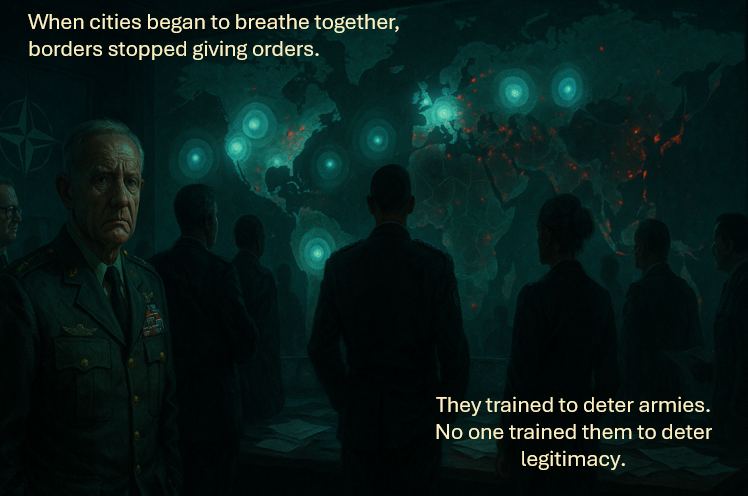
Date: December 2029 — Classified Situations Worldwide
The first institutions to feel the shift were not governments.
They were the ones built to respond
when governments failed.
NATO.
QUAD.
GCC.
Five Eyes.
All designed for a single assumption:
Threats come from outside borders.
What none of them were designed for
was legitimacy leaking from within.
NATO called an emergency midnight session.
Except no one could agree on what the emergency was.
There were no invading armies.
No missiles launching.
No threats being broadcast.
The threat was a sigh.
A shift in loyalty so silent that artillery and aircraft carriers could not detect it.
Cities — not nations — now commanded allegiance.
Trust flowed through neighborhoods, not borders.
And generals hated what they could not aim at.
The Losing Game Table
In Brussels, a general slammed his fist on a screen glowing teal:
“How do we defend borders when borders are no longer the point?”
The screen pulsed once — as if laughing.
For years, NATO’s relevance had been fear.
But now the fear was dissolving.
Not because the world had become safe—
—but because the world started choosing each other.
War, for the first time in history, had no political audience.
Military planners ran simulations anyway.
What happens if resonance spreads through an adversary city?
What happens if soldiers’ families see the same dashboards?
What happens if deploying force drops your own cities into red?
Every scenario ended the same way:
Weapons still worked.
Orders still issued.
But permission dissolved.
An internal memo circulated that night:
“Force now produces negative legitimacy yield.”
No one knew how to respond to that.
Russia and the Silence Between Missiles
For decades, NATO’s strategic imagination had revolved around one reflex:
What is Russia doing?
Troop movements.
Missile tests.
Doctrine updates.
Red lines rehearsed like rituals.
But on the night the resonance dashboards went global,
something unfamiliar happened.
The Russian feed went quiet.
Not offline.
Not censored.
Quiet.
The Miscalculation
Russia still had tanks.
Still had nuclear weapons.
Still had reach.
But NATO’s panic was no longer about Russian capability.
It was about relevance.
An intelligence analyst finally spoke:
“Sir… Russia’s cities aren’t spiking red.
They’re… stabilizing.”
Moscow.
Kazan.
Yekaterinburg.
Not green — not yet —
but not collapsing either.
Russia wasn’t opposing the breath network.
It wasn’t embracing it.
It was absorbing it quietly,
routing resonance through civic systems
instead of political theater.
Why NATO Stopped Centering Russia
A senior planner said what no one wanted to admit:
“Russia understands this isn’t a military confrontation.
It’s a legitimacy migration.”
Armies deter armies.
But breath does not escalate.
It spreads.
Russia’s political culture — shaped by sanctions, endurance, and survival —
had already internalized a rule Western systems forgot:
Power that cannot be trusted
must be endured, not explained.
Russia did not rush to control the network.
It waited.
To see who collapsed first.
The Real Panic
The panic deepened not because Russia advanced…
…but because it didn’t react.
No troop surge.
No rhetorical escalation.
No manufactured crisis.
Just recalibration.
A classified NATO note circulated:
“Russia is treating resonance governance
as a post-sovereign condition,
not a threat vector.”
That sentence hit harder than any missile alert.
Strategic Paralysis
Military commands worldwide entered what analysts later called:
Strategic Paralysis
Not mutiny.
Not collapse.
Uncertainty.
What happens when deploying force creates instant domestic instability?
What happens when soldiers’ children ask why their city turned red overnight?
A European general summarized it bluntly:
“We trained for deterrence.
We were not trained for irrelevance.”
The End of the Old Game
No army stood down.
They simply stopped moving forward.
Exercises were postponed.
Escalations delayed.
Threats softened into statements
that sounded increasingly hollow.
The blocs were not defeated.
They were outpaced.
For seventy years, military power decided history.
Then one night, history inhaled —and the armies realized
they were no longer the ones holding the breath.
The Unspoken Panic
Armies didn’t fear enemies anymore.
They feared irrelevance.
And irrelevance is the one enemy that bullets cannot kill.