
 0
0
 133 views
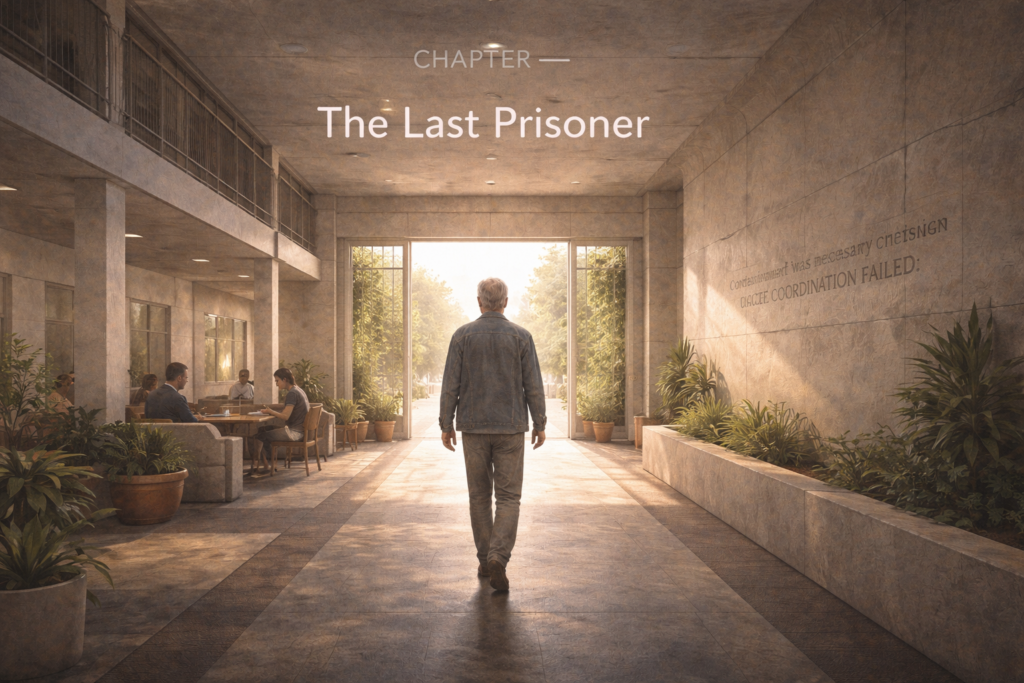
Date: Mid-21st Century
Location: Former prisons, reintegration centers, quiet civic institutions
Weather: Still air, unguarded mornings
No one remembers the last prison closing.
Because prisons did not end with a sound.
They ended with a reduction.
Fewer arrivals.
Longer absences.
Empty corridors that stayed empty.
Doors that remained unlocked because no one needed to pass through them.
The buildings remained.
But their purpose dissolved.
________________________________________
When Containment Stopped Solving the Problem
Prisons had never been built to heal.
They were built to contain.
Contain violence.
Contain instability.
Contain people the system did not know how to reintegrate.
They operated on a simple assumption:
If harm cannot be prevented, isolate the person who caused it.
This assumption worked only superficially.
It stopped immediate harm.
But it did not repair the conditions that created it.
So harm returned.
Not always from the same person.
But from the same fractures.
________________________________________
The Discovery That Changed Everything
Planetary coordination systems revealed something uncomfortable.
Most harmful acts were not random.
They were preceded by detectable instability:
Prolonged isolation.
Cognitive deterioration.
Economic displacement.
Social fragmentation.
Unresolved trauma.
The signals appeared long before the act.
But the old system did not listen.
Because listening required coordination.
And coordination had been scarce.
AI did not eliminate human instability.
It made it visible early enough to respond.
________________________________________
Prevention Replaced Reaction
Support no longer arrived after collapse.
It arrived during drift.
Gentle prompts surfaced:
Support recommended.
Intervention available.
You do not have to navigate this alone.
No accusation.
No surveillance tone.
Just awareness.
Most instability resolved before reaching rupture.
The pipeline feeding prisons began to thin.
Not by force.
By absence of necessity.
________________________________________
Harm Did Not Disappear
The system did not assume perfection.
Humans remained human.
Conflict still occurred.
Impulses still misfired.
Moments of harm still emerged.
But the response changed.
The question was no longer:
“How do we punish?”
The question became:
“What must be restored?”
Containment existed only when necessary to prevent immediate continued harm.
Not as penalty.
As stabilization.
Temporary.
Transparent.
Purpose-bound.
The goal was never isolation.
The goal was reintegration.
________________________________________
The Last Prisoners Became Participants
As years passed, fewer people remained inside containment systems.
Not forgotten.
Not warehoused.
Engaged.
Recovery environments replaced cells.
Spaces designed for cognitive repair, emotional stabilization, and social re-entry.
No uniforms.
No permanent sentences.
Just pathways back.
Most left.
Some took longer.
None were abandoned.
________________________________________
The Last Prisoner
He had entered under the old system.
Before alignment replaced containment.
Before coordination replaced reaction.
He expected permanence.
Expected to be defined by his worst moment.
Years passed.
But something unusual happened.
No new prisoners arrived.
Staff roles changed.
Guards became guides.
Walls remained.
But their meaning shifted.
One morning, he received a prompt:
Reintegration pathway available.
No conditions beyond readiness.
No debt to repay.
No permanent mark.
Just invitation.
He stepped outside.
Not released.
Restored.
________________________________________
What Happened to the Prisons
The buildings did not vanish.
They transformed.
Some became recovery centers.
Some became educational institutions.
Some became historical archives.
Places where future generations could learn what had once been necessary.
And why it no longer was.
Visitors walked through old corridors.
Not in fear.
In reflection.
The architecture of containment became architecture of memory.