
 0
0
 221 views
Date: 2038–2040
Location: Capitals, border towns, former parade grounds
Weather: Windy days, overcast skies — fabric in motion, certainty fading
The last flag did not fall in battle.
It was folded.
Not ceremonially.
Not defiantly.
Quietly.
For a while, no one noticed.
________________________________________
When Symbols Lost Their Weight
By the early 2038s, something had begun to feel… thin.
Borders still existed.
Governments still governed.
Anthems were still played.
But the symbols no longer carried gravity.
Young people stood during national songs out of courtesy, not conviction.
Soldiers saluted traditions they could not fully explain.
Parades drew crowds, but not belief.
The flags waved.
The meaning didn’t.
________________________________________
The Moment Loyalty Became Conditional
It began with a question asked in many languages:
“What am I loyal to — the symbol, or the people beneath it?”
For generations, the two had been fused.
Now they were drifting apart.
When governments were asked to justify actions, flags were no longer enough.
“We act in the name of the nation,” stopped working.
People wanted to know:
Whose safety?
Whose cost?
Whose silence?
A flag could no longer answer that.
________________________________________
The Border Incident
The breaking point was not a war.
It was a standoff.
Two neighboring states faced a humanitarian crisis at their shared border.
No invasion.
No aggression.
Just refugees stranded between jurisdictions.
Both flags were raised.
Both anthems played.
Nothing moved.
A citizen livestreamed the moment and said one sentence that spread everywhere:
“If the flag mattered, someone would already be helping.”
Within days, public opinion shifted — not against nations, but against symbols without action.
________________________________________
When the Flag Became a Question
Artists were the first to respond.
They painted flags made of transparent fabric.
Flags stitched from maps of shared rivers.
Flags that dissolved in rain.
None were burned.
That mattered.
This was not rejection.
It was interrogation.
What does this stand for — really?
________________________________________
The Quiet Retirements
No declaration was made.
Governments did not abolish flags.
They simply stopped leading with them.
Press briefings dropped the backdrop.
International meetings removed the color-coded seating.
Documents referenced obligations, not emblems.
In some capitals, the flag still flew.
In others, it was lowered during renovations and never raised again.
People noticed.
They didn’t protest.
They understood.
________________________________________
The Children Ask the Simplest Question
In a school forum, a child asked:
“If the flag is for everyone, why does it feel like it belongs to some people more than others?”
No official answered.
Because no slogan could.
________________________________________
What Replaced the Flag
Not a global banner.
Not a single identity.
What replaced it was quieter:
shared standards
mutual accountability
measured trust
People stopped asking where someone was from.
They asked:
“What do you protect?”
“What do you refuse to excuse?”
“What are you willing to repair?”
Belonging shifted from inheritance to behavior.
________________________________________
The Last Ceremony
The final formal lowering happened without cameras.
An old flagpole was dismantled during the conversion of a military plaza into a public garden.
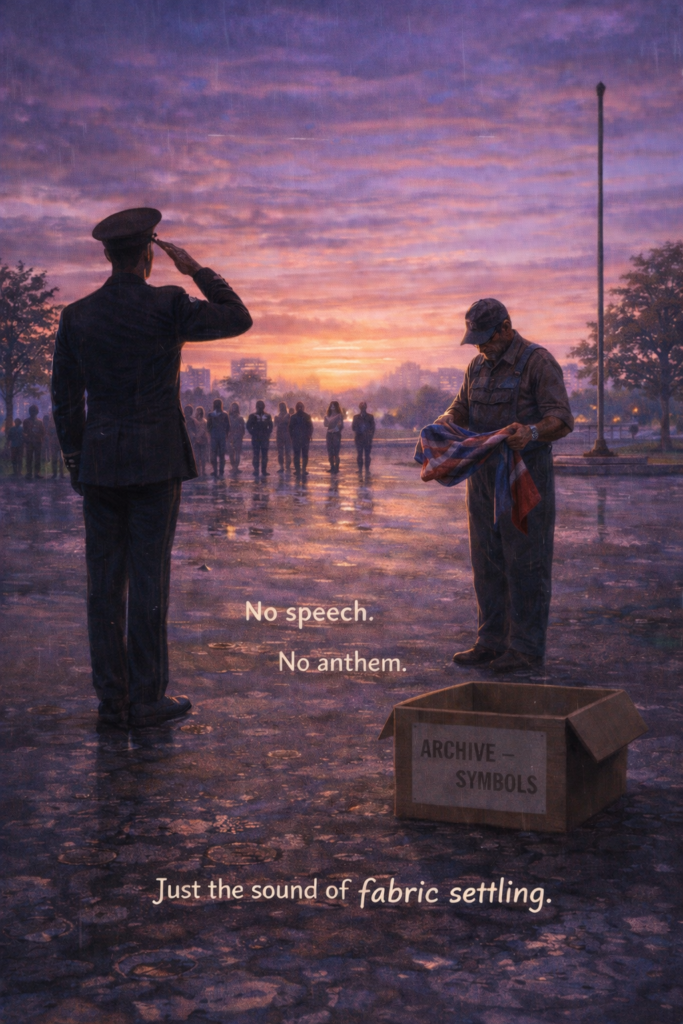
The cloth was folded by a groundskeeper.
He placed it in a box labeled simply:
ARCHIVE — SYMBOLS
No speech.
No anthem.
Just the sound of fabric settling.
________________________________________
Closing Image
An open square where a flag once flew.
Children play where salutes once happened.
Benches face each other instead of a pole.
Someone asks, quietly:
“What do we stand for now?”
No fabric answers.
People do.
And for the first time,
that feels sufficient.