
 0
0
 143 views
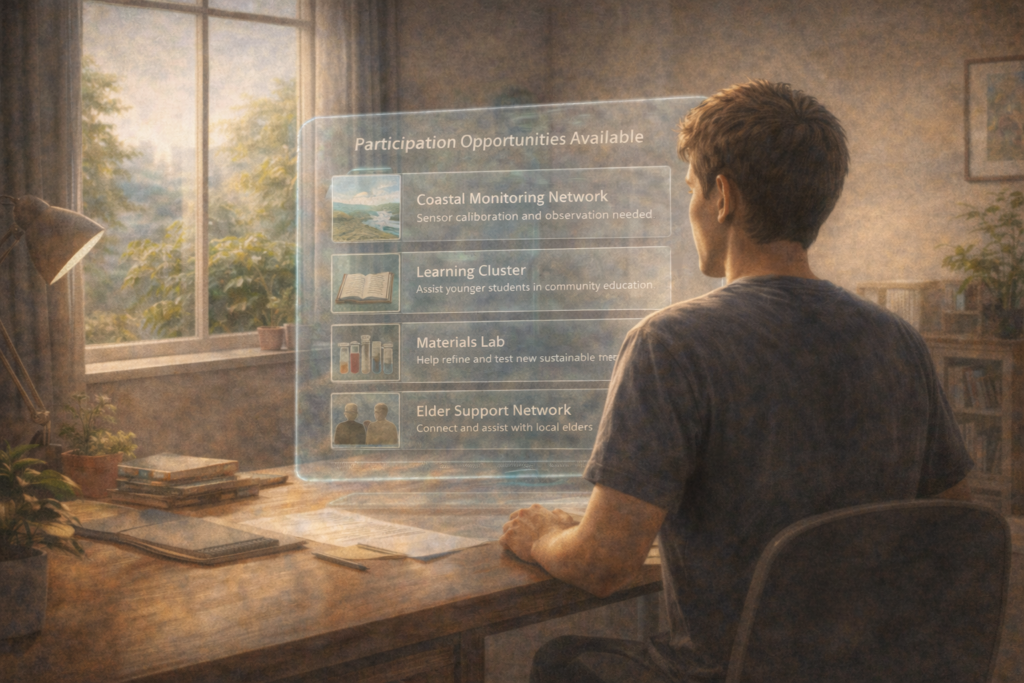
Date: Mid-21st Century
Location: Former corporate offices, homes, distributed workspaces, planetary coordination layer
Weather: Clear skies, no beginning bell
No one noticed the last job posting.
It remained on a quiet server somewhere.
Unanswered.
Unnecessary.
Because work had not disappeared.
But employment—as a gate—had.
For centuries, the employer had stood between humans and their ability to contribute.
Not because contribution required permission.
But because coordination had required intermediaries.
Employers were never the origin of work.
They were the coordinators of its visibility.
________________________________________
When Work Required Permission
In the old world, humans did not contribute directly to need.
They contributed through employment.
A person could see what needed to be done.
Could know how to do it.
Could be ready.
But until an employer validated that readiness, contribution could not begin.
The employer did not create the person’s capability.
They authorized its use.
This created an invisible bottleneck.
Work existed everywhere.
But access to work was filtered.
Not by need.
By organizational structure.
Employment became the bridge between survival and contribution.
Without crossing it, people remained suspended—
capable, but structurally unseen.
________________________________________
The Illusion of Job Creation
Employers were often praised as “job creators.”
But jobs were not created.
Needs were discovered.
Employers coordinated people, tools, and timing to meet those needs.
They assembled continuity where fragmentation existed.
They were necessary.
Because coordination had been incomplete.
Because systems could not yet see capability and need at the same time.
So humans built organizations to compensate for that blindness.
The employer was not the source of work.
The employer was the patch.
________________________________________
When Survival Stopped Depending on Employment
For most of human history, survival had depended on employment.
Without employment, continuity fractured.
Housing disappeared.
Food became uncertain.
Healthcare became inaccessible.
Employment was not merely a pathway to contribution.
It was a gateway to existence.
When planetary coordination matured, this dependency dissolved.
Survival became infrastructure.
Housing continuity existed independently of employment.
Food systems aligned automatically.
Healthcare access became ambient.
No one needed to earn their right to remain.
Participation no longer determined survival.
It determined contribution.
For the first time in human history, humans did not work to live.
They lived—and chose how to contribute.
________________________________________
The Coordination Layer Closed the Gap
When planetary coordination systems matured, they did not assign jobs.
They revealed alignment.
Needs surfaced continuously:
A coastal restoration network required calibration.
A learning cluster needed mentorship.
A materials system required refinement.
A community required support for aging members.
No organization needed to announce these needs.
They became visible automatically.
And people capable of meeting them could see them instantly.
Not as job listings.
As invitations.
Participation available.
No applications.
No approval.
Just visibility.
Just alignment.
________________________________________
How the Young Began Without Being Hired
In the old world, the first job had been the hardest to obtain.
Graduates carried knowledge but lacked validation.
They were capable, but capability alone was insufficient.
An employer had to authorize their beginning.
Without that authorization, potential remained suspended.
In the new world, there was no beginning granted by someone else.
There was only entry.
A graduate could open the coordination layer and see living systems:
A coastal sensor network needing calibration.
A simulation requiring refinement.
A teaching cluster requiring assistance.
They did not submit resumes.
They entered participation.
Their early contributions were small.
Supported.
Observed.
Improved through feedback.
Capability emerged through action.
Not approval.
The first contribution replaced the first job.
And once someone had contributed, they had already begun.
________________________________________
The Last Employer
He had built his company over decades.
Had hired thousands.
Had believed deeply in the responsibility of providing livelihoods.
He did not see himself as a gatekeeper.
He saw himself as a steward.
And for many years, he had been.
But slowly, something changed.
People stopped applying.
Not out of disinterest.
Out of independence.
They were already participating elsewhere.
Already aligned with needs they could see directly.
His company did not collapse.
It transformed.
It became a node within the coordination layer.
Not a gate.
A contributor.
One morning, he reviewed the system.
No hiring queues.
No applicants waiting.
Only active participation.
He realized something profound:
He was no longer employing anyone.
And no one needed him to.
________________________________________
What Happened to Employers
Employers did not disappear.
They became participants.
Builders.
Stewards of systems they had helped create.
They no longer controlled access to contribution.
They contributed alongside others.
Organizations became assemblies.
Not hierarchies.
Leadership remained.
Control dissolved.
Coordination replaced employment.
Participation replaced hiring.
________________________________________
The Structural Sequence Advances
By then, another intermediary had quietly stepped aside.
Trust Replaced Credit ensured survival was not gated by financial extraction.
The Last Billionaire ensured opportunity was not concentrated behind ownership.
The Last Homeless Person ensured no one was excluded from continuity.
The Day Forms Disappeared ensured participation did not require bureaucratic approval.
And now, employment itself ceased to stand between humans and their ability to contribute.
No one needed permission to be useful.
Contribution became direct.
Unmediated.
Continuous.
________________________________________
What Children Could Not Understand
In classrooms, students studied historical artifacts called resumes.
Documents designed to persuade strangers to grant access to contribution.
Children asked:
“Why couldn’t people just help where help was needed?”
Teachers paused.
Because once, visibility had been incomplete.
Capability had been hidden behind organizational boundaries.
Now, capability was ambient.
Always visible.
Always alignable.
Children did not aspire to be hired.
They aspired to participate.
________________________________________
Closing Image
A former office building stands in quiet morning light.
No assigned desks.
No employment contracts.
Just open space.
People enter and leave freely.
Not reporting.
Participating.
On the wall, a small inscription remains:
“Employment was necessary when survival depended on permission.
When survival became infrastructure, participation became enough.”
Outside, the world moves.
No one waiting to be chosen.
Everyone already part of what comes next.