
 0
0
 91 views
Date: Several years after The Day Politics Quietly Ended
Location: Former polling stations, civic halls, planetary coordination networks
Weather: Calm, uneventful
The last election arrived without tension.
No rallies.
No slogans.
No last-minute campaigning.
No predictions scrolling across screens.
For centuries, elections had been the central ritual of political life.
They were the moment citizens transferred authority.
The moment power changed hands.
Or was believed to.
Ballots carried hope.
And fear.
People voted not only for policies—but against those they feared.
Against those they distrusted.
Against those they believed might harm their future.
Elections were designed for a world where governance required representatives.
But by the time the final election arrived, representation itself had already begun to dissolve.
________________________________________
When Politics Quietly Ended
Years earlier, something subtle had already happened.
The chapter historians later called “The Day Politics Quietly Ended.”
It did not happen through revolution.
Or constitutional collapse.
It happened through irrelevance.
As planetary coordination matured, many governmental decisions became automatic.
Environmental monitoring triggered response systems.
Resource flows adjusted dynamically.
Public services aligned with real-time needs.
Healthcare capacity expanded when signals showed strain.
Infrastructure repairs began before formal requests.
Systems did not wait for legislation.
They responded to reality.
Politics, which had once mediated decisions, began to shrink.
Not because democracy was rejected.
But because decision latency was no longer tolerable.
When systems could see reality instantly, waiting years for electoral cycles to adjust policy became irrational.
The political layer slowly thinned.
And with it, the urgency of elections faded.
________________________________________
The Ritual Remained
At first, elections continued.
People voted out of habit.
Out of tradition.
Out of respect for a system that had once protected them from monarchy and tyranny.
Ballot boxes still appeared in schools.
Volunteers still counted votes.
But fewer policies depended on those outcomes.
The world had moved faster than electoral calendars.
Representation began to feel symbolic.
Like reenacting a ritual whose original purpose had already been fulfilled.
________________________________________
When Governance Became Observable
The real change occurred when governance became transparent.
Every citizen could see the functioning of planetary systems.
Energy flows.
Food distribution.
Environmental stability.
Infrastructure performance.
Nothing was hidden behind ministries or party agendas.
If a system malfunctioned, it appeared immediately in the global coordination layer.
And people capable of repairing it participated directly.
Governance shifted from ideological debate—
to operational stewardship.
Not “Which party should rule?”
But:
“What does reality require right now?”
________________________________________
The Last Ballot
The final election took place quietly.
Participation was low.
Not from apathy.
But from clarity.
Most of the decisions that once required elected officials were already handled by coordinated systems and civic participation networks.
The remaining offices were ceremonial.
Observers.
Facilitators.
Not rulers.
When the votes were counted, no one celebrated.
Not because democracy had failed.
But because democracy had matured.
People realized something profound:
They no longer needed to choose rulers.
They needed to choose responsibility.
________________________________________
What Happened to Political Power
Political power did not disappear.
It dispersed.
In the old world, power concentrated in offices.
Presidents.
Prime ministers.
Parliaments.
In the new world, power moved into systems.
Into communities.
Into transparent coordination.
No individual could dominate planetary decisions.
Because the information required to do so was visible to everyone.
Authority became distributed.
Responsibility became shared.
________________________________________
The Final Lesson of Elections
Elections had once protected humanity from tyranny.
They allowed peaceful transfer of power.
They prevented rulers from becoming permanent.
For centuries, that innovation preserved freedom.
But elections had also concealed something deeper.
They allowed citizens to outsource responsibility.
To vote once every few years.
And then return to private life.
The planetary civilization required something else.
Continuous participation.
Not periodic delegation.
The last election did not mark the end of democracy.
It marked its transformation.
Democracy stopped being an event.
It became a condition.
________________________________________
What Children Could Not Understand
In classrooms, students studied election campaigns.
Speeches.
Debates.
Political advertisements.
Children asked:
“Why didn’t people just fix the problems they were arguing about?”
Teachers paused.
Because once, systems were too slow.
Information too fragmented.
Coordination too limited.
Representation had been necessary.
Now participation replaced representation.
And elections became history.
________________________________________
Closing Image
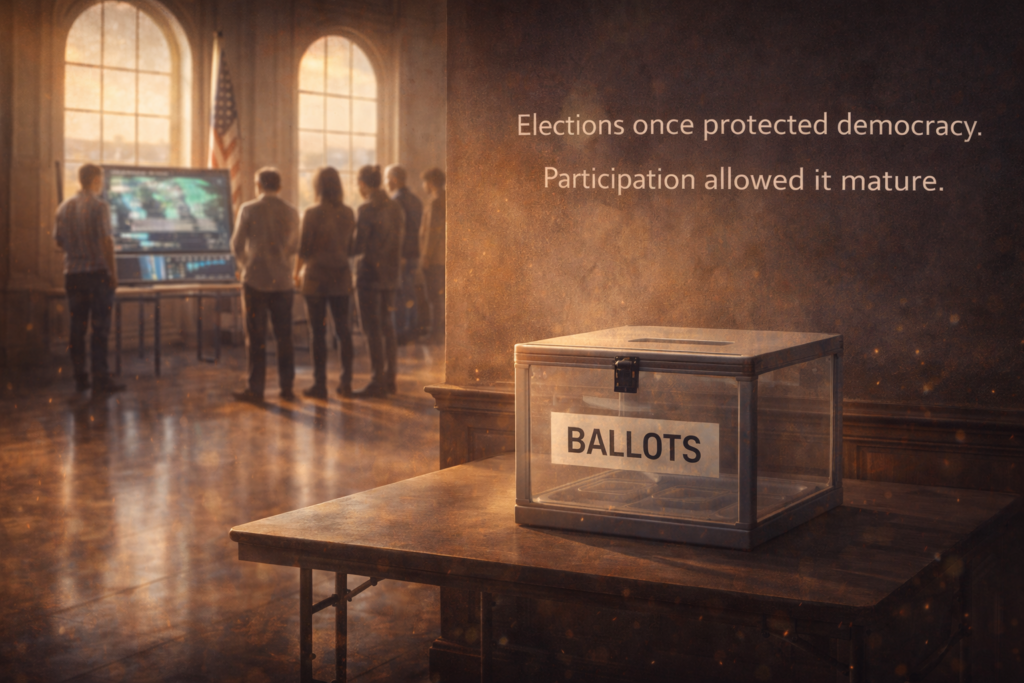
A former polling station sits in quiet afternoon light.
The ballot box remains on a table.
Unused.
Nearby, citizens gather around a shared civic interface.
Discussing.
Repairing.
Participating.
On the wall, a small inscription reads:
“Elections once protected democracy.
Participation allowed it to mature.”
The ballot box remains preserved.
Not as a relic of failure.
But as a reminder of the time when freedom required representatives.
Now freedom requires presence.