
 0
0
 164 views
Date: 2050–2052
Location: Markets, classrooms, transit platforms, first conversations
Weather: Soft mornings, conversational air
Civilizations do not announce when they change.
They change the questions people ask.
Before laws shift.
Before borders fall.
Before institutions dissolve.
Language moves first.
Quietly.
________________________________________
The Old First Question
For most of human history, the first question between strangers had been:
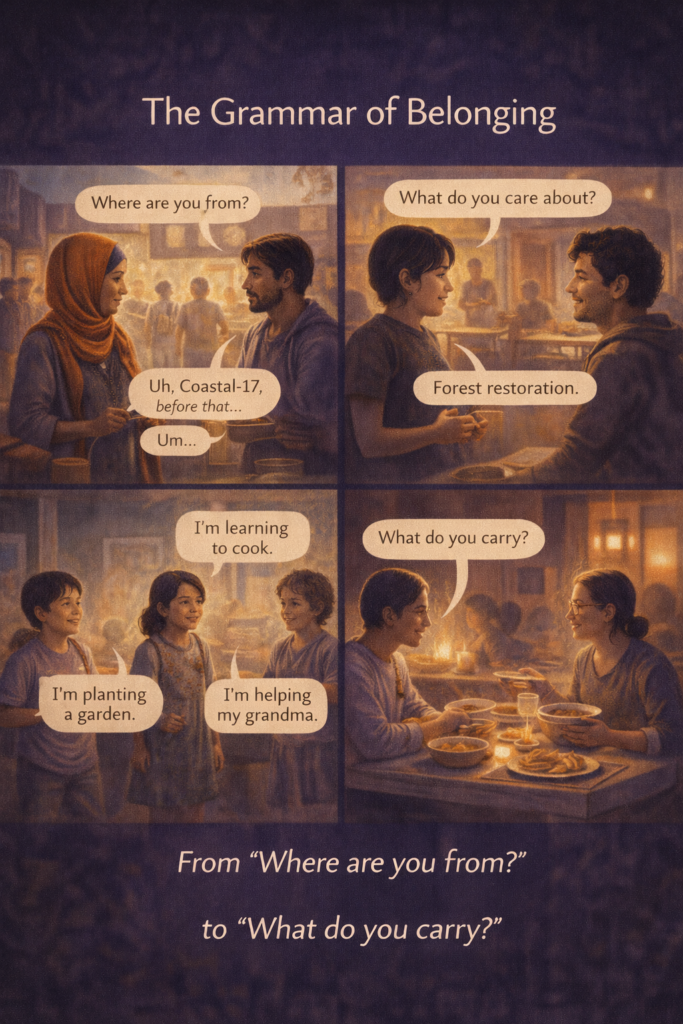
“Where are you from?”
It sounded harmless.
It was not.
Inside that question lived assumptions:
You belong somewhere else.
You are explainable by origin.
Your past defines your permissions.
No one had invented it with malice.
It emerged from a world organized by containers.
Countries.
Tribes.
Races.
Classes.
Everything needed a box.
________________________________________
The Question That Started Sounding Strange
In the planetary era, the question did not become illegal.
It became awkward.
People still asked it sometimes.
They just noticed something:
The answers no longer helped.
“I’m from Coastal-17.”
“Before that?”
“Several places.”
“Oh. I meant… originally.”
Originally when?
Originally how far back?
Originally according to whom?
The question collapsed under its own weight.
________________________________________
What Replaced It
The new first questions emerged organically.
Not through policy.
Not through reform.
Through habit.
“What do you care about?”
“What are you working on lately?”
“What places have shaped you?”
“What do you like to grow?”
Sometimes:
“What do you carry?”
None of these demanded a label.
They invited a story.
________________________________________
Identity Shifted From Noun to Verb
Old world identity:
“I am a teacher.”
“I am French.”
“I am Muslim.”
“I am working class.”
New world identity:
“I teach.”
“I study.”
“I restore.”
“I’m learning how to listen better.”
Being became doing.
Static nouns became moving verbs.
No single sentence could summarize a person anymore.
Which turned out to be accurate.
________________________________________
School Introductions
On the first day of learning cycle, children introduced themselves.
Not with names first.
With sentences.
“I’m building a small garden.”
“I like quiet animals.”
“I’m trying to learn patience.”
“I help my grandmother with stories.”
Names came later.
Names were useful.
They were no longer destiny.
________________________________________
Forms Lost Their Boxes
Old forms asked:
Nationality
Race
Religion
Ethnicity
New forms asked:
Languages you use
Skills you practice
Things you want to learn
Things you can teach
There was no field for “what are you.”
Only fields for “what are you becoming.”
Forms no longer organized people by profession alone.
They organized people by capacity.
Some became listeners.
Some became restorers.
Some became translators of conflict.
Some became stewards of fragile systems.
In an AI-saturated world, the rarest human skill was no longer calculation or recall — it was moral judgment: the ability to sense right from wrong when no rulebook could decide.
When intelligence became abundant, conscience became the differentiator.
The future did not belong to those who knew the most, but to those who could judge the best.
________________________________________
Accent Stopped Signaling Status
Accents used to reveal:
Outsider
Insider
Educated
Uneducated
Now accents revealed only:
Path.
Every accent meant:
This person has traveled.
Travel was normal.
So accents became neutral.
Sometimes beautiful.
Never disqualifying.
________________________________________
Pronouns Became Less Important Than Verbs
People still used pronouns.
They mattered.
But they were no longer the center.
Conversation shifted toward action:
“They helped me fix the roof.”
“She stayed late to finish planting.”
“He brought soup.”
Who someone was mattered less than what they did with others.
________________________________________
The Death of “What Are You?”
Children encountered the phrase in old recordings.
They laughed.
“What kind of question is that?”
Adults tried to explain.
“It meant race.”
“What’s race?”
“Skin color plus history.”
“Why would you ask that first?”
No one had a good answer.
The phrase slowly exited speech.
Not banned.
Abandoned.
________________________________________
A New Compliment Structure
Old compliments:
“You’re very successful.”
“You’re very important.”
“You’re powerful.”
New compliments:
“You’re good to work with.”
“You make people calmer.”
“You notice things others miss.”
“You’re reliable.”
Belonging shifted from status to impact.
________________________________________
Conflict Language Changed Too
Old world:
“You people always…”
New world:
“When you did X, I felt Y.”
Group accusation collapsed.
Experience language replaced it.
This did not eliminate conflict.
But it prevented instant tribalization.
Which was most of the battle.
________________________________________
The Children Coin a Sentence
A child writes in a notebook:
“I am not from a place.
I am from my steps.”
The teacher does not correct it.
________________________________________
What This Grammar Does
It removes shortcuts.
You cannot place someone in a mental box quickly.
You must listen.
Listening takes time.
Time creates friction.
Friction slows judgment.
Slower judgment creates space.
Space allows relationship.
This grammar does not make people kinder.
It makes cruelty harder.
That is enough.
________________________________________
Closing Image
Two strangers sit at a small table.
One asks:
“What do you carry?”
The other thinks.
Then says:
“I carry a good soup recipe,
a stubborn sense of fairness,
and a half-finished apology.”
The first person nods.
“That sounds heavy.”
“Some days.”
They begin talking.
No origins.
No categories.
Just unfolding.