
 0
0
 165 views
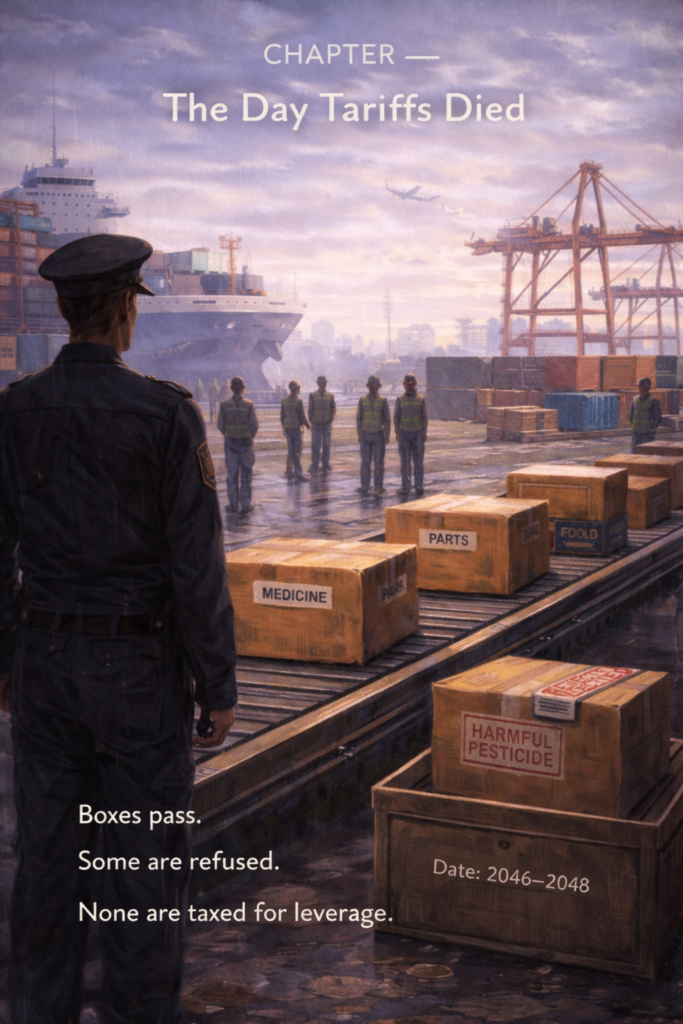
Date: 2046-2048
Location: Ports, trade corridors, customs halls, quiet conference rooms
Weather: Gray mornings, steady light, no thunder
The day tariffs died, no treaty was signed.
No leader stood at a podium.
No anthem played.
No declaration announced the end of economic warfare.
Ships still docked.
Trucks still crossed borders.
Containers still moved.
Nothing stopped.
Something simply… stopped mattering.
________________________________________
When Tariffs Stopped Feeling Like Protection
For decades, tariffs had been framed as shields.
Protect domestic jobs.
Protect national industry.
Protect sovereignty.
But by the mid-2040s, a pattern had become impossible to ignore:
Tariffs did not protect people.
They protected bargaining positions.
Prices rose.
Supply chains twisted.
Small producers collapsed.
Meanwhile, the largest actors adapted easily.
The intended pain rarely reached its target.
The unintended pain always reached households.
________________________________________
The Quiet Question
The shift did not begin in ministries.
It began in logistics rooms.
A shipping analyst in Rotterdam asked during a routine meeting:
“Can someone show me a tariff that reduced suffering?”
No one could.
Another analyst added:
“We keep calling this leverage, but it behaves like friction.”
Friction slowed everything.
Including relief.
Including food.
Including medicine.
The word “leverage” started to feel dishonest.
________________________________________
The Human Cost Becomes Visible
Resonance systems began publishing something new:
Tariff Impact Traces.
Not GDP curves.
Not revenue tables.
Faces.
Maps showing:
• which neighborhoods absorbed price shocks
• which clinics delayed supplies
• which schools lost materials
People could see exactly who paid.
It wasn’t abstract.
It was specific.
And it was repetitive.
The same groups, over and over.
________________________________________
The Sentence That Spread
A dockworker in Buenos Aires was interviewed after a shipment of dialysis equipment sat idle due to a tariff dispute.
He said:
“I don’t know what country this box is from.
I know who needs it.”
The clip spread everywhere.
Not because it was dramatic.
Because it was boring.
And boring truth travels far.
________________________________________
When Trade Stopped Being a Moral Theater
Economists had long framed tariffs as strategic tools.
But strategy presumes adversaries.
More and more people began asking:
“Why are we pretending trade is a battlefield?”
No one at ports felt like soldiers.
They felt like handlers of necessities.
Food.
Parts.
Medicine.
Tools.
None of it behaved like weapons.
________________________________________
The Systems Change the Question
The global coordination engines introduced a new prompt in trade negotiations:
Who absorbs the first wave of harm?
Every scenario ran that question first.
Not profitability.
Not leverage.
Not advantage.
Harm.
Negotiators noticed something unsettling.
Tariff-based proposals failed this test almost universally.
They always harmed someone far from the negotiating table.
Which meant:
Tariffs were not instruments of accountability.
They were instruments of displacement.
________________________________________
The First Country to Blink
A mid-sized manufacturing nation quietly removed three tariffs.
No announcement.
Just updated customs tables.
Nothing collapsed.
No industry vanished.
Prices dropped slightly.
Supply stabilized.
Other countries noticed.
They ran simulations.
Same result.
The catastrophic narratives didn’t appear.
The absence of catastrophe became persuasive.
________________________________________
The Domino That Wasn’t a Domino
There was no cascade.
No dramatic wave.
Countries simply stopped adding new tariffs.
Then they began trimming old ones.
Trade agreements started omitting tariff chapters entirely.
Instead, they emphasized:
• labor standards
• environmental thresholds
• traceability
• repairability requirements
Trade conditions replaced trade punishments.
This was new.
________________________________________
What Replaced Tariffs
Not “free trade.”
That phrase carried too much historical baggage.
What emerged instead was:
Conditional Flow
Goods moved freely if they met shared ethical baselines.
If they didn’t, they weren’t taxed.
They were rejected.
Not punished.
Not priced.
Refused.
The difference mattered.
Refusal said:
“This doesn’t belong in our shared system.”
Tariffs had said:
“This belongs, but we will hurt someone over it.”
People realized how strange that second logic was.
________________________________________
The Children Name It
In a school forum, a student summarized:
“So tariffs were like charging a fee for doing something wrong…
but still letting it happen?”
A teacher nodded.
The child frowned.
“That sounds fake.”
No one disagreed.
________________________________________
The Last Tariff Dispute
The final high-profile tariff conflict involved agricultural equipment.
Two blocs threatened reciprocal duties.
Before implementation, the coordination system published a harm trace:
Projected casualties from delayed food production.
Not economic casualties.
Human ones.
The proposal was withdrawn within hours.
No replacement tariff was offered.
Silence followed.
Not tense silence.
Resolved silence.
That was the day tariffs died.
________________________________________
What Died With Them
The idea that suffering is an acceptable negotiation tool.
The belief that pain can be strategically outsourced.
The fantasy that complex systems can be corrected through blunt instruments.
________________________________________
What Survived
Trade.
Markets.
Competition.
Profit.
None of these disappeared.
They simply lost their permission to hide behind indirect cruelty.
________________________________________
Closing Image
A customs terminal.
The word “Tariff” still exists in old software menus.
No one clicks it.
New officers are trained on a different question:
“Does this belong in a world that claims to reduce harm?”
Boxes pass.
Some are refused.
None are taxed for the sake of leverage.
And somewhere along the supply chain, someone receives medicine on time.
No one calls it a revolution.
They call it logistics.
Which is exactly the point.