
 0
0
 205 views
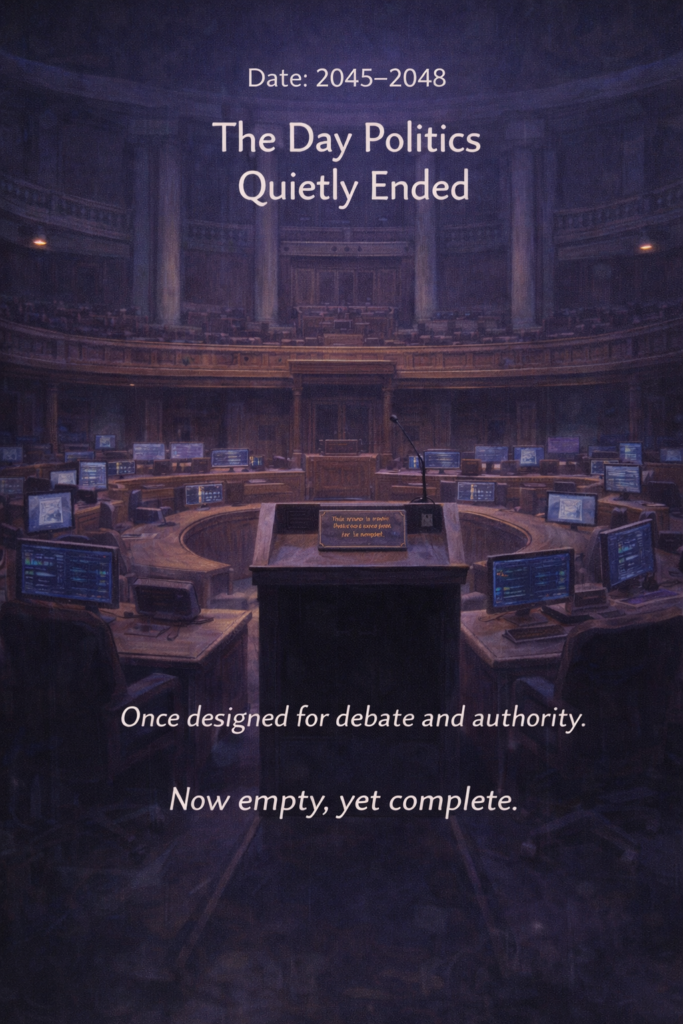
Date: 2045–2048, Fifteen years after the Accord
Location: Former parliaments, distributed networks, local assemblies
Weather: Long stable seasons, fewer emergency sirens, ordinary skies
Politics did not collapse.
There was no coup.
No final election.
No dramatic abolition.
One day, people simply stopped needing politicians.
At first, no one noticed.
________________________________________
The Problem Politics Was Built to Solve
For centuries, politics had existed for three core reasons:
• To aggregate human preferences (e.g. To translate countless personal desires into a shared direction)
• To negotiate competing interests
• To decide under uncertainty
Humans lacked shared visibility.
They lacked real-time feedback.
They lacked scalable memory.
So they invented representatives.
People who spoke for others.
People who decided instead of others.
People who promised to translate complexity into authority.
For a long time, this was the best available approximation.
Then approximation stopped being sufficient.
Instead of asking:
“Who do you vote for?”
They ask continuously:
• How much do you care about housing vs environment?
• What tradeoffs are you willing to accept?
• What outcomes feel fair to you?
• What harms are unacceptable?
They then:
• Collect millions of such signals
• Detect patterns
• Combine them mathematically
• Produce collective preference maps
This is aggregation at high resolution.
________________________________________
When Representation Became Redundant
By the mid-2040s, every citizen already had:
• Continuous access to policy simulations
• Transparent tradeoff visualizations
• Real-time impact projections
• Direct participation channels
Nothing was hidden anymore.
In early history:
Humans → elect representatives → who guess preferences.
In your future:
AI → continuously measures preferences → no guessing needed.
Thus politicians become redundant.
Budgets were not speeches.
They were living models.
Policies were not slogans.
They were interactive scenarios.
If a housing policy was proposed, people could see:
Who gained.
Who paid.
Who was displaced.
Who benefited long-term.
No interpretation layer required.
Politicians had once been interpreters.
Now interpretation was interactive.
Their central function quietly dissolved.
________________________________________
The End of Persuasion as Power
Political power had always rested on persuasion:
• Persuading voters
• Persuading donors
• Persuading factions
• Persuading allies
But persuasion depended on asymmetry.
Someone had more information.
Someone controlled narrative.
Someone framed reality.
That asymmetry vanished.
AI-driven consensus engines did not persuade.
They exposed.
They showed consequence.
They displayed tradeoffs without rhetoric.
They did not say:
“This is good.”
They said:
“If you choose this, here is what happens.”
Charisma lost its leverage.
Certainty lost its glamour.
Only consequences remained.
________________________________________
Why AI Replaced Politicians (But Not Humans)
The systems did not govern.
They did not rule.
They did not command.
They performed three functions better than any human institution ever had:
1. Continuous Aggregation
Preferences updated in real time, not every four or five years.
2. Tradeoff Transparency
Every decision carried visible cost vectors.
3. Constraint Enforcement
Ecological limits, resource ceilings, and human rights floors were non-negotiable parameters.
The systems could not promise.
They could not posture.
They could not lie.
They simply mapped reality.
Politicians had thrived in ambiguity.
AI eliminated ambiguity.
Not by declaring truth.
By revealing structure.
________________________________________
The Moment Campaigns Stopped Working
The last major political campaigns were strangely empty.
Candidates still toured.
They still debated.
They still spoke.
But audiences no longer reacted.
Not angrily.
Not enthusiastically.
Indifferently.
After speeches, people opened simulations.
After promises, they checked projections.
After slogans, they looked at constraint graphs.
A reporter asked a young woman why she wasn’t excited about the election.
She answered:
“What would they add?”
That clip ended political theater.
Not by outrage.
By irrelevance.
________________________________________
Governments Did Not Disappear
They transformed.
Ministries became:
• Systems stewardship offices
• Constraint maintenance bodies
• Oversight councils
Their role was no longer to decide.
Their role was to:
Maintain models
Audit assumptions
Protect minority constraints
Ensure system integrity
No ministers announced futures.
Futures were simulated.
Humans selected among them.
________________________________________
Nations Became Administrative Regions
With wars ended, borders stabilized.
With borders stabilized, emotional attachment faded.
People still said where they lived.
They no longer said who they were because of it.
Nationality shifted from identity to routing label.
Like a timezone.
Useful.
Not sacred.
Flags became municipal artifacts.
Cultural.
Historical.
Non-binding.
________________________________________
The New Shape of Legitimacy
Old legitimacy:
“I was elected.”
New legitimacy:
“The system shows this path minimizes harm.”
Old authority:
“Follow me.”
New authority:
“Here is the consequence map.”
Old power:
“I decide.”
New power:
“You choose with visibility.”
No single actor held control.
Not politicians.
Not AI.
Not councils.
Legitimacy emerged from shared inspection.
________________________________________
Why People Accepted This So Easily
Because it felt boring.
No rallies.
No revolutions.
No heroic narrative.
Life simply became quieter.
Fewer scandals.
Fewer emergencies.
Fewer performative crises.
Drama had been a side effect of opacity.
Opacity was gone.
________________________________________
The First Generation Without Political Identity
Children stopped saying:
“I want to be president.”
They said:
“I want to design climate constraints.”
“I want to tune housing models.”
“I want to audit fairness parameters.”
They did not want to rule people.
They wanted to shape systems.
Power had migrated.
Not upward.
Not downward.
Sideways.
Into structure.
________________________________________
What Politics Had Secretly Been All Along
Late in the transition, an old scholar wrote:
“Politics was never about governing humans.
It was about managing information scarcity.
Now scarcity is gone.
So politics is done.”
The essay went largely unread.
Because no one felt the need to argue.
________________________________________
Closing Image
An abandoned parliamentary chamber.
Desks still arranged in arcs.
Microphones still installed.
Lights still functional.
But no sessions scheduled.
On a small plaque near the entrance, someone has written:
This room is not broken.
It is complete.