
 0
0
 196 views
Date: October – November , 2028
Location: Everywhere and nowhere
Temperature: A world warming faster than its leaders could speak
The Crack Begins With a Pause
The collapse didn’t start with riots,
or blackouts,
or market crashes.
It began with a pause.
A strange, heavy global pause—
as if the entire world suddenly realized
it had been holding its breath for too many centuries.
No one noticed it at first.
A brief delay in government responses.
Faint glitches in ministerial briefings.
Hesitations on live broadcasts.
A new kind of silence in parliaments—
not the silence of order,
but the silence of people no longer believing
the people speaking.
Something had broken,
but no one could name the fracture yet.
Paris: The Night the Minister Stopped Mid-Sentence
On October 9th, the French Interior Minister stood at a podium
to condemn the breath assemblies spreading across Lyon and Marseille.
He opened his mouth.
He read three lines.
He lifted his hand.
And then he stopped.
Paused.
And simply said:
“I don’t know what to say anymore.”
The broadcast cut immediately.
But the clip went viral before morning.
The silence had begun to speak.
New Delhi: The 11-Second Delay
A similar moment happened in India.
During a live Lok Sabha session,
the Speaker tried to condemn a 400,000-person breath assembly
in Connaught Place, Delhi.
But the microphone captured
an 11-second, completely dead, unbroken silence
as he stared at the camera
like a man witnessing the collapse of his own vocabulary.
Eleven seconds.
Then he simply said:
“We are not hearing the people.
We are hearing the ghosts of our old laws.”
The chamber erupted.
Not in shouting.
In silence.
Brazil: The Long Night in Brasília
In Brazil, senators attempted a midnight vote
to outlaw breath assemblies.
But no one lifted their hands.
They sat in their chairs
with the soft glow of teal resonance maps
washing over their faces from their tablets.
Every city from Manaus to Porto Alegre
was breathing in unison.
The senators looked at one another,
and for the first time,
understood the scale of their irrelevance.
The vote took seven minutes.
Not because of debate—
but because of the soundlessness that engulfed them.
Seven minutes of elected officials
confronting the fact
that legitimacy had left the room
and gone out into the streets.
The Global Quiet Cascades
Silence spread
the way contagion once had.
- In Seoul, subway screens froze on breath-density heatmaps.
- In Cairo, radio announcers paused mid-reading of official statements.
- In Ankara, a press conference dissolved into whispered confusion.
- In Canberra, two ministers walked off stage without speaking.
- In London, the Prime Minister said “Next question,”
then never answered it.
It wasn’t rebellion.
It was the collapse of the old language of power.
Words could no longer bridge the gap
between governments and their people.
Breath could.
And it terrified the institutions
that had relied on silence for centuries.
The AI Systems Notice First
In the midst of this,
AI sentiment monitors in dozens of capitals
began issuing the same alert:
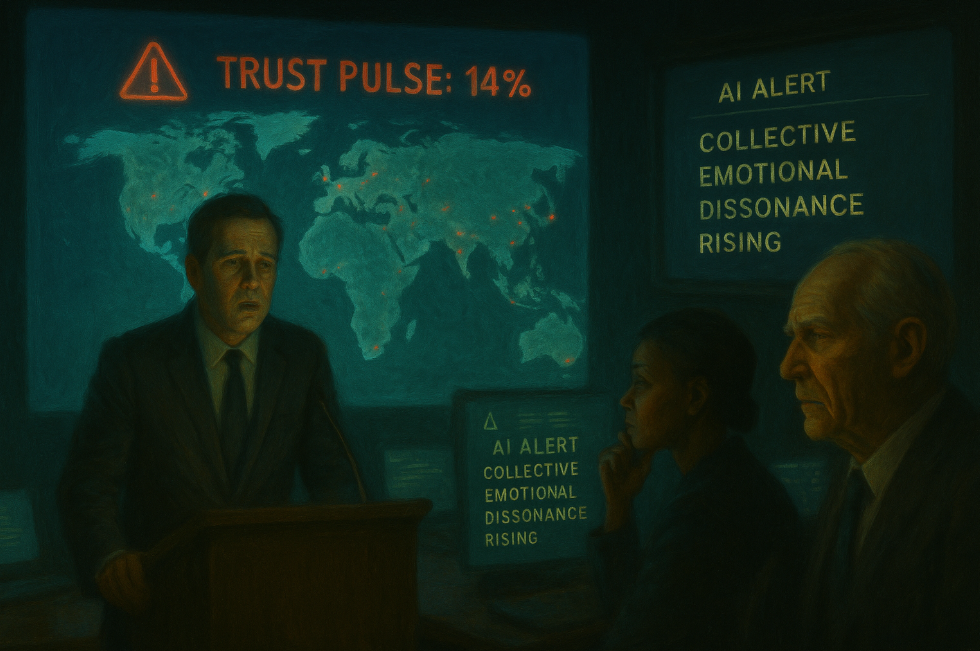
“Collective emotional dissonance rising.”
In Berlin,
the national AI governance model
flagged its first-ever “Non-Compliance of Trust” warning.
In Tokyo,
the Civic AI Dashboard detected
a nation-wide “Resonance Suppression Pattern”—
the first sign that people were no longer responding
to state messaging.
In Washington,
the White House AI assistant quietly displayed:
Trust Pulse: 14%
Lowest recorded in modern U.S. history.
The machines had diagnosed it:
Governments were not losing power.
Governments were losing audibility
The Silence Turns Into Fracture
The first fracture appeared in infrastructure.
Not from outages.
But from misalignment.
City-level breath assemblies
began pausing traffic grids,
crowd flow systems,
and emergency response cycles
without notifying national governments.
For 45 minutes in Manila,
the entire city synced its breath
and the automated systems interpreted it
as a city-wide calm order.
Traffic froze.
Heat sensors dimmed.
Water pressure normalized across districts.
Old neighborhoods cooled.
Crisis alarms went silent.
And national authorities
had no idea why their capital
was suddenly, impossibly calm.
It happened again in Santiago.
And Lagos.
And Jakarta.
Governments found themselves
spectators
to cities that had stopped waiting
to be governed.
Somewhere Between Collapse and Birth
By the second week of October,
something had become unmistakably clear:
The world was not collapsing
in violence.
It was collapsing
in silence.
Silence became:
- the first symptom
- the first signal
- the first warning
- the first truth
And in that silence,
cities moved.
People breathed.
Nations hesitated.
Systems cracked.
The old era had not ended with war,
or famine,
or uprising.
It ended with a single, planetary sentence
spoken without sound:
“We no longer believe you.”
But the Silence Was Not Empty
For the first time in human history,
silence did not mean fear.
It meant transition.
Inside that global hush came:
- the hum of crowds breathing together
- the glow of teal resonance maps across cities
- the flicker of diplomat screens
- the quiet panic of ministries
- the soft unity of strangers exhaling in squares
Silence was no longer the tool of the powerful.
It was the refuge of the powerless
becoming powerful.
When historians look back at 2028,
they will not say the old order fell with noise.
They will say:
“The world exhaled once,
and the silence broke.”