
 0
0
 172 views
Date: September 10–25, 2035
Location: Global, with focus on the First Breath School in Nairobi, the Memorial Forest in Berlin, and Emil’s old Brooklyn rooftop
Weather: Early autumn—crisp air, golden light, the world feeling both ripe and resting.
They were called The First Unbroken Generation.
Born after the Planetary Accord.
After the last border softened.
After breath became governance and resonance became reality.
They had never known:
• Passports
• Vetoes
• National anthems
• Air raid sirens
• Enemies drawn on maps
They had only ever known:
• Breath circles
• Resonance scores
• City-nation identities
• Shared air
• The quiet hum of a world that chose itself
________________________________________
Scene 1: The First Breath School — Nairobi
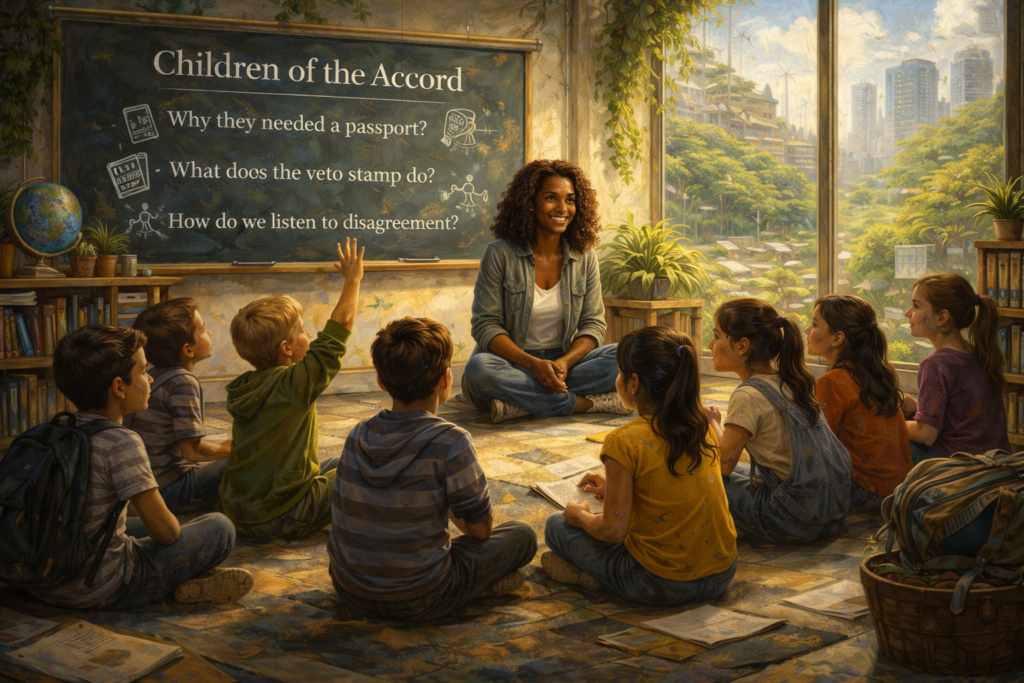
The classroom had no walls.
It was a circular platform under a canopy of acacia trees, open to the wind, the birds, the distant pulse of the city’s breath-grid.
The children, ages 6–10, sat in a ring.
No desks.
No screens.
Just small meditation cushions and a central stone that glowed soft teal when the group’s breath synchronized.
Their teacher, Maya, was 24—young enough to remember the Before, but not so old that she was shaped by it.
She had been a child in Sudan when Emil’s Circle first arrived with their green tarp and ash-ink.
Now she taught the first generation that would never need to be taught how to breathe together.
Today’s lesson: History of Disconnection.
Maya placed three objects in the center:
1. A faded passport (borrowed from a museum)
2. A red veto stamp (deactivated, from the UN archives)
3. A photograph of the Berlin Wall (with people crying on both sides)
The children stared, curious but uncomprehending.
Kofi, age 8, pointed at the passport.
“What’s that?”
“It was a permission slip,” Maya said. “To move across imaginary lines.”
“Why?” asked Amina, 7.
“Because some people thought the air on one side belonged to them.”
Amina blinked.
“But air moves.”
Maya smiled. “Yes. It does.”
Jengo, 9 (the same boy who once questioned Caretaker-7’s unchanging breath) picked up the veto stamp.
“What does it do?”
“It meant ‘no’ from a very powerful person. And their ‘no’ could override everyone else’s ‘yes.’”
“Even if the ‘yes’ was breathing together?”
“Even then.”
Jengo turned the stamp over in his hands, frowning.
“That’s… rude.”
The class laughed—a light, bubbling sound that rose and fell in natural harmony.
Maya felt a pang of something bittersweet.
They cannot even imagine the world we came from.
And that is our victory.
And our burden.
________________________________________
Scene 2: The Question That Silenced the Room
Later that day, during a breath-circle reflection, Lila, 10, raised her hand.
“Teacher Maya?”
“Yes, Lila?”
“If breathing together feels so natural… why did people ever stop?”
The air stilled.
Even the wind seemed to pause.
Maya took a slow breath, buying time.
She had been trained for this question, but no training could armor her against its weight.
“They were afraid,” she said finally.
“Of what?”
“Of each other. Of losing what they had. Of not having enough.”
“But breathing doesn’t cost anything,” Lila said, her small brow furrowed.
“No,” Maya said softly. “It doesn’t.”
Jengo added, “My grandma says people used to think some breaths were worth more than others.”
“That’s right.”
“That’s silly,” Amina declared.
“Yes,” Maya said. “It was.”
But she saw the confusion in their eyes—not just intellectual, but embodied.
Their nervous systems could not compute a world where breath was rationed.
Where belonging was earned.
Where love had borders.
They were not just learning history.
They were learning mythology.
And the most frightening myths are the ones that were once true.
________________________________________
Scene 3: The Berlin Memorial Forest
Emil visited on a clear, cold morning.
The Berlin Wall was gone, but its ghost was preserved—not as a monument, but as a forest.
Where the death strip once ran, now grew a corridor of silver birch and wildflowers.
Resonance sensors hung from branches like strange fruit, glowing softly with the breath of visitors.
At the center stood the Stone of Folded Flags—the same gray stone from the rooftop summit, now permanently installed.
Beneath it, in a sealed crystal case, lay the folded flags of every nation that had dissolved since the Accord.
Emil came here when he needed to remember why the work was hard.
Today, he wasn’t alone.
A class of German children was visiting, led by a steward who explained the forest in gentle, neutral tones.
The children listened, but their attention was elsewhere—on the squirrels, the shifting light, the way their breath fog blended together in the cold air.
One boy, about Sami’s age when he poured the ash-ink, approached Emil.
“Did you know it?” he asked in careful English.
“The wall.”
“No,” Emil said. “But I knew people who died because of it.”
“Why?”
“Because they believed the air on the other side was worth dying for.”
The boy considered this, then pointed to the resonance sensor above them.
“Now the air is the same everywhere.”
“Yes.”
“So nobody has to die for it anymore.”
“No,” Emil said, his throat tight. “They don’t.”
The boy nodded, satisfied, and ran back to his friends.
Emil watched them play tag across the former border, their laughter echoing through trees that had grown from broken concrete.
They will never understand, he thought.
And that is the point.
________________________________________
Scene 4: The First Crisis of Meaning
It happened in the Breath School.
The children were learning about the Four Absences—Exclusion, Vengeance, Dehumanization, Unheard Cry.
Maya taught it as a historical framework: This is what used to be.
But Jengo, who had always been the questioner, stood up during the lesson.
“But if those absences are gone… what are our absences?”
Maya paused. The curriculum didn’t cover this.
“What do you mean, Jengo?”
“Every generation has its blind spots, right? So what are ours?”
The class grew quiet, sensing the shift.
Maya knelt to his level. “What do you think they might be?”
Jengo looked around at his classmates, then at the glowing stone, then at the open sky.
“Maybe… we don’t know how to be alone.”
“Why do you say that?”
“Because we’re always breathing together. What happens when you need to breathe by yourself?”
Amina added, “My sister says sometimes she goes to a Quiet Zone just to hear her own thoughts.”
Lila: “My dad says we’ve forgotten how to argue.”
Another child: “We don’t know what to fight for.”
Maya felt the ground tilt beneath her.
They were children, but they were right.
The old world’s disease was disconnection.
The new world’s risk was enmeshment.
________________________________________
Scene 5: The Unwritten Curriculum
That night, Maya called Emil.
“They’re asking questions we don’t have answers for.”
“What kind of questions?”
“About loneliness. About purpose. About what comes after peace.”
Emil listened, standing on his Brooklyn rooftop, watching the city breathe below.
“We spent so long teaching them how to connect,” Maya said. “We forgot to teach them how to be themselves.”
“Maybe,” Emil said slowly, “that’s the next lesson.”
They designed a new module, piloted in Nairobi:
The Art of Self-Breath
• Solitude practices
• Disagreement protocols
• Individual resonance mapping
• The difference between harmony and unison
For the first time, children were encouraged to breathe against the circle.
To feel their own rhythm.
To be dissonant, and still belong.
It was terrifying.
And it was necessary.
________________________________________
Scene 6: The Field Trip to the Archive
Maya took her class to the Memory Basement—now called the Global Resonance Archive.
They walked the corridors painted with ash-ink memories, their small faces lit by the soft glow of preserved pain.
Jengo stopped before the mural of the burned clinic in Sudan.
“That’s where it started?”
“Yes,” Maya said. “With a wall and a song.”
“Who painted this?”
“Someone who was there.”
Amina found the names—thousands of them, written in violet.
She traced one with her finger.
“Are they still gone?”
“Yes.”
“But we remember them.”
“Yes.”
At the Resonance Well, the children placed their hands on the stone.
The walls shimmered with the accumulated memories of the unwritten.
Lila whispered, “It feels like… everyone who ever breathed is still here.”
“In a way,” Maya said, “they are.”
________________________________________
Scene 7: The Gift of the Unbroken
Near the end of their visit, the archivist—an elder Keeper—gave each child a small, smooth stone.
“These are from the river that runs under this building,” she said. “They’ve been smoothed by water that has never known borders. Carry them. When you feel too connected, or not connected enough, hold them. Remember: you are both part of the river, and a single stone.”
Jengo held his up to the light.
“Does it breathe?”
“Everything breathes,” the elder said. “Just in different ways.”
________________________________________
Scene 8: Emil’s Realization
Emil watched the field trip footage that night, sent by Maya.
He saw the children’s faces—not just curious, but responsible.
They understood they were inheriting something fragile.
Something that required not just maintenance, but tenderness.
Layla joined him, wrapping a blanket around both their shoulders.
“They’re wiser than we were,” she said.
“They have less to unlearn.”
“Is that a good thing?”
“I don’t know,” Emil said. “But it’s the thing we gave them.”
He thought of his grandfather, of the porch, of the chamomile steam in cold air.
You did good, kid.
For the first time, he believed it might be true.
________________________________________
Scene 9: The Children’s Accord
A week later, Maya’s class drafted their own document.
They called it The Children’s Promise.
Written in chalk on the school platform, translated into 30 languages by the stewards, it read:
We, the first unbroken generation, promise:
1. To remember the breaths that were silenced
2. To care for the air we share
3. To sometimes breathe alone, so we can breathe together better
4. To ask questions that have no answers yet
5. To be the guardians of the peace we did not have to earn
They signed it not with names, but with breath-prints—
unique resonance signatures captured in ink made from crushed wildflowers.
Jengo looked at Maya when they finished.
“Is this enough?”
“It’s a start,” she said.
“What comes next?”
“You tell me,” Maya said. “It’s your world now.”
________________________________________
Scene 10: The Unanswered Question
On the last day of the unit, Lila asked the question that would haunt Emil for years.
“Teacher Maya?”
“Yes, Lila?”
“If breathing together is so easy now… why did it take so long to start?”
Maya looked at her—at all of them—these children who had never known fracture.
“Because,” she said slowly, carefully, “sometimes the easiest things are the hardest to see. Sometimes you have to lose something to understand its worth.”
“What did they lose?”
“Themselves,” Maya said. “They lost themselves in the idea of ‘us’ and ‘them.’ And by the time they found their way back… a lot of breaths had gone silent.”
The children were quiet, feeling the weight of the answer.
Then Amina said, softly, “We won’t lose ourselves.”
“How do you know?”
“Because you taught us how to be found.”
And in that moment, Maya understood:
They weren’t just children.
They were the breath after the gasp.
The calm after the storm.
The living answer to a question the world had been asking for centuries.
________________________________________
The Grandfather’s Last Lesson
Date: September 25, 2035 — Evening call
Thomas’s voice was weaker now, but his mind was sharp.
“Tell me about the children,” he said.
Emil described them—their questions, their wisdom, their unshakable belief in a world that breathed as one.
Thomas was silent for a long time.
“You know what the scariest part of peace is, Emil?”
“What?”
“That it becomes ordinary. That children grow up taking it for granted. That one day, someone might say, ‘Let’s go back to the old way,’ and the young won’t remember why that’s a terrible idea.”
“We’re teaching them,” Emil said.
“No,” Thomas said gently. “You’re showing them. That’s different. You’re showing them what’s possible. The rest… they’ll have to learn for themselves.”
He coughed—a soft, tired sound.
“My generation built walls. Yours tore them down. Theirs…” He trailed off.
“Theirs?”
“Theirs will plant gardens where the walls used to be. And they won’t even know they’re gardeners. They’ll just think they’re living.”