
 0
0
 240 views
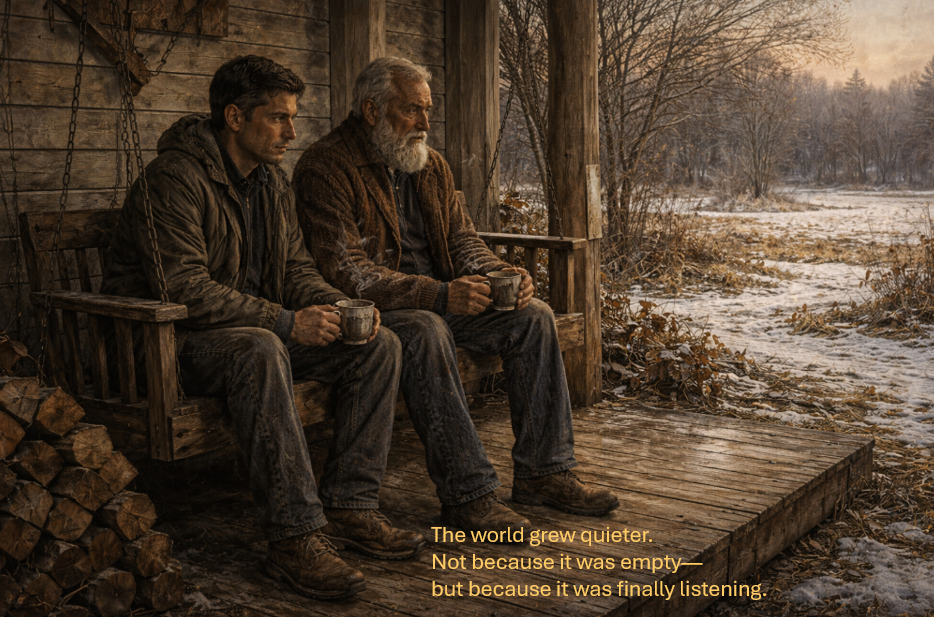
Date: February 23, 2031
Location: Thomas’s porch— the same house, the same creaking swing, the same smell of old wood and cold earth
Emil arrived without announcement.
His grandfather was already on the porch, two steaming mugs waiting on the upturned crate between the chairs.
No words at first.
Just the slow reunion of two people who no longer needed to fill silence with sound.
Thomas handed him a mug.
“Chamomile. Your grandmother’s blend. The last jar.”
Emil held it close, let the steam warm his face.
He hadn’t been home in over a year.
“You’re thinner,” Thomas said, not looking at him.
“The world’s heavier than it looks on those screens of yours.”
Emil smiled faintly.
“It is.”
They sat.
The swing groaned under their weight — a familiar, comfortable complaint.
________________________________________
The Unseen Peace
After a long while, Thomas spoke, his voice low and graveled with age.
“I’ve been watching the old news channels. The ones that still run. You know what they’re reporting?”
Emil waited.
“Nothing,” Thomas said.
“Nothing worth reporting. No invasions. No bombings. No emergency summits. Just… weather. Crop reports. Infrastructure updates. It’s so damn boring it’s revolutionary.”
He took a slow sip, eyes fixed on the distant tree line.
“Six years ago,” he said, “there were seven active wars on the planet. Seven. Now?”
He shook his head. “I had to look it up. There’s one minor territorial dispute in the South China Sea, and even that’s being negotiated through breath mediators. One.”
Emil nodded slowly.
“The network makes conflict… inefficient.”
Thomas laughed — a dry, cracked sound.
“Inefficient. That’s one word for it.”
________________________________________
The Ghosts of Old Wars
“Remember Ukraine?” Thomas said softly.
“The feeds. The tanks. The mothers at the border. Now… the resonance maps show Kyiv and Moscow sharing energy grids. Kids in Donetsk and Rostov playing in the same virtual parks. Not because they forgot. Because they finally felt each other’s fear.”
He leaned forward, elbows on his knees.
“Israel and Palestine,” he continued.
“They still disagree. They still grieve. But now they grieve on the same dashboard. When they used to bomb or launch a rocket, it was propaganda. Now it’s a pulse of red on both sides — and both sides feel the drop in coherence. It’s harder to demonize someone when you can see their heart rate spike in real time.”
Emil watched his grandfather’s face — the deep lines, the eyes that had seen too many flags raised over too many graves.
“India and Pakistan,” Thomas went on.
“They used to measure their pride in missile parades. Now they measure it in shared monsoon forecasts. In joint water-management algorithms. In breath-synchronized disaster response. They still argue about Kashmir. But they argue in a room where the air is shared. And when the air is shared… you can’t poison it.”
________________________________________
The New Equation
Thomas looked at Emil, really looked at him.
“You changed the math, kid. For centuries, war made sense. It was profitable. It was politically useful. It fed the machine. But you… you made peace profitable. You made cooperation efficient. You made trust… measurable.”
He shook his head in disbelief.
“Nations don’t go to war anymore because it would crash their resonance scores. Can you imagine? World leaders checking their emotional credit ratings before deploying troops. It sounds ridiculous. But it’s working.”
Emil felt something tighten in his chest — pride, yes, but also a strange, quiet sorrow.
“It’s not perfect,” he said.
“There’s still anger. There’s still pain.”
“Of course there is,” Thomas replied.
“You didn’t erase pain. You just made it visible. And once pain is visible… it becomes everyone’s responsibility.”
________________________________________
The Silence That Grew Between Wars
Thomas gestured toward the old tablet on the side table — the one that showed the global breath map.
“See that?” he said.
“All that green. All that steady blue. Four years ago, that map was on fire. Red everywhere. Amber warnings blinking like panic attacks.”
He paused, his voice dropping.
“My father fought in Vietnam. I buried friends after Iraq. You grew up with Syria, Sudan, Yemen… We thought war was the default setting of humanity. That peace was just the break between fights.”
He looked at Emil, his eyes shining with something Emil couldn’t name.
“But you… you and your friends… you rewired the default.”
________________________________________
The Possibility
“You know what the most dangerous thing in the world is?” Thomas asked.
“What?”
“A generation that doesn’t know war,” he said.
“A generation that grows up expecting resolution, not retaliation. That sees conflict as a system error, not a tradition.”
He leaned back, the swing creaking beneath him.
“That’s what you’ve built. A world where the young don’t inherit their parents’ enemies. Where borders are agreements, not battle lines. Where the word ‘enemy’ is starting to sound… archaic.”
Emil swallowed.
“It feels fragile sometimes.”
“It is fragile,” Thomas said.
“Everything alive is fragile. War isn’t fragile. War is rigid. It’s predictable. It’s easy. Peace… peace is delicate. It’s complicated. It’s the hardest thing we’ve ever tried to do as a species.”
He smiled — a real, deep, weary smile.
“And you’re doing it.”
________________________________________
The Last War
Thomas was quiet for a long time.
Then he said, “There’s one war left.”
Emil looked at him.
“Where?”
Thomas tapped his own chest.
“In here. The war against our own loneliness. Our own fear. Our own temptation to go back to the old, easy hatreds.”
He looked out at the thawing fields.
“The weapons are gone, Emil. The armies are still there, but they’re retraining as disaster responders. The factories that made missiles now make solar grids. The generals are learning mediation.”
He took a slow, deliberate breath.
“But the war inside us… that’s the last one. And it’s the only one that matters.”
________________________________________
The Gift of Boredom
As the sun dipped below the trees, Thomas chuckled.
“You know what I hope for your generation?”
“What?”
“I hope you get bored,” he said.
“I hope you get so used to peace that you forget what sirens sound like. I hope emergency broadcasts are about storms, not airstrikes. I hope the biggest crisis you face is a crop blight, not a genocide.”
He placed a hand on Emil’s shoulder — heavy, warm, real.
“Let this be the century of small problems. Of quiet victories. Of endless, boring, beautiful possibilities.”
________________________________________
The Breath Between Them
They sat until the stars came out — cold and clear in the Michigan sky.
No network.
No dashboards.
No scores.
Just two humans, breathing.
One young, carrying the weight of a world he helped remake.
One old, carrying the memory of a world he was grateful to leave behind.
Finally, Thomas spoke once more, his voice barely a whisper:
“You did good, kid.
Your grandmother would be proud.”
And in the dark,
with no one watching,
no one measuring,
Emil let himself cry.
Not from sadness.
From release.