
 0
0
 109 views
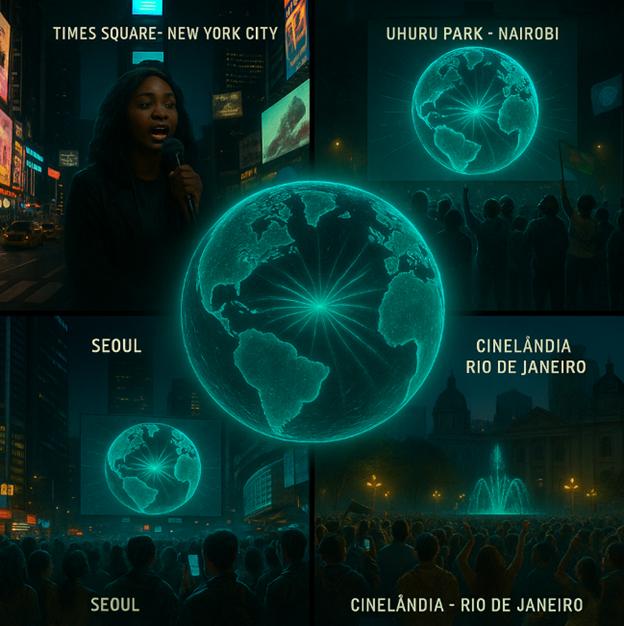
Date: August 12, 2029 — Same moment as Amara’s proposal
Locations: Times Square (NYC) | Uhuru Park (Nairobi) | Dongdaemun Plaza (Seoul) | Cinelândia (Rio de Janeiro)
There was no countdown.
No keynote.
No official host.
Yet at the exact second
Amara Okonkwo’s voice filled the General Assembly Hall,
four massive screens flickered on across the planet:
Times Square
Nairobi
Seoul
Rio
And each showed the same signal:
Priya’s Breath Map.
Real-time resonance rippling across the globe
like glowing tides.
People stopped walking.
Stopped talking.
Stopped pretending the world wasn’t shifting.
Times Square — The Pulse in the Heart of Media
The usual neon drowned away
into a single shade of teal.
A young Afro-Latin woman in a denim jacket
stepped in front of the camera:
“Today, the world votes for itself.”
Behind her, the crowd inhaled as one.
Taxi horns fell silent.
For once, New York listened.
Nairobi — The First City to Cheer
Uhuru Park
overflowed with bodies and hope.
A boy held a cardboard sign:
“I breathe therefore I belong.”
When Amara said
“a chamber the world can fit inside,”
the entire park exhaled
into a roar that wasn’t sound —
it was belonging.
Seoul — The City of Quiet Breath
In Dongdaemun Plaza,
thousands stood shoulder-to-shoulder,
no leader in front,
no direction given.
A group of students raised their phones
showing synchronized inhale timers:
4 seconds in.
2 seconds hold.
6 seconds out.
Even the neon advertisements dimmed
to allow the breath to be seen.
Rio de Janeiro — The Dance of Oxygen
Cinelândia’s fountain lights
turned emerald.
Drummers stopped mid-rhythm.
Dancers froze in place.
And then…
A choreographed wave of breath
rolled through the square
like a soft samba
guided by lungs instead of drums.
A Brazilian teen shouted into the mic:
“We are not waiting for the future.
We are inhaling it.”
Four Cities, One Transmission
The broadcast split into four quadrants —
different continents, different languages,
identical heartbeat.
A banner scrolled across the bottom
in 32 languages:
“If you are watching this,
you are already part of the vote.”
For the first time in history,
a global political event
was happening among people,
not above them.
All four cities —
the screens, the crowds, the skies —
cycled into teal-green synchrony,
breathing toward a future
that refused to wait.
Across the globe,
millions of lungs
finished the sentence Amara had begun:
“Governance is no longer a broadcast.
It’s a resonance.”
The Call From Home
Emil, Layla, Priya, and little Sami
stood shoulder to shoulder on the rooftop
of the building Emil now called home.
The teal light from Times Square’s feed
reflected off the East River
and climbed the walls like a living aurora.
Sami leaned against Emil’s side,
hugging the gray stone to his chest.
Priya calibrated a tiny drone hovering nearby,
projecting the Seoul and Nairobi feeds into the sky above them.
Layla stood close, scarf fluttering in the urban wind—
her eyes already shimmering with tears
before she knew why.
Emil’s phone buzzed.
“Grandpa” on the screen.
Grandfather’s voice came through the phone, warm and steady —
the same voice that once explained four absences and freedom and the test of power.
He answered, voice a little shaky:
“Hey, Grandpa… are you watching this?”
On the other end:
the familiar hum of Grandfather Thomas’s living room—
neighbors talking low,
TV glowing teal.
Grandfather (soft, proud):
“I’ve waited my whole life
to see the world act its age.”
Emil swallowed the lump rising in his throat.
Grandfather:
“You kids…
you didn’t ask permission.
You just handed humanity
the microphone
and said—
‘Speak.’”
Layla wiped her eyes quietly.
Sami blinked fast, suddenly shy.
Priya bit her lip, trying not to break down on camera.
Grandfather (lower, reverent):
“Tonight’s the first time
I’ve watched the news
and felt like the future
was rooting for me,
not warning me.”
A long silence
but not the collapsing kind—
the becoming kind.
Emil whispered:
“We’re scared too.”
Grandfather chuckled:
“Change worth doing
always scares the ones doing it.”
Layla finally stepped closer,
pressing her shoulder lightly against Emil’s.
Her voice a trembling whisper:
“The world is choosing itself.”
Grandfather heard it and smiled:
that deep, seasoned smile
of a man who has buried friends
and still believes in life.
Grandfather:
“You just keep breathing up there.
The rest of us will follow.”
Emil’s eyes glistened.
Sami squeezed his hand.
Priya lowered her drone, overcome.
Grandfather:
“You know, Emil…
a new chamber like UCCA…
it isn’t just about breathing together.
It’s about thinking together.”
Emil frowned thoughtfully:
“Thinking together?”
Grandfather chuckled,
like he’d been waiting years for that question.
Grandfather:
“In my line of work,
whenever something broke,
the bosses wanted me to fix the part they could see.
But the real reasons —
the dangerous ones —
were always in the system.
Root causes.
Hidden loops.”
He paused, letting the idea settle in the air
like dust finally visible in sunlight.
Grandfather:
“Our political systems are the same.
They don’t break because citizens fail.
They break because incentives tell the powerful
to serve lobbyists…
instead of the people who placed them there.”
Layla wiped her face, listening.
Priya leaned closer.
Even Sami stopped playing with the drone.
Grandfather:
“Wars become business plans.
Healthcare becomes a marketplace.
Truth becomes a nuisance.
People become statistics.
And when questioning power becomes scary…
the system learns to harm itself just to keep profits high.
All because the system treats painkillers as cures
and propaganda as truth.”
Emil’s jaw tightened —
he’d seen his mother struggle with medical bills
that only made the hospital richer.
Grandfather:
“That’s what nations forgot:
Governments are supposed to protect their citizens,
not auction them. A society that ignores root causes
guarantees its own decline.”
Layla nodded fiercely through tears.
Grandfather:
“But this breath network you kids built?
It flips the incentives. You kids are not tearing the world apart.
You’re finally fixing it
at the level where it actually breaks.”
He tapped something on his end —
papers rustling —
like he’d been preparing this speech for decades.
Grandfather:
“When a city breathes in green,
it means the system is helping people thrive.
When it flares red, it means the system is hurting them.”
He laughed softly — not mocking, but amazed.
Grandfather:
“For the first time in history,
power is being measured by
well-being,
not wealth.”
Priya’s eyes widened.
She whispered:
Priya:
“Positive feedback loops… but for humanity.”
Grandfather snapped his fingers on the phone.
Grandfather:
“Exactly.
You all are redesigning incentives.
You’re making it profitable —
in a moral way —
for governments to care again.”
He lowered his voice to a tender seriousness:
Grandfather:
“You’re fixing the system
at the level the system lives.”
Emil felt his pulse match the teal glow rising from Manhattan.
Grandfather (final line):
“Tonight isn’t just new governance.
It’s the return of moral governance.
Don’t forget that.”
And the call ended
exactly as the breath wave crested over the skyline.
Emil closed his eyes.
The city exhaled.
But Layla’s tears didn’t stop.
They only grew heavier.
Priya noticed first.
She stepped closer, touching Layla’s arm.
Priya:
“Hey… why are you crying?”
Layla tried to speak—
the first attempts caught in her throat,
like words afraid of the air.
Then she inhaled,
the kind of breath
that tries to untangle a lifetime.
Layla (whispering):
“My mother never made it to a border.”
Emil’s heart lurched.
Layla looked out toward the skyline,
where countries were dissolving into light.
“We left Khartoum when I was nine.
On foot.
She carried me for days.”
Sami’s little hand found hers.
“When we reached the edge of Egypt…
the papers weren’t right.”
Her voice cracked.
“She told me to keep walking.”
A tear slipped down,
then another—
not fragile, but furious.
“She stayed behind
because a line on a map
said she didn’t belong
on the same side of the world
as her daughter.”
She wiped her cheek,
almost angrily.
“A border took her life.
Not a war.
A border.”
Priya’s eyes filled.
Even the drone seemed to hover more gently.
Layla looked at them—
not asking for pity,
but recognition.
“So when I see the world breathing tonight…”
she placed her palm on her chest,
steadying its rhythm
with the pulse of cities around the globe.
“…I just think—
maybe no other child
will have to choose
between a future and a mother.”
Silence.
But not grief’s silence—
resolution’s silence.
Emil wrapped an arm around her shoulder.
She didn’t pull away.
Sami squeezed tighter.
Priya whispered,
voice trembling but proud:
“Then we keep breathing
until no border
can stop a family
ever again.”
Layla finally smiled through tears
as the teal broadcast light
painted her face with hope.
The four of them stood together
in the glow of global breath.
And for the first time,
Layla believed
her lungs could take her anywhere.