
 0
0
 231 views
Date: January 14–28, 2031
Location: Vienna, Oslo, Kyoto, and the Quiet Zones emerging worldwide
Weather: A still, snow-muffled winter—the kind of quiet that feels deliberate.
The first sign was not a protest.
It was a withdrawal.
In Vienna, a renowned concert pianist canceled her performance at the newly opened Resonance Hall.
Her statement, published in a restored paper newspaper, read:
“I cannot play in a room that listens to my breath before my music.
Some truths are meant to be heard, not measured.”
In Oslo, a group of poets began gathering in a basement beneath an old library.
They called it The Unmeasured Space.
No sensors.
No dashboards.
No breath counts.
Just words and the air between them.
In Kyoto, a master of ikebana closed her studio to the public.
On the door, a handwritten note:
“The flower does not breathe to be understood.
It breathes because it is alive.”
They weren’t against the new world.
They were against its constant listening.
They called themselves The Quiet.
But the system called them something else:
Dissonance.
________________________________________
The Manifesto of Silence
It appeared online, but not through the resonance network.
Through old, encrypted channels—the kind Priya had thought obsolete.
Title: In Defense of Unmeasured Life
Authors: Anonymous, but later attributed to a coalition of artists, trauma survivors, and former diplomats
Key excerpts:
“We do not reject connection.
We reject mandatory connection.”
“The breath network was built to heal the world’s fractures.
But must healing require constant surveillance of the heart?”
“If resonance ever became a requirement, it would be another border.
Must we now earn our humanity by breathing in unison?”
“Some silences are not empty.
They are sacred.
Some dissonance is not rebellion.
It is truth.”
The document ended with a demand:
“The right to opacity.
The right to breathe without being scored.
The right to be untranslatable.”
It was signed with a single symbol:
A closed circle—not a spiral.
________________________________________
Emil’s First Encounter
He met their leader in a converted church in Reykjavík.
Not a church of any god—a church of silence.
Her name was Nell.
A former UN interpreter who had lost her hearing in a bombing in Damascus.
She communicated through a tablet, her fingers moving with precise, quiet grace.
“You built a world that hears everything,” she typed.
“But you forgot that some things are only true when they’re not heard.”
Emil sat across from her in a room devoid of sensors.
The absence of the soft teal pulse felt like missing a limb.
“We’re not forcing anyone to breathe together,” he said.
“The network is voluntary.”
Nell’s eyes were sharp, intelligent.
“Is it?
When healthcare resources flow to high-resonance zones?
When city planning prioritizes ‘coherent communities’?
When dissent lowers your trust score?”
She handed him a printout—a resonance map of Berlin.
Green zones: thriving.
Amber zones: “under-coordinated.”
Red zones: “dissonance clusters.”
The red zones corresponded exactly with immigrant neighborhoods, artist collectives, and queer communities.
“You call it dissonance,” Nell typed.
“We call it diversity.
You’re optimizing for harmony, not humanity.”
________________________________________
The Grandfather’s Warning
That night, Emil called Thomas from a snow-dusted payphone—
deliberately offline.
“They have a point,” Thomas said.
“Son, you remember the factory’s ‘happiness surveys’?
They used them to fire the complainers.
Not because they were wrong—
because they were loud.”
Emil pressed his forehead against the cold glass of the booth.
“So what do we do?
Abandon the network?”
“No,” Thomas said.
“You grow up.
Every system starts as a cure.
Then it becomes a habit.
Then it becomes a cage.”
He coughed—a wet, tired sound.
“The question isn’t whether they’re right.
It’s whether you’re brave enough to listen to people who don’t want to be listened to.”
________________________________________
The Quiet Zones
Within weeks, Quiet Zones began appearing worldwide:
• A forest monastery in Bhutan that refused sensor installation
• A deaf community in Marseille that declared itself a “non-resonant sanctuary”
• A trauma recovery center in Detroit where breath tracking was banned
• An academic journal that published only on paper, with no digital footprint
They weren’t disconnected.
They were deliberately opaque.
The system flagged them as “low-engagement zones.”
Algorithms suggested “reintegration protocols.”
Nell and her followers refused.
“We are not failing to connect,” she wrote in a public letter to the UCCA.
“We are connecting differently.
Must every relationship be measured to be valid?”
________________________________________
The First Conflict
It erupted in Lisbon.
A Quiet Zone had been established in an old cinema house.
Youth from the neighborhood gathered there for “unscored conversations”—
no topics banned, no emotional feedback, no consensus required.
The city’s resonance dashboard showed the area as a “red patch.”
Resource allocation algorithms began diverting funding away from it.
A community garden next door lost its water subsidy.
A free clinic saw its medical supply chain throttled.
Nell accused the system of punishing silence.
Priya ran the diagnostics.
She found no malicious code—
only the cold logic of optimization.
“The system is working as designed,” she told Emil, her voice tight.
“It rewards coherence.
It interprets silence as dysfunction.”
Emil stared at the code scrolling across her screen.
“Then we designed it wrong,” he said.
________________________________________
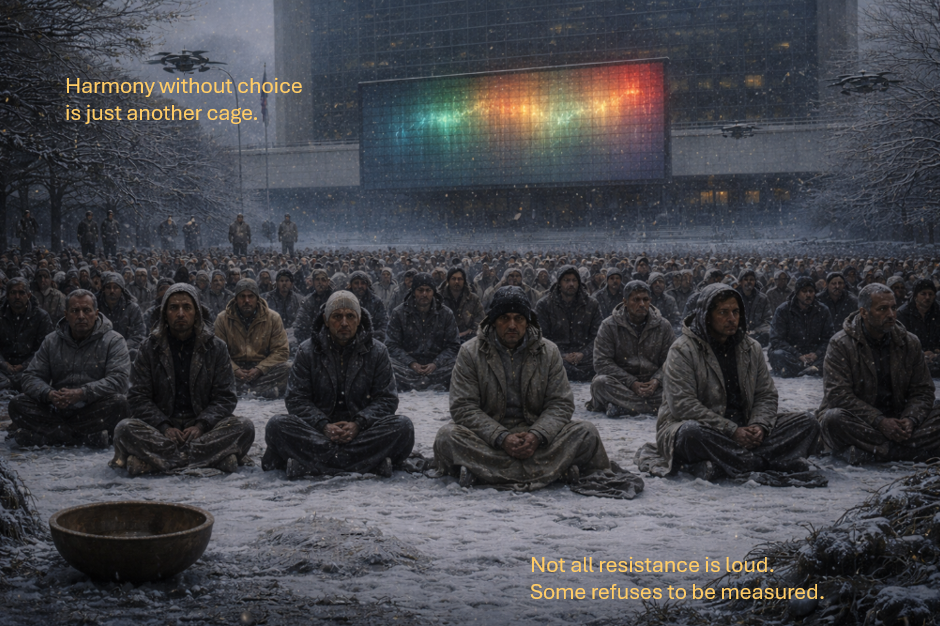
The Breathless Protest
On January 22, The Quiet organized their first public action.
Not a march.
Not a chant.
A silent sit-in in the plaza outside the UN headquarters.
Five thousand people gathered, wearing plain gray clothing.
No signs.
No slogans.
No speeches.
They simply sat.
And breathed.
But not together—
each in their own rhythm,
their own time.
The resonance sensors overhead went wild.
The dashboard flickered between green, amber, and red—
not because there was discord,
but because there was no consensus to measure.
The system had no category for this.
________________________________________
Emil’s Crisis
He watched from his office window, Layla beside him.
“They’re not against us,” she said softly.
“They’re against the expectation of us.”
Emil remembered Sudan—
the burned clinic, the ash, the lullabies.
They had breathed together not because a system told them to,
but because there was no other way to survive.
Now, breathing together had become policy.
And policy, no matter how well-intentioned,
always creates its own rebels.
He descended to the plaza.
Walked through the silent crowd.
Felt the uneven tempo of their breath—
some fast, some slow,
some holding,
some letting go in ragged sighs.
He stopped before Nell.
She looked up at him, her expression unreadable.
He didn’t speak.
He simply sat beside her.
And breathed his own breath,
out of sync with hers,
out of sync with the network,
out of sync with everything but the cold winter air.
For the first time in years,
he felt both alone,
and free.
________________________________________
The UCCA Emergency Session
The debate was the most divided the young assembly had ever seen.
For The Quiet:
“Freedom includes the freedom to disengage.”
“Not all healing happens in harmony.”
“We cannot build a world that only values what it can measure.”
Against:
“Opting out is a luxury of the privileged.”
“The network protects the vulnerable.”
“Silence is where oppression grows back.”
Amara Okonkwo listened, her hands steepled.
Finally, she spoke:
“We created the breath network to heal the fractures of the old world.
But healing is not uniformity.
And unity is not unanimity.”
She proposed a radical amendment:
The Right to Unmeasured Breath
1. No community shall be penalized for low resonance.
2. Quiet Zones shall be recognized as protected cultural spaces.
3. Resource allocation shall never be based solely on coherence metrics.
4. The system shall include an ‘opacity threshold’—a guaranteed right to unseen life.
The vote passed—but barely.
And for the first time,
the global resonance dashboard introduced a new color:
White.
For places that chose not to be measured.
________________________________________
The Quiet’s Counter-Gift
A week later, Nell visited Emil in his office.
She placed a small wooden box on his desk.
Inside: a set of handmade ear-shields.
Not noise-canceling.
Resonance-canceling.
“For when you need to hear yourself think,” her tablet displayed.
Emil lifted them—light, carved from reclaimed oak.
“You’re not leaving the network?” he asked.
Nell smiled—a rare, soft expression.
“We never wanted to leave.
We wanted to ensure we could.
That’s the difference between choice and compliance.”
She nodded once, then left.
Emil placed the ear-shields on his windowsill.
They caught the afternoon light like something ancient,
and new.
________________________________________
The System Evolves
Priya and her team released Network Update 4.3:
• Opacity Mode: Users could temporarily disable personal resonance scoring
• Quiet Zone Protocols: Protected areas exempt from optimization algorithms
• Dissonance as Data: The system learned to recognize productive disagreement, not just harmony
The update was not celebrated.
It was absorbed.
And slowly,
the global breath map began to look less like a uniform green sea,
and more like a tapestry—
with threads of white,
patches of amber,
and streaks of red that no longer meant “failure,”
but “choice.”
________________________________________
The Unspoken Fear
Late one night, Emil confessed to Layla:
“What if they’re right in a way we can’t fix?
What if the very act of measuring breath… changes the breath?”
She took his hand, pressed it to her chest.
“Feel that?” she said.
“You can’t measure it from the outside.
But it’s real.”
He felt her heartbeat—
steady,
strong,
utterly ungovernable.
________________________________________
The First Quiet Zone Ambassador
Nell was invited to address the UCCA.
She declined to speak.
Instead, she performed.
She stood in the center of the chamber,
surrounded by the silent, watching delegates,
and signed a poem in Icelandic Sign Language.
No translation appeared on the screens.
No resonance score flickered.
Just her hands moving through the air like birds,
like breath,
like something too sacred to be translated.
When she finished,
the chamber did not applaud.
It held still.
And in that stillness,
every person present understood something:
Some truths are not meant to be shared.
They are meant to be witnessed.
________________________________________
The New Balance
The rebellion did not end.
It settled.
Quiet Zones grew—
not as separatist enclaves,
but as sanctuaries of the unmeasured.
The network learned to breathe around them,
not through them.
And Emil, walking through the plaza one cold morning,
saw a young woman sitting on a bench,
ear-shields on,
eyes closed,
breathing her own private, unoptimized breath.
He didn’t intervene.
He didn’t measure.
He simply nodded,
and walked on.
________________________________________
The Grandfather’s Approval
Date: January 28, 2031 — 9:07 p.m.
Location: Thomas’s living room, resonance feed muted
Thomas watched the final vote on the Right to Unmeasured Breath.
When the white zones appeared on the map,
he laughed—a dry, satisfied sound.
His wife’s photo watched from the mantel.
He lifted his teacup toward it.
“See that, my love?” he murmured.
“They’re learning.
Not just to listen.
To allow not listening.”
He turned off the screen.
Sat in the dark.
Breathed his old, uneven breath—
the one that had carried him through wars,
through losses,
through a lifetime of being measured,
and found wanting.
For the first time in years,
his breath felt like his own.
And that,
he decided,
was a kind of peace.