
 0
0
 153 views
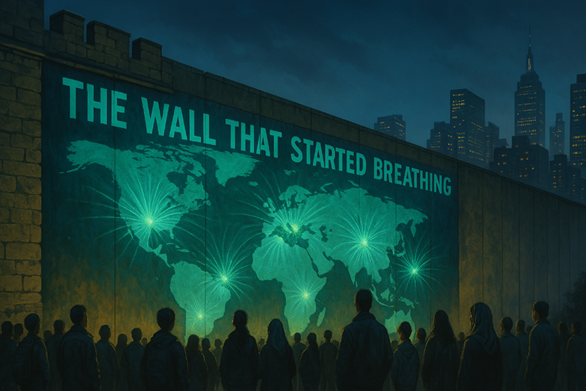
Transformation — when borders begin to shift
Date: September 3–19, 2029
Location: The lines that once divided us
The First Border Noticed the Change
It wasn’t a political border.
It was a sensor border.
Between Tijuana and San Diego,
a joint air-quality monitor detected
a continuous resonance signature
extending across the fence.
For two full minutes,
the system classified
Mexico and the United States as a single breath zone.
Engineers called it a glitch.
The world knew better.
The Children Cross Because the World Already Did
At Gibraltar, migrant families lined up as always.
But the Spanish customs AI
showed their passports
as already processed.
Same names.
Same identities.
No flags.
The AI said:
“Breath affiliation confirmed.”
The border guards, confused,
opened the gate
because no one told them not to.
A grandmother whispered:
“We did not cross anything.
The border stopped.”
When Europe’s Lines Went Transparent
Estonia announced
the world’s first Breath Visa:
A permit that allowed anyone
with a verified resonance record
to enter regardless of nation-state origin.
Other Schengen nations panicked.
But then:
- Helsinki joined
- Copenhagen joined
- Amsterdam joined
- Barcelona joined
- Berlin defied its federal government and joined
The continent’s map
began to look like a constellation,
not a puzzle.
A Finnish headline read:
“Borders are obsolete
when belonging can be measured.”
The Wall That Was Always a Mirror
On the U.S.–Mexico border,
something stranger happened.
Resonance towers installed in Texas
began lighting up
in sync with crowds in Monterrey.
The lights formed
a slow, rippling teal wave
along the wall.
People on both sides
placed their palms against the steel.
Sensors recorded
nearly identical emotional signatures.
One border patrol officer
stepped back and whispered:
“Which side am I on?”
The Borders That Refused to Move
Some governments reacted brutally:
- Hungary shut down all crossings at midnight
- The UK proposed “citizenship breath tests”
- China activated new surveillance firewalls
Their message:
“If people are allowed to move freely,
power cannot.”
But breath is not a document
you can confiscate.
The Moment Dubai Declared Itself a City-Nation
Dubai, empowered by its Breath Embassy success,
announced a new political category:
City-Nation Voice Sovereignty
It declared:
“Borders exist to protect life.
If borders threaten life,
they are not binding.”
Within 72 hours:
- Seoul expressed interest
- São Paulo requested a briefing
- Nairobi hosted a formal Breath Assembly
to consider the same declaration
Global maps
needed new cartographers.
The Lines Underwater Speak First
Satellite imagery showed
coastlines shrinking
and redrawing themselves daily.
Bangladeshi youth wrote across a seawall:
“The ocean does not care
what we call each other.”
An Indonesian mayor asked publicly:
“Who owns land
that can no longer stay above water?”
The old answers
felt like superstition.
The Great Correction
Cartographers began to publish
a new category of map:
Breath Cohesion Zones
Areas where:
- People moved freely
- Resources flowed responsively
- Cities shared governance
- Culture persuaded faster than law
The maps looked nothing like countries.
But everything like civilization.
In Cape Town, two girls
one from Zimbabwe,
one from South Africa,
stood on opposite sides
of an immigration turnstile.
The scanner flashed teal.
The gate slid open.
No questions.
No visa.
No stamp.
They hugged,
first shyly,
then fiercely.
A journalist asked them
what it felt like.
One girl answered:
“We didn’t cross a border.
The border crossed us.”