
Author: Syed Suhail Ahmad
December 25, 2025
 0
0
 167 views
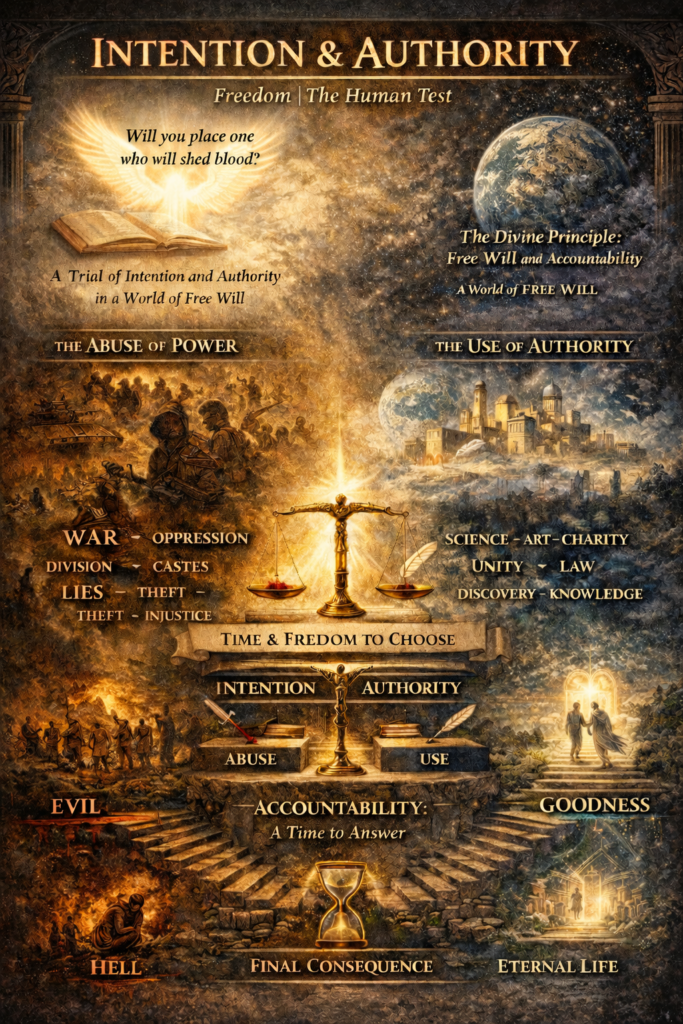
When individuals are endowed with both intention and authority , freedom must necessarily be granted to them as well. Without freedom, intention and authority become meaningless and serve no purpose. Oppression emerges precisely because humans possess the intention to act and the power to carry it out. This world was created as a testing ground, where it is our intentions and authority that are put to the test. Animals do not possess the kind of authority that allows them to oppress others, and for this reason, they are not held accountable in the same way. When hungry, they hunt for sustenance; they do not seek to subjugate or dominate other creatures. Thus, this profound test is reserved solely for human beings.
For the test to be meaningful and fair, a span of time must be provided during which people can freely exercise their intentions and authority—this necessitates the granting of freedom. Consequently, God has established this as a principle: He will not intervene during this period. If He did, the unseen would become seen, and the very process of testing would cease. Because of intention and authority, people often misuse them—shedding blood, oppressing others, dividing humanity into classes and castes, or into religious sects (such as Judaism, Christianity, Shia, Sunni, Hinduism, Sikhism, and Buddhism), or claiming superiority based on skin color, treating certain groups as inferior, violating international norms, and employing deceptive propaganda to satisfy greed and desires. Other base instincts further tempt them toward theft, backbiting, lying, murder, and sexual assault.
All these evils stem from the intention and authority bestowed upon humans. Yet, as the angels foretold, humans would indeed shed blood. At the same time, it is this very intention and authority that elevates us above other creatures, such as animals and birds. We are not only conscious but self-aware. Every invention and the entire edifice of civilization arise from the proper and constructive use of these two gifts. In truth, the vast majority—perhaps ninety percent—of the time, human intentions and authority are employed for the betterment and benefit of mankind. Only a minority among us misuse them in harmful ways. If God were to intervene constantly, freedom would be revoked, and no one would truly exercise their intention and authority. In such a case, the concepts of test, trial, accountability, and eternal life would lose all meaning. Without grasping God’s purpose in creation, all criticism of these matters remains superficial and futile. God intervenes only in the case of His messengers (e.g. Abraham , Moses, Jesus, and Mohammad peace be all to them). Those who believe that a messenger like Jesus could be killed or overpowered demonstrate a lack of understanding of the deeper purpose behind creation.
When human beings face challenges at a global scale, the response cannot be despair or withdrawal, but the continuous creation and strengthening of just institutions. Evil does not emerge in isolation; it thrives where institutions fail, accountability weakens, and moral responsibility is abandoned. To prevent oppression, violence, and exploitation, humanity must design institutions that restrain the misuse of authority, protect human dignity, and channel power toward the common good. Strong institutions grounded in justice, transparency, and ethical values serve as collective safeguards, ensuring that individual flaws do not spiral into global harm. In this way, confronting global challenges becomes not only a test of human intention, but also a test of our capacity to build systems that uphold moral order.