
 0
0
 148 views
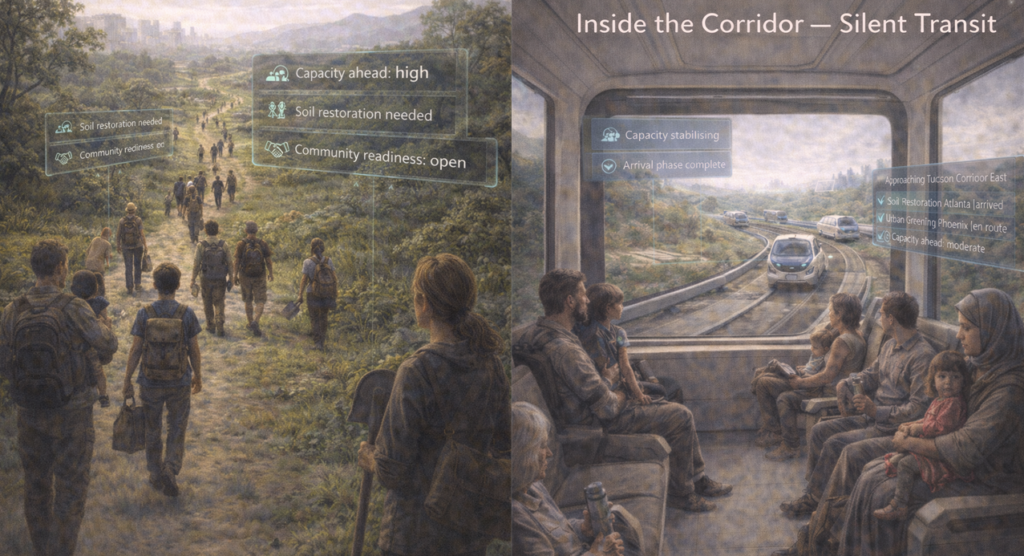
Date: Mid-21st Century
Location: Former borders, transit regions, coastal zones, interior cities
Weather: Seasonal, predictable, moving
The first corridor was not built.
It was acknowledged.
A river of people had been flowing there for decades —
workers, families, students, refugees, dreamers —
slowed, redirected, criminalized, and blamed.
One day, the system stopped asking how to block the river
and began asking how to guide it.
That was the beginning of the Harmony Corridors.
________________________________________
When Movement Was Finally Understood
For most of human history, movement had been treated as threat.
Borders hardened.
Walls rose.
Fear learned to speak the language of law.
But climate data, labor patterns, demographic curves, and ecological stress maps all told the same story:
People move where life can continue.
Migration was not a decision.
It was a response.
The corridors began with a reframing:
Migration is not a crisis.
It is a planetary function.
________________________________________
The End of the Border as a Wall
Borders were redesigned.
Not erased.
Redesigned.
They stopped behaving like scars and began acting like membranes.
At a membrane, pressure is not resisted.
It is equalized.
Sensors replaced checkpoints.
Guidance replaced detention.
Coordination replaced enforcement.
No one was stopped for arriving.
People were met.
________________________________________
How the Corridors Worked
Each corridor aligned three flows:
1. Human flow — people seeking safety, work, education, stability
2. Capacity flow — regions needing labor, care, renewal
3. Regeneration flow — ecosystems requiring human stewardship
AI systems did not assign people.
They revealed opportunities.
Migrants were shown:
• places where skills were needed
• climates compatible with health
• communities prepared to receive
Movement became informed, not coerced.
Choice returned.
________________________________________
The Quiet Death of “Illegal”
The word lingered for a while.
Then lost meaning.
When movement is coordinated, legality becomes redundant.
No one was “illegal” for following a corridor any more than a bird is illegal for following a wind current.
Documentation still existed.
But it described trajectory, not permission.
Where you were coming from.
Where you were headed.
What you hoped to do.
Not what you were allowed.
________________________________________
Cities Learn to Breathe
Receiving cities were not overwhelmed.
They were prepared.
Housing scaled gradually.
Schools expanded in advance.
Health systems adjusted before arrival.
The corridors carried data, not surprise.
Communities participated in preparation.
Fear had thrived on suddenness.
Predictability dissolved it.
________________________________________
The Corridor Councils
Every corridor had a council.
Not national.
Not corporate.
Composed of:
• local residents
• recent arrivals
• ecological stewards
• logistics coordinators
Their mandate was simple:
Keep movement dignified.
Keep impact reversible.
Keep belonging possible.
If a corridor strained a region, flow slowed.
If a region recovered, flow resumed.
Migration learned rhythm.
________________________________________
When Camps Became Obsolete
Refugee camps vanished.
Not by decree.
By redundancy.
Why warehouse people when movement could continue?
Why freeze lives when adaptation was possible?
Temporary shelters still existed.
But they were pauses, not endpoints.
No child grew up in a camp.
That alone changed everything.
________________________________________
The Children Name It
A classroom discussion captured it best.
A student said:
“So borders used to be like fists.”
Another replied:
“Now they’re more like hands.”
Open enough to help.
Firm enough to hold.
No one added anything.
________________________________________
The Cultural Shift
Stories about “waves” and “floods” disappeared.
Language softened.
People stopped asking:
“Where are they from?”
They asked:
“Which corridor brought you?”
The answer said more.
It described purpose, not origin.
________________________________________
Resistance Fades
Some feared loss of identity.
But identity proved stubborn.
It did not dissolve when newcomers arrived.
It adapted.
Cultures didn’t vanish.
They composted.
Something richer grew.
________________________________________
What the Corridors Prevented
Not all conflict.
But predictable conflict.
Starvation reduced.
Human trafficking collapsed.
Smuggling networks dried up.
When movement has a path, predators lose power.
________________________________________
Closing Image
A dawn scene.
People walking along a wide, green corridor.
Some carrying tools.
Some carrying children.
Some carrying nothing but intent.
Digital markers hover gently:
Capacity ahead: high
Soil restoration needed
Community readiness: open
No guards.
No fences.
Just motion —
guided, humane, ordinary.
The Earth breathes.
People follow.
And for the first time in history,
movement is not a problem to be solved,
but a rhythm to be honored.