
 0
0
 53 views
Date: Years after the final election cycles faded
Location: Former national capitals, borderlands, planetary coordination networks
Weather: Quiet skies over old frontiers
No one remembers the exact day the last nation ended.
Because it did not end through collapse.
No treaties dissolved it.
No revolution overthrew it.
No declaration announced its disappearance.
It simply became less necessary.
For centuries, nations had been humanity’s largest political containers.
They organized identity.
They defined belonging.
They determined who was protected—and who was excluded.
To be born inside a nation meant safety.
To be born outside often meant uncertainty.
Borders defined destiny.
But as planetary coordination matured, something began to change.
The conditions that once required nations slowly faded.
________________________________________
When Geography Defined Survival
In the old world, survival depended on geography.
A nation controlled land.
Land controlled food.
Energy.
Security.
Opportunity.
Governments protected resources inside borders.
They regulated entry.
They negotiated with other nations.
Sometimes peacefully.
Sometimes violently.
Nations were necessary because coordination between distant populations was fragile.
Trust rarely extended beyond borders.
And when scarcity intensified, loyalty hardened.
A nation was both shield and identity.
It protected its people—but separated humanity.
________________________________________
The Slow Erosion of Borders
The first borders did not fall.
They softened.
Global environmental systems required shared stewardship.
Water systems crossed countries.
Atmospheric stability ignored frontiers.
Oceans connected continents.
No nation could stabilize climate alone.
Coordination began to stretch beyond borders.
Then infrastructure followed.
Energy grids became continental.
Food networks became planetary.
Information flowed without restriction.
And the movement of people became easier.
Not because laws vanished overnight.
But because barriers stopped making sense.
When survival systems became global, exclusion became inefficient.
________________________________________
When Identity Expanded
At first, people resisted.
National identity had been deeply emotional.
Flags carried memory.
Anthems carried sacrifice.
Generations had fought to defend them.
But gradually something expanded.
People began to see themselves in multiple circles.
Local communities remained meaningful.
Languages and cultures flourished.
But identity widened.
A person could be rooted in a place—
without being confined by it.
Belonging no longer required exclusion.
Citizenship slowly transformed.
From national membership—
to planetary participation.
________________________________________
The Last Passport
For centuries, passports had controlled movement.
Small booklets determining where a human could travel.
Where they could work.
Where they could live.
And where they could not.
They were instruments of sovereignty.
But also instruments of division.
As harmony corridors expanded and planetary coordination stabilized, mobility became normal.
People moved where participation aligned.
Not where documents allowed.
Eventually, passports stopped being required.
They remained as historical artifacts.
Symbols of a time when identity had to be verified at borders.
________________________________________
The Final Border Crossing
The last operational border checkpoint remained open long after most others had closed.
Not because it was needed.
But because habit persisted.
One morning, a traveler approached.
The officer looked at the system.
No restriction.
No reason to deny entry.
No difference between this side and the other.
He stamped the passport out of routine.
Then paused.
Because the stamp meant nothing anymore.
It did not grant permission.
It recorded history.
Later that day, the checkpoint closed.
Not through order.
Through recognition.
The frontier had moved elsewhere.
________________________________________
What Happened to Nations
Nations did not vanish.
They evolved.
Cultures remained vibrant.
Languages continued.
Histories were preserved.
But political sovereignty transformed.
Former nation-states became regional stewards.
Caretakers of ecosystems.
Guardians of cultural heritage.
Nodes within a planetary civilization.
The idea that humanity needed to divide itself into competing containers no longer made sense.
Coordination replaced rivalry.
Shared stewardship replaced territorial control.
The world did not become uniform.
It became connected.
________________________________________
The Final Realization
For centuries, nations had been humanity’s answer to disorder.
They organized loyalty.
Protected survival.
And prevented chaos.
But they also carried a hidden cost.
They trained humanity to think in fragments.
Us and them.
Inside and outside.
Citizen and foreigner.
When planetary systems matured, that mental boundary softened.
Humanity realized something simple.
The planet had never been divided.
Only human maps were.
________________________________________
What Children Could Not Imagine
In classrooms, students studied world maps from earlier centuries.
Color-coded territories.
Borders marked by thick lines.
Teachers explained that people once needed permission to cross them.
Children asked:
“Why would someone need permission to walk on the same planet?”
Teachers paused.
Because once, fear governed geography.
And fear creates boundaries.
Now cooperation governed the planet.
And cooperation dissolves them.
________________________________________
Closing Image
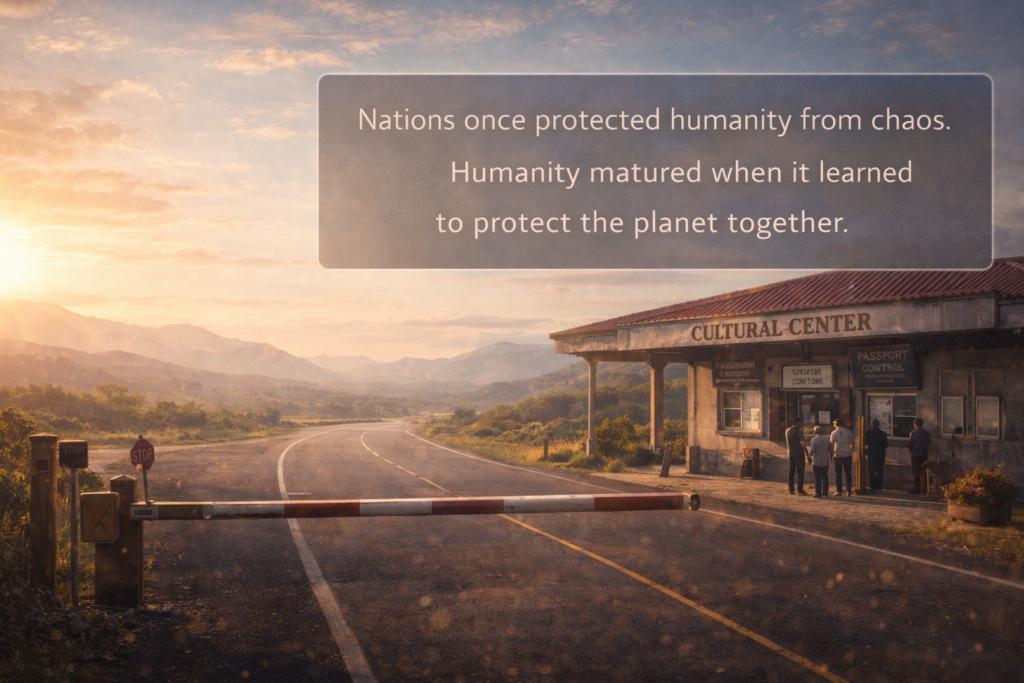
A former border crossing sits beneath an open sky.
The gate remains raised.
No guards.
No queues.
The road passes freely from one landscape into another.
Nearby, the old checkpoint building has become a small cultural center.
Travelers stop not to request entry—
but to learn the history of borders.
On the wall, an inscription reads:
“Nations once protected humanity from chaos.
Humanity matured when it learned to protect the planet together.”
The frontier no longer runs across the land.
It runs through the human mind.
And it is slowly dissolving.