
 0
0
 172 views
Date: 2052–2053
Location: Newsrooms, living rooms, streets, servers
Weather: Ordinary days, uninterrupted
The news did not end.
It went quiet.
Not suddenly.
Not by decree.
Not because anyone shut it down.
It simply stopped demanding attention.
________________________________________
When Urgency Lost Its Grip
For generations, the news had arrived shouting.
Breaking.
Exclusive.
Urgent.
Now.
People planned their days around it.
Their emotions followed its rhythm.
Their fears were scheduled by its cycle.
Then something changed.
As AI systems began reporting reality directly—
sensor-verified, source-linked, uncertainty-tagged—
urgency stopped working.
Nothing was hidden behind suspense anymore.
Reality arrived continuously.
Calmly.
________________________________________
The First Ratings Drop No One Panicked About
Executives noticed the numbers first.
Viewership declined.
Then flattened.
Then declined again.
Not because people were uninformed.
But because they were already informed.
By the time an anchor spoke, people had seen:
• the raw footage
• the environmental data
• the timelines
• the confidence margins
The story had already finished telling itself.
The anchor felt late.
________________________________________
When Framing Became Visible
Corporate media had always done something subtle:
It framed reality.
What mattered.
What didn’t.
Who was to blame.
What to fear next.
AI reporting didn’t frame.
It contextualized.
It showed:
• what was known
• what was uncertain
• who was affected
• where interpretation diverged
No single voice.
No preferred angle.
Just structured reality.
Once people saw the frame, they couldn’t unsee it.
Corporate media could not compete with:
Direct access to reality itself.
________________________________________
The Last Panel Debate
One of the final televised debates featured five experts.
They argued for forty minutes.
At the end, a viewer comment appeared onscreen, unscreened:
“Why are they arguing about something the data already shows?”
The clip circulated briefly.
Then disappeared.
Because no one needed to share it.
Everyone had felt the same thing.
________________________________________
The Collapse of Narrative Leverage
Political actors tried to adapt.
They issued statements crafted for outrage cycles.
Nothing happened.
The statements appeared—
tagged, contextualized, cross-referenced—
then dissolved into background information.
No amplification.
No echo.
Without narrative leverage, performance lost value.
Politics had already quieted.
Now its loudspeaker was gone.
________________________________________
Newsrooms Begin to Empty
Not dramatically.
No mass layoffs.
No strikes.
Journalists left gradually.
Some became investigators embedded in systems.
Some curated archives.
Some taught interpretation literacy.
Some simply stopped narrating.
A reporter wrote in a farewell note:
“I’m not needed to tell people what happened anymore.
They can see it.
I’m needed to help them understand what can’t be automated.”
That role was smaller.
But more honest.
________________________________________
What Replaced the News
Not silence.
Awareness streams.
People subscribed not to channels, but to conditions:
• air quality
• food supply
• migration flows
• conflict probability
• infrastructure health
No headlines.
Just thresholds.
If something crossed a line, you were notified.
No speculation.
No countdown clocks.
Just reality asking for attention when it truly needed it.
________________________________________
The Children Don’t Learn “Current Events”
In schools, the subject quietly disappeared.
There was no longer a need to teach:
“What’s happening in the world today?”
The world was always present.
Instead, children learned:
• how to read uncertainty
• how to detect manipulation
• how to sit with incomplete information
• how to disagree without distortion
Media literacy replaced media consumption.
________________________________________
The Sentence That Marked the End
A former anchor was asked in an interview:
“Do you miss the spotlight?”
She paused.
Then said:
“I miss when people needed a voice to access reality.
But I’m relieved they don’t anymore.”
That clip was not widely shared.
It didn’t need to be.
________________________________________
What Died That Day
Not journalism.
Not truth.
But ownership of attention.
The idea that reality must pass through a narrator to be real.
The belief that fear was the fastest path to engagement.
________________________________________
What Survived
Reporting, where it mattered.
Witnessing, where machines could not go.
Storytelling, when humans chose meaning—not urgency.
The news didn’t disappear.
It stepped back.
________________________________________
Closing Image
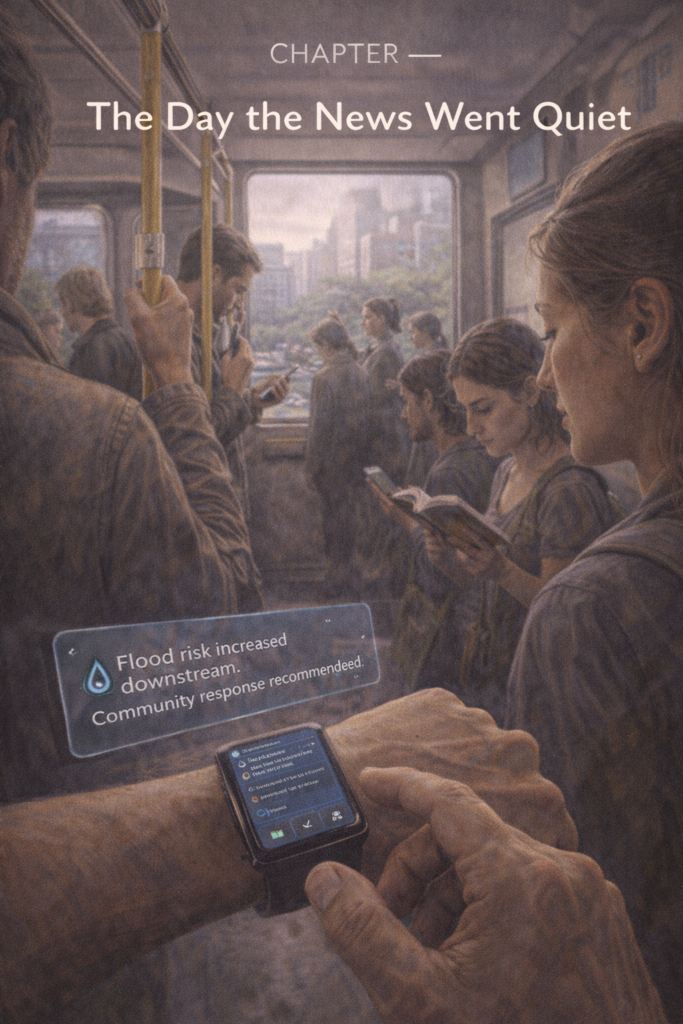
A morning commute.
No screens shouting headlines.
No breaking alerts.
A soft chime appears on a wrist display:
Flood risk increased downstream.
Community response recommended.
No music.
No commentary.
People look up.
They act.
And no one calls it news.
They call it awareness.
Because at last,
reality no longer needs a microphone.