
 0
0
 4 views
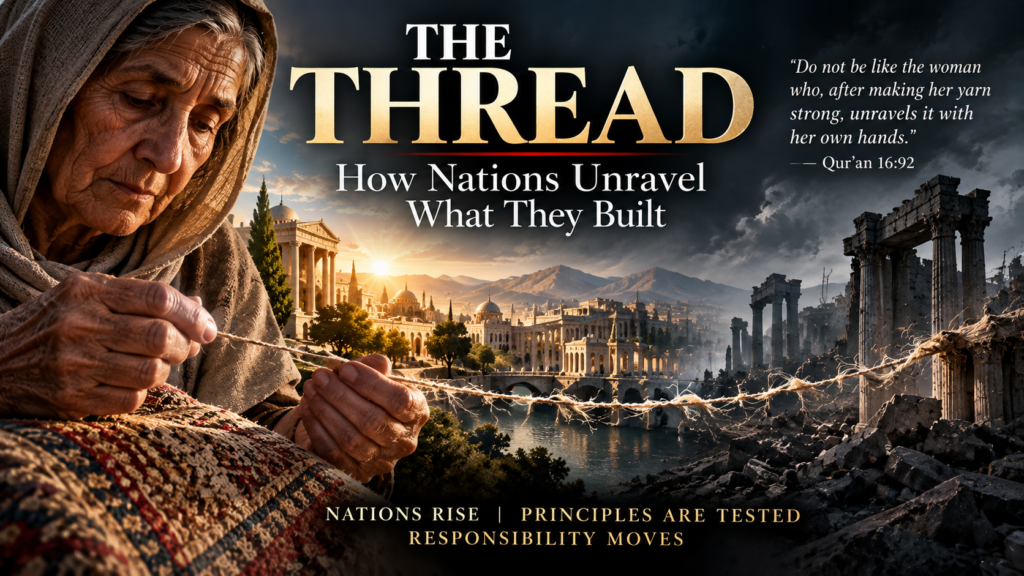
Civilizations are not built in a day. They are woven across generations.
Knowledge gives them strength. Morality gives that strength direction. Covenants create trust. Justice builds legitimacy. Restraint places limits on power. Slowly, these individual threads become institutions, societies—and eventually an entire civilizational order.
But what happens when a nation becomes powerful enough to believe that the principles which helped build its strength no longer need to restrain it?
“The Thread: How Nations Unravel What They Built” is a short philosophical film inspired by a remarkable metaphor in the Qur’an:
“Do not be like the woman who unravels her yarn after having spun it firmly…” — Qur’an 16:92
In its immediate context, the verse warns against breaking covenants and using agreements deceptively when circumstances or balances of power change. This film takes that powerful image as a broader invitation to reflect on the rise and decline of civilizations.
A society may spend generations weaving together knowledge, morality, justice, institutions, agreements and trust—only to begin pulling those threads apart when power makes principles inconvenient.
A covenant becomes negotiable.
Justice becomes selective.
Truth becomes convenient.
Exceptions become normal.
Restraint begins to look like weakness.
And yet the buildings may still stand. The armies may remain powerful. The economy may continue functioning. From the outside, the civilization may appear secure.
A Deeper Religious Meaning
For viewers interested in the deeper religious context, the image of Qur’an 16:92 can also be read within the larger Qur’anic story of responsibility and covenant. The verse itself speaks about honoring commitments and warns against becoming like a woman who painstakingly spins strong yarn and then unravels it with her own hands. Within a broader Islamic interpretation of sacred history, this image can illuminate what happens when a community (e.g. Children of Isralites) entrusted with divine guidance gradually abandons the moral principles associated with that responsibility. The prophetic mission that had flourished for generations among the Children of Israel eventually continues, in Islamic belief, through Muhammad—an Arab messenger traditionally descended from Ishmael—and through a community charged with carrying the message of submission to the One God (Islam) to humanity after Israelites abandoned it. This should not be understood as one ethnicity receiving permanent superiority over another: the Qur’an itself says of Abraham’s descendants that God’s covenant does not extend to wrongdoers. Responsibility remains a trust and a test, not an inherited entitlement or the “chosen one”.
From Sacred Responsibility to Civilizational Responsibility
This ancient metaphor also invites reflection on the rise and decline of nations.
History does not demonstrate a simple mechanical law in which every unjust nation immediately loses power or every righteous nation immediately gains it. Empires can remain powerful despite serious wrongdoing, sometimes for generations. Nor should every geopolitical transition be interpreted as direct divine intervention.
But history does show something more subtle.
Power depends on more than weapons and wealth.
It also depends upon institutions, credibility, alliances, social cohesion, knowledge, economic capacity and legitimacy.
When a state commits grave abuses, systematically violates human rights, disregards agreements, or engages in conduct alleged to constitute atrocities or genocide, the damage may extend beyond its immediate victims. Its credibility can deteriorate. Institutions can lose moral authority. Alliances can be strained. The principles used to justify an international order can appear selective when they are applied differently to allies and adversaries.
Legal terms such as genocide have precise meanings and their application to particular conflicts depends on evidence and legal adjudication. But the broader moral question remains:
What happens to an order when those who defend its principles begin making exceptions for themselves?
This is where the woman and her thread become such a powerful image.
The civilization does not necessarily collapse because someone tears the entire fabric apart.
One thread is pulled.
Then another.
Then another.
Until something once strong can no longer hold itself together.
And the World Order Changes
World orders are not permanent either.
Centers of knowledge have moved.
Centers of commerce have moved.
Military power has moved.
Scientific leadership has moved.
Political influence has moved.
Civilizations that once appeared indispensable eventually discovered that history could continue without them.
The transition is rarely caused by morality alone; technology, economics, geography, institutions, demography, war and many other forces shape geopolitical change. Yet the metaphor of the thread asks us to consider whether moral and institutional self-destruction can become one of the forces of decline.
Perhaps a civilization’s greatest danger therefore does not always come from the civilization waiting beyond its borders.
Sometimes the hand pulling the thread is its own.
The Warning Is for Everyone
And this is where the message must return to ourselves.
It would be easy for Muslims to read sacred history only as a story about what previous communities did wrong.
That would miss the warning.
If Muslims believe that they inherited a responsibility, then they inherited a test, not immunity from one.
If they abandon justice, tolerate corruption, oppress the weak, manipulate truth, violate covenants or use religion to excuse wrongdoing, fight among themselves, they too can unravel what was entrusted to them.
The principle of Qur’an 2:124 remains uncompromising:
“My covenant does not include the wrongdoers.”
No ancestry changes that.
No flag changes that.
No civilization changes that.
No claim of chosenness changes that.
No amount of power changes that.
The thread belongs to no nation forever.
One generation receives it.
Another strengthens it.
Another may neglect it.
Another may unravel it.
And somewhere else, new hands may begin weaving.
Perhaps that is one of history’s deepest lessons:
Knowledge can help a civilization rise.
Principles can make its power legitimate.
Power tests whether those principles were genuine.
And history eventually reveals the answer.
So the question posed by The Thread is not:
Which civilization once held the thread?
Nor even:
Which civilization holds it today?
The more unsettling question is:
What are those holding the thread doing with it?
Because what generations patiently weave,
one generation can unravel.
And sometimes—
the fall begins long before the ruins appear.
The fall can begin long before the ruins appear.
This film is therefore not simply about civilizations of the past, nor is it an accusation against any particular nation. It is about a recurring human and civilizational test: What happens after we become powerful?
Can we remain faithful to principles when violating them would benefit us?
Can we apply to ourselves the standards we demand from others?
Can knowledge remain governed by morality?
Can power remain restrained when restraint is voluntary?
The Qur’anic metaphor leaves us with an unsettling possibility: sometimes what generations painstakingly build is not ultimately destroyed by an enemy from outside.
Sometimes we unravel it ourselves.
And when one civilization loosens enough of the principles that sustained its moral responsibility, history continues. Centers of influence change. New peoples rise. New generations inherit responsibility—and eventually face the same test.
Because inheritance is not immunity.
Power is not permanence.
And responsibility is never merely a privilege.
**Every civilization inherits a thread.
Every generation decides what to do with it.**
What will we do with ours?