
 0
0
 440 views
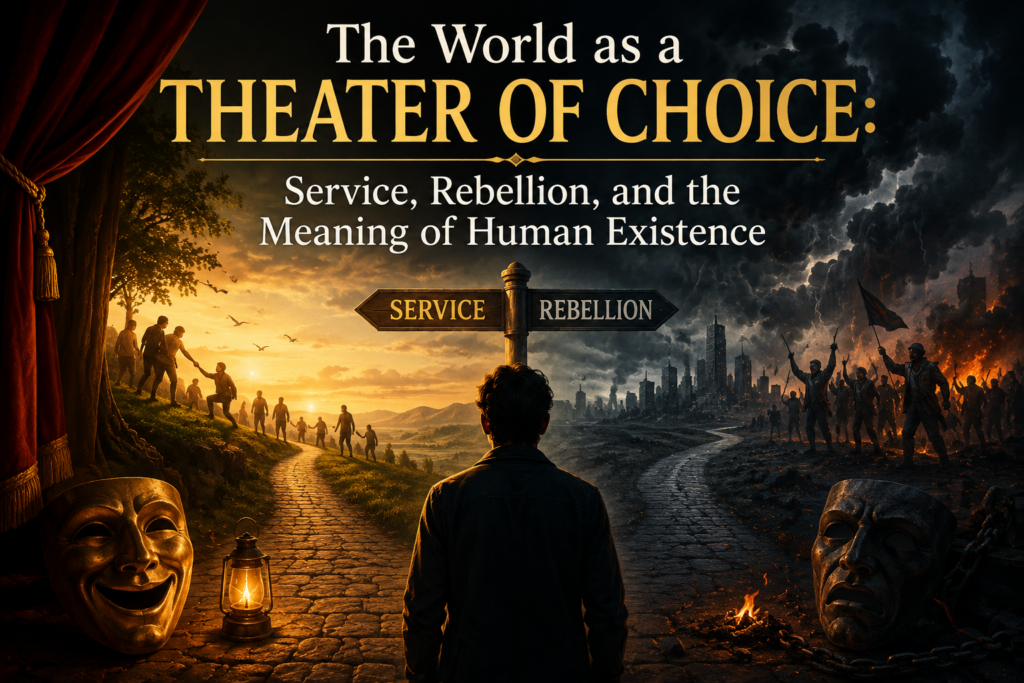
“What is the world? It is a realm where the ongoing battle between the call to serve the Almighty and the temptation to defy Him unfolds.”
This simple statement contains a profound interpretation of human existence. It suggests that the world is not merely a physical environment inhabited by biological creatures pursuing survival and pleasure. Rather, it is a moral and spiritual arena in which every human being is confronted with a fundamental choice: whether to align with the higher purpose embedded within creation or to pursue a path of self-centered rebellion against it.
Modern civilization often describes the world in material terms. Economists see markets, politicians see power, scientists see natural processes, and technologists see systems to optimize. While each perspective captures an aspect of reality, none fully explains the persistent moral drama that unfolds across history. Why do humans continually struggle between justice and oppression, generosity and greed, truth and falsehood, humility and arrogance? Why do societies rise and fall not merely because of resources or technology, but because of the moral choices they make?
The answer may lie in understanding the world not simply as a place, but as a test.
The Architecture of Choice
Unlike other creatures, human beings possess a remarkable capacity for moral agency. We are not driven solely by instinct. We can choose to act against our immediate desires in pursuit of higher principles. We can sacrifice comfort for truth, wealth for integrity, and even life for justice.
This freedom makes human life meaningful.
If every action were predetermined, morality would become irrelevant. Virtue would carry no value because it would require no effort. The possibility of failure is what gives success significance. Courage matters because fear exists. Generosity matters because selfishness is possible. Faith matters because doubt is present.
The world therefore functions as an environment where choices reveal character. It is a place where what is hidden within the human heart gradually becomes visible through action.
Two Competing Calls
Every age, culture, and civilization experiences the tension between two opposing invitations.
The first is the call toward service: to recognize a reality greater than oneself, to live with humility, gratitude, and responsibility, and to understand that power is a trust rather than a possession.
The second is the temptation toward defiance: to place the self at the center of existence, to treat desires as ultimate authority, and to pursue power without accountability.
The ancient narratives of humanity repeatedly illustrate this conflict. Whether one studies the stories of Pharaoh, Nimrod, Qarun, or countless modern tyrants, the pattern remains remarkably consistent. Rebellion rarely begins with open hostility toward God. It often begins with excessive confidence in oneself.
The desire to be independent gradually transforms into the desire to be supreme.
The Illusion of Autonomy
One of the most powerful temptations in human history is the illusion of absolute autonomy—the belief that we are self-sufficient and answerable to no higher authority.
This illusion becomes especially attractive during periods of prosperity. When societies become technologically advanced and economically powerful, they often begin to assume that human intelligence alone can solve every problem. Yet history repeatedly demonstrates the fragility of such confidence.
Empires collapse. Economies fail. Technologies become obsolete. Even the most powerful individuals eventually confront their own limitations.
The world constantly reminds humanity of a truth it often resists: power without humility eventually becomes self-destructive.
Why Evil Exists
Many people ask why suffering, injustice, and evil exist if God is wise and merciful.
This question becomes easier to understand when the world is viewed as a testing ground rather than a final destination.
A classroom without examinations cannot reveal mastery. A world without alternatives cannot reveal moral commitment. The existence of temptation creates the possibility of virtue.
This does not mean that evil is good. Rather, it means that the presence of evil provides the context in which moral excellence becomes possible.
Justice acquires meaning because injustice exists.
Patience becomes valuable because hardship exists.
Forgiveness becomes noble because injury exists.
The struggle itself becomes part of the process through which human beings grow.
The Invisible Battlefield
Many people imagine this struggle as a conflict between nations, ideologies, or political movements. Yet the most important battlefield is often invisible.
It exists within the human heart.
Every day individuals confront choices between honesty and convenience, compassion and indifference, humility and pride. Entire civilizations are shaped by the accumulation of these seemingly small decisions.
The fate of societies is often determined long before political revolutions occur. It begins when moral values weaken, when truth becomes negotiable, and when personal interests consistently outweigh collective responsibility.
External crises frequently reveal internal conditions that have existed for years.
Success Reconsidered
Modern culture frequently defines success in terms of wealth, status, influence, and visibility.
Yet from a spiritual perspective, success is measured differently.
The question is not how much power a person accumulated, but how they used it.
Not how much wealth they possessed, but whether they remained generous.
Not how loudly they were praised, but whether they remained sincere.
In this sense, the world’s standards and the standards of eternity often move in opposite directions.
Many who appear successful may have failed the deeper purpose of life, while many who appear insignificant may have achieved extraordinary success in the sight of God.
The Purpose of the Journey
If the world is indeed a realm where the battle between service and defiance unfolds, then every moment becomes meaningful.
Every decision contributes to the formation of character.
Every challenge becomes an opportunity for growth.
Every blessing becomes a test of gratitude.
Every hardship becomes a test of perseverance.
Life is no longer a random sequence of events but a purposeful journey toward moral and spiritual maturity.
The ultimate question is not whether we will face this struggle, but how we will respond to it.
Conclusion
The world is far more than a collection of mountains, oceans, cities, and nations. It is a stage upon which humanity reveals its deepest loyalties.
The ongoing battle between serving the Almighty and defying Him is not merely a theological concept—it is the underlying drama of human history. Every civilization, every community, and every individual participates in it.
The greatest victories are not always won on battlefields. They are often won quietly within the human heart, when a person chooses truth over convenience, humility over pride, and service over self-worship.
For in the end, the world is not simply where we live.
It is where we choose who we become.
Watch the video…