
 0
0
 177 views
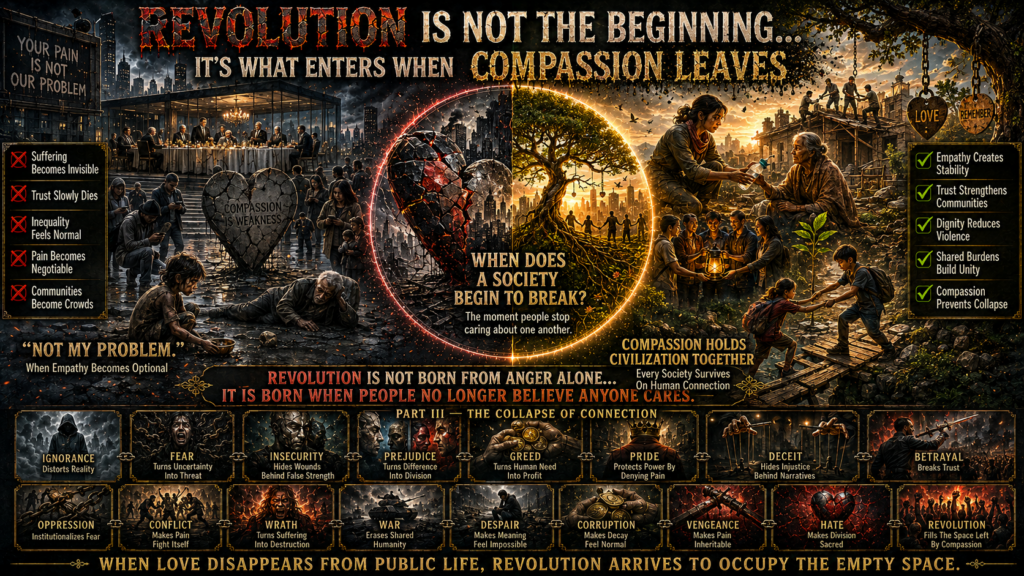
Revolution is rarely born in a single moment. It does not begin with fire in the streets or slogans shouted through crowded squares. Long before the first stone is thrown, something far more important has already collapsed quietly beneath the surface: love. Not romantic love, but the deeper civic love that allows human beings to recognize one another as worthy of dignity, protection, and care. Every healthy society survives because people still feel connected enough to one another to restrain their anger, share burdens, forgive differences, and protect the vulnerable. But when compassion begins to disappear, society slowly transforms from a community into a battlefield of competing fears, identities, and hungers. At first, the signs appear small—people become indifferent to suffering that does not directly touch them, public discourse hardens, trust weakens, and inequality becomes normalized. Over time, empathy fades and entire groups are reduced to statistics, threats, or obstacles. Once this happens, injustice no longer feels morally urgent. Human pain becomes negotiable. And that is the moment when societies unknowingly begin preparing themselves for revolution.
Oppression, betrayal, greed, prejudice, and hatred do not emerge from nowhere; they flourish in emotional climates where compassion has already withered. A government may possess armies, laws, prisons, and surveillance systems, but no civilization can remain stable once people no longer feel emotionally invested in each other’s humanity. Revolutions therefore are not simply political failures—they are failures of collective compassion. When people lose faith that society cares for them, they stop seeing institutions as shared structures of belonging and begin seeing them as instruments of domination. Fear grows. Resentment deepens. Communities fracture into hostile tribes competing for dignity, security, and survival. In such conditions, even small conflicts can ignite enormous unrest because the emotional foundation holding society together has already cracked. History repeatedly shows that societies collapse not only when resources disappear, but when compassion disappears first. Hunger becomes unbearable when no one cares who starves. Injustice becomes explosive when people believe no one is listening. Violence becomes attractive when dignity feels unreachable through peaceful means.
This is why compassion must no longer be treated merely as a private moral virtue; it must become a serious political idea. Modern societies discuss economics, military strength, technology, and national security endlessly, yet rarely ask whether their systems cultivate empathy, belonging, and human dignity. Compassion is often dismissed as softness in political life, when in reality it is one of the deepest forms of social stability ever discovered. Compassion reduces the emotional distance between people. It allows citizens to see the struggles of others not as threats, but as shared responsibilities. Compassionate societies build stronger trust, healthier institutions, and more resilient communities because people feel emotionally connected to the collective good rather than isolated inside personal survival. Without compassion, democracy becomes transactional, justice becomes selective, and leadership becomes performance instead of stewardship. A nation may appear economically successful while quietly becoming emotionally fractured beneath the surface.
Perhaps the greatest challenge of our century is not technological advancement, but emotional civilization. Humanity has learned to split atoms, manipulate algorithms, and reshape nature itself, yet many societies still struggle to teach people how to live together without hatred. Compassion is not weakness; it is the ability to recognize that another person’s suffering eventually reaches us all. The future stability of nations may depend less on military deterrence and more on whether societies can rebuild cultures of empathy before fear and resentment harden into irreversible division. Because when love disappears from public life, revolution eventually enters to occupy the empty space it leaves behind.