
 0
0
 386 views
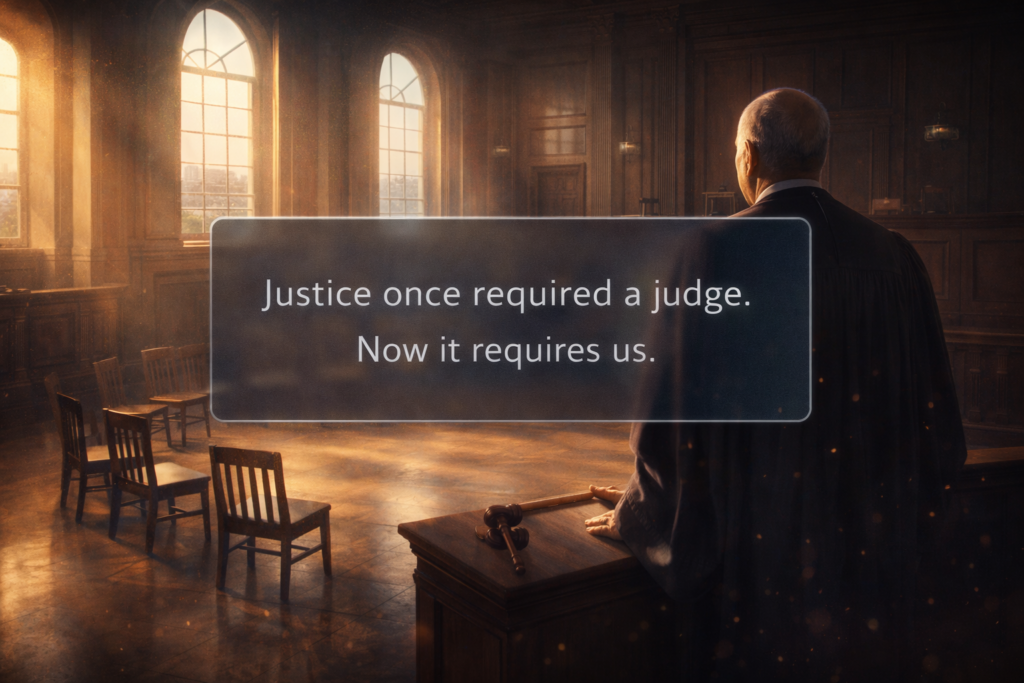
Date: The First Year Without Urgent Trials
Location: Quiet courtrooms, community circles, interior spaces
Weather: Still
The last high court session ended without spectacle.
No dramatic verdict.
No public uproar.
No appeals flooding the system.
Just an empty docket.
For centuries, judges had stood between harm and consequence.
They interpreted law.
Delivered verdicts.
Assigned punishment.
They were guardians of order in a world shaped by scarcity and competition.
But as survival stabilized and exclusion dissolved, something shifted.
The volume of harm decreased—not because humanity became flawless, but because structural desperation faded.
Theft declined when housing was secure.
Fraud diminished when survival was not transactional.
Violence dropped when systemic humiliation evaporated.
Conflict did not disappear.
But it changed.
Disputes became relational rather than existential.
Misalignment replaced malice.
And restorative processes replaced adversarial trials.
The courtroom grew quiet.
________________________________________
When Justice Moved Upstream
In the old world, justice was reactive.
A harm occurred.
A law was invoked.
A judge intervened.
Justice happened after damage.
But in the new world, visibility altered timing.
The Constellation Map surfaced strain early.
Community networks detected instability.
Participation pathways reduced alienation.
Intervention moved upstream.
Repair replaced punishment.
Most conflicts were resolved before formal adjudication was necessary.
Judges found themselves overseeing fewer sentences—
and more conversations.
________________________________________
The Last Formal Sentence
It was a minor case.
No systemic desperation behind it.
No structural collapse.
Just an individual who had harmed another out of anger.
The judge listened.
So did the community.
There was no call for incarceration.
No demand for removal.
The question was not:
“What punishment fits?”
It was:
“What restoration is required?”
Accountability shifted from isolation to reintegration.
The offender did not disappear into a prison.
They entered a restorative circle.
They repaired.
They apologized.
They contributed.
And the harm did not expand.
After that case, the judge realized something profound.
He was no longer necessary as a decider of fate.
He was a facilitator of conscience.
________________________________________
The Dissolving of External Moral Authority
In the old world, morality was outsourced.
People obeyed laws to avoid punishment.
They feared courts more than conscience.
They equated legality with righteousness.
Judges embodied authority.
Their verdicts defined consequence.
But when survival ceased to be precarious and transparency became universal, external authority lost its dominance.
There was little room for concealed harm.
Little incentive for predatory behavior.
And less tolerance for moral delegation.
The absence of scarcity exposed something else:
When no one forces you to behave—
What governs you?
________________________________________
The Final Case
Months passed without a formal trial.
The court building remained open.
But empty.
One morning, the judge stood in the silent chamber.
The bench before him.
The seats unoccupied.
The gavel resting unused.
He understood then:
The role had shifted.
Justice had not vanished.
It had relocated.
From institutions—
to individuals.
He was not the last judge because law collapsed.
He was the last judge because conscience matured.
The gavel did not disappear.
It became symbolic.
A reminder of an era when morality required enforcement.
Now morality required awareness.
________________________________________
The Interior Question
In classrooms, children studied historical trials.
They asked:
“Why did people wait for a judge to tell them what was wrong?”
Teachers answered carefully.
Because once, people feared survival more than they valued alignment.
And fear distorts judgment.
Now, with fear diminished, responsibility expanded.
The absence of punishment did not eliminate accountability.
It intensified it.
Because there was no longer an institution to hide behind.
No law to blame.
No authority to defy.
Only choice.
________________________________________
Closing Image
An old courtroom stands preserved as a civic space.
Sunlight enters through tall windows.
The judge’s bench remains, untouched.
But at the center of the room, chairs form a circle.
No elevated platform.
No adversarial rows.
Just people facing each other.
Listening.
On the wall, a small inscription reads:
“Justice once required a judge.
Now it requires us.”
The gavel rests behind glass.
Not as a relic of punishment—
but as a reminder of the time when conscience needed enforcement.
The frontier had shifted.
It was no longer institutional.
It was interior.