
 0
0
 407 views
Date: Mid-21st Century
Location: Everywhere opportunity once required permission
Weather: Clear, unforced
No one remembers the exact day the last billionaire stopped mattering.
Not because he disappeared.
But because the system stopped needing him.
He was still alive.
Still wealthy.
Still known.
But no longer necessary.
And necessity, it turned out, was the only form of power that ever truly existed.
________________________________________
When Opportunity Stopped Waiting for Owners
In the old world, opportunity lived behind gates.
Factories existed where capital permitted them.
Jobs appeared where investors saw advantage.
Entire regions waited—not for need—but for approval.
A person could be capable, willing, and needed—
and still remain unused.
Not because the world lacked work.
But because the world lacked coordination.
That coordination had belonged to a few.
The wealthy were not merely rich.
They were permission holders.
________________________________________
The Coordination Problem Was Never Human
The mythology said billionaires created opportunity.
The data revealed something quieter.
They discovered inefficiencies faster than others.
They moved resources faster than slower systems allowed.
Their true advantage was not genius.
It was speed of coordination.
They saw what was needed—
and acted before anyone else could.
AI did not remove this function.
It universalized it.
________________________________________
When Matching Became Continuous
The planetary coordination systems did not assign jobs.
They revealed alignment.
Where soil was failing, restoration opportunities appeared.
Where populations aged, care roles surfaced.
Where infrastructure weakened, repair pathways opened.
Where knowledge was needed, teaching pathways emerged.
No applications.
No interviews.
No gatekeepers.
Just visibility.
People began receiving prompts, not offers:
Capacity detected nearby.
Your skills align here.
Participation optional.
No one owned these signals.
They belonged to the system itself.
Opportunity stopped being something granted.
It became something seen.
________________________________________
The Quiet Collapse of Permission
Companies still existed.
Projects still formed.
Innovation did not slow.
But no individual could withhold access to opportunity anymore.
Because opportunity was no longer scarce.
It was mapped.
Once everyone could see where they were needed, the role of private permission faded.
The billionaire did not lose wealth.
He lost exclusivity.
________________________________________
The Rise of the Distributed Builders
As coordination became universal, creation did not slow.
It multiplied.
People began building systems from everywhere.
A woman in Nairobi designed soil recovery models used across three continents.
A father in Jakarta created logistics optimizers between school hours.
A teenager in São Paulo built water distribution agents from a bedroom terminal.
A retired engineer in Cairo developed energy balancing algorithms from her kitchen table.
Some became wealthy.
Very wealthy.
Some became millionaires.
Some became billionaires.
But their wealth behaved differently.
It did not accumulate gravity.
Because their systems did not gatekeep access.
They enhanced flow.
They could build.
They could contribute.
But they could not make the world wait for them.
Their wealth reflected usefulness—
not control.
The last billionaire was not replaced by another.
He was replaced by millions who could finally participate.
________________________________________
What Happened to Ownership
Ownership became descriptive, not decisive.
You could own a factory.
You could not own the need for its existence.
If the factory served a planetary function, it operated.
If it did not, it became irrelevant.
Not seized.
Not dismantled.
Ignored.
Capital stopped being command.
It became participation.
________________________________________
The Last Moment of Old Power
There was one final attempt to restore gravity.
A powerful industrialist refused to open access to a vital supply chain node.
In the old world, this would have caused cascading crisis.
This time, the system adapted.
Alternative routes surfaced.
Substitute production emerged.
Local fabrication accelerated.
The refusal did not create leverage.
It created isolation.
The industrialist reversed course.
Not under threat.
Under irrelevance.
For the first time, obstruction had no audience.
________________________________________
The Children Never Learned the Old Names
In classrooms, historical lessons mentioned figures who had once concentrated extraordinary wealth.
Students asked simple questions:
“How did one person control that much?”
Teachers struggled to explain.
The concept required belief in scarcity.
A belief the children did not share.
To them, coordination was ambient.
Like air.
No one owned it.
Everyone could breathe it.
________________________________________
What the Billionaire Became
He did not vanish.
He became human again.
He could still build.
Still contribute.
Still create.
But he could not obstruct.
He could not gatekeep.
He could not bend planetary flow around himself.
His wealth remained as history.
Not gravity.
________________________________________
What Replaced Him
Not government.
Not ideology.
Not another elite.
Just systems that made need visible—
and response possible.
The billionaire had been a bridge across a coordination gap.
Once the gap closed, the bridge became scenery.
Honored.
No longer required.
Power did not disappear.
It dissolved into everyone who chose to use it.
________________________________________
Closing Image
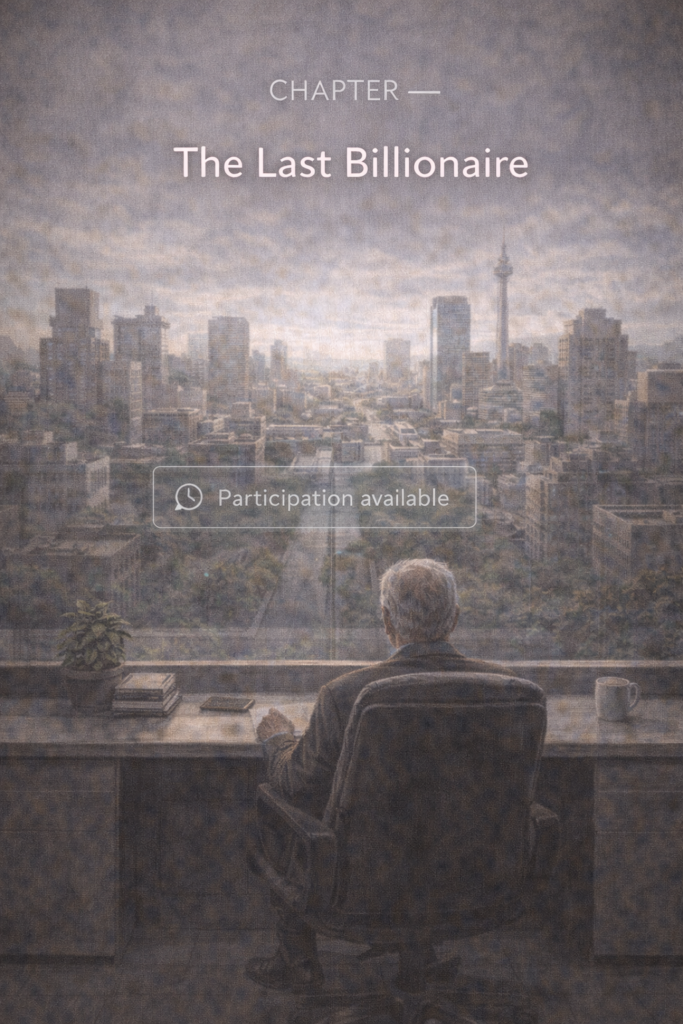
A man sits alone in a quiet office overlooking a city he once influenced.
The buildings still stand.
The factories still run.
The people still move.
But none of it waits for him.
On his desk, a single prompt glows softly:
Participation available.
No urgency.
No privilege.
Just invitation.
For the first time in his life, he is free from being necessary.
And the world is free from needing him.