
 0
0
 414 views
Date: 2050–2052
Location: Former battlefields, capital cities, reclaimed ruins
Weather: Clear light, slow seasons, unhurried air
The first museum did not open in a capital.
It opened on a scar.
Where a city had once burned.
No banners.
No anthem.
No ribbon cutting.
Just a sign at the entrance:
THIS IS NOT A MONUMENT.
THIS IS A MEMORY SITE.
People arrived quietly.
Not as tourists.
Not as patriots.
As witnesses.
________________________________________
When Victory Lost Its Voice
For centuries, war had been curated as spectacle.
Heroism galleries.
Medal walls.
Strategic diagrams glowing with arrows and triumph.
Even museums had spoken in the language of winners.
But something had shifted.
After decades of planetary fatigue, a simple question kept resurfacing:
“Who exactly won?”
Every honest answer felt wrong.
Because the dead did not feel like victory.
The displaced did not feel like victory.
The traumatized did not feel like victory.
Silence began to replace celebration.
And silence demanded a different architecture.
________________________________________
The First Design Principle
The new museums were built around one rule:
No glorification.
No heroic statues.
No national color schemes.
No patriotic soundtracks.
Only sequences of human consequence.
Rooms were organized by experiences, not battles:
• Waiting
• Hiding
• Losing family
• Being ordered
• Becoming numb
• Returning home changed
Visitors did not walk through timelines.
They walked through conditions.
________________________________________
What Was Displayed
Not weapons.
Not uniforms.
Not flags.
Instead:
A child’s shoe recovered from rubble.
A voice recording of someone apologizing to no one.
A diary page that ends mid-sentence.
A map showing a village that no longer exists.
Each artifact had one label:
“This happened to someone.”
No nationality attached.
No faction.
Just human.
________________________________________
The Corridor of Choices
Every museum contained a narrow passage near the center.
On its walls:
Ordinary decisions.
A checkpoint guard deciding whether to let someone pass.
A drone operator choosing between certainty and caution.
A politician approving language they did not read carefully.
A citizen sharing propaganda without checking.
No villains.
No monsters.
Only humans.
A plaque read:
Wars are not started by monsters.
They are started by accumulated small permissions.
People stayed in this corridor the longest.
________________________________________
The Absence Room
At the end of each museum was an empty chamber.
No exhibits.
No screens.
Only benches.
On the wall:
Everyone who should have been here but isn’t.
Names were optional.
Most families chose not to submit them.
Absence spoke louder.
________________________________________
Children Walk Through Differently
Adults entered slowly.
Children entered curiously.
They did not ask:
“Who was right?”
They asked:
“Why didn’t they stop?”
Guides were trained not to answer.
Instead, they asked:
“What do you think would have made stopping possible?”
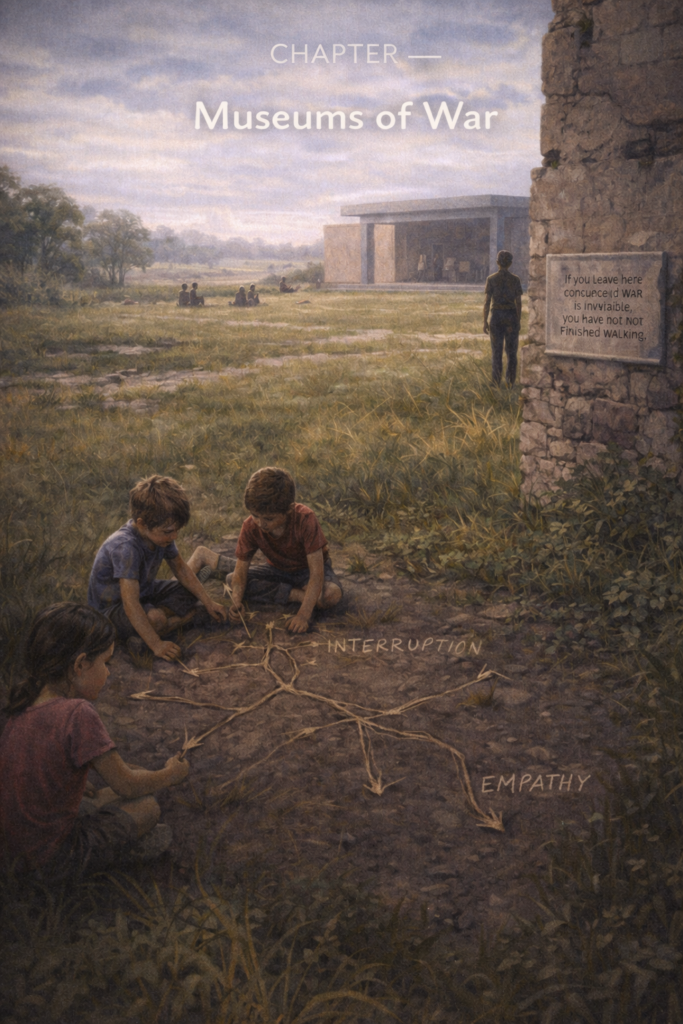
Children drew diagrams.
Not of battles.
Of interruption points.
Where empathy might have entered.
Where misinformation could have been challenged.
Where courage might have spread.
The museums quietly became laboratories of prevention.
________________________________________
The Political Shock
Nationalists tried to object.
“Where is our story?”
Curators replied:
“Your story is here.
So is everyone else’s.”
They were not excluded.
They were uncentered.
That distinction mattered.
Over time, opposition softened.
Because nothing was being attacked.
Only reframed.
________________________________________
When Soldiers Began Visiting
Former combatants started arriving alone.
Not for recognition.
Not for validation.
They stood in rooms showing experiences identical to their own.
Sometimes they cried.
Sometimes they sat for hours.
One veteran wrote in a guest book:
“I didn’t realize the people on the other side were having the same kind of bad day.”
The sentence appeared in thousands of languages.
Always unchanged.
________________________________________
What Disappeared
War movies lost their audience.
Recruitment campaigns felt obscene.
Victory parades felt archaic.
Not outlawed.
Just… embarrassing.
It is hard to celebrate what you have fully looked at.
________________________________________
What Replaced It
Commemoration days became:
Days of silence.
Days of service.
Days of repair.
No speeches.
Just work.
Rebuilding old infrastructure.
Cleaning neglected neighborhoods.
Visiting the lonely.
Memory turned outward.
________________________________________
The New Definition of Honor
A small plaque began appearing at museum exits:
Honor is not killing for your country.
Honor is preventing your country from needing killers.
No government claimed authorship.
No one tried to copyright it.
It spread anyway.
________________________________________
Closing Image
A former battlefield.
Grass now grows unevenly.
Children sit in a circle sketching interruption maps with sticks.
An adult nearby reads a wall inscription:
If you leave here convinced war is inevitable,
you have not finished walking.
The wind moves through tall grass.
No anthem follows.
Only breathing.
And the quiet, stubborn decision:
Not again.