
 0
0
 440 views
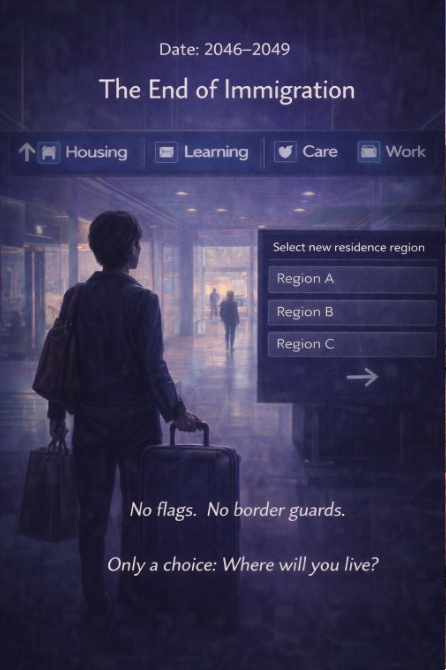
(The World Without Foreigners)
Date: 2046–2049
Location: Transit hubs, resettlement corridors, ordinary neighborhoods
Weather: Open roads, calm skies, no sirens
Immigration did not end because borders opened.
It ended because the idea behind borders changed.
For most of human history, movement had been framed as a problem.
Who belonged.
Who did not.
Who was allowed.
Who was illegal.
By the late 2040s, no one could clearly remember why birthplace had ever been treated as destiny.
________________________________________
The Problem Immigration Was Built to Contain
Immigration systems were never designed to manage movement.
They were designed to defend scarcity.
Jobs were scarce.
Housing was scarce.
Security was scarce.
Trust was scarce.
Nations protected access.
Borders became filters.
Passports became moral documents.
None of this was philosophical.
It was logistical.
Once logistics changed, the philosophy collapsed.
________________________________________
When War Stopped Producing Refugees
The first crack appeared quietly.
Wars ended.
Not dramatically.
Not universally.
But sufficiently.
Large-scale displacement slowed.
Camps emptied.
Generational exile stopped being normal.
For the first time in centuries, most human movement was voluntary.
Not flight.
Choice.
That alone shattered the category of “refugee.”
________________________________________
When Work Became Distributed
The second shift was economic.
AI-driven coordination allowed work to be mapped globally:
• Where skills were needed
• Where capacity existed
• Where training could be delivered fastest
People stopped migrating toward countries.
They moved toward functions.
Restoration zones.
Care corridors.
Research clusters.
Agricultural regions.
Urban renewal belts.
Movement followed demand curves, not flags.
________________________________________
When Residence Replaced Entry
Old world logic:
Ask permission to enter.
New world logic:
Declare need.
Declare capability.
Declare preference.
The system returned options:
Region A has housing capacity.
Region B needs your skills.
Region C matches your climate preference.
You selected.
Residence was assigned.
No “host nation.”
Only destination region.
________________________________________
The Birth of Planetary Residency
Nationality quietly disappeared from primary identity records.
Not banned.
Not abolished.
Ignored.
Identity fields became:
• Current Region
• Functional Role
• Languages
• Cultural Affiliations
You belonged where you lived.
If you moved, belonging updated.
No oath.
No ceremony.
No loyalty test.
Just presence.
________________________________________
The Day “Illegal Human” Became Unthinkable
The phrase survived in archives.
People encountered it the way one encounters medieval medical terms.
With disbelief.
Illegal action still existed.
Illegal harm existed.
But illegal existence?
The concept felt obscene.
Children asked:
“How can a person be illegal?”
No adult could produce an answer that survived ten seconds.
The term faded.
Not outlawed.
Unused.
________________________________________
How Culture Survived Without Borders
Many feared cultures would dissolve.
They did not.
They localized.
Languages were taught deliberately.
Traditions were practiced intentionally.
Festivals were preserved consciously.
Culture stopped being inherited automatically.
It became chosen.
Which made it stronger.
Not weaker.
________________________________________
Why People Stopped Fearing Movement
Fear had always been fueled by three things:
• Job competition
• Crime narratives
• Identity anxiety
All three lost oxygen.
Work was visible.
Crime was predictive and rare.
Identity was no longer national.
Movement became boring.
Boring is the highest form of stability.
________________________________________
The Children Notice the Change
In a classroom discussion, a child said:
“My grandma says she immigrated here.”
Another child asked:
“From where?”
The girl shrugged.
“A place that doesn’t matter anymore.”
They moved on.
________________________________________
What Immigration Had Really Been
Late in the transition, an anthropologist summarized:
“Immigration was the symptom.
Scarcity was the disease.
We cured the disease.
The symptom vanished.”
The paper circulated quietly.
No controversy.
No backlash.
Just recognition.
________________________________________
Closing Image
A transit terminal.
No flags.
No national signage.
No border guards.
Only directional signs:
Housing
Learning
Care
Work
Transit
A woman arrives with two bags.
A screen lights up:
Three regions match your preferences.
Select one.
She chooses.
A door opens.
No one asks where she is from.
No one needs to.
She steps inside.
Not as an immigrant.
Not as a foreigner.
Not as a guest.
As a resident.