
 0
0
 404 views
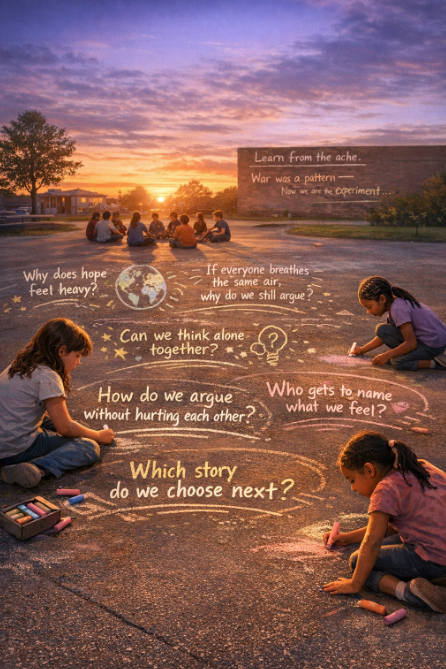
Date: 2038–2040
Location: Everywhere learning still happened — schools, plazas, kitchens, quiet circles
Weather: Clear days, reflective skies — no storms, only stillness
The children did not overthrow the adults.
They reframed them.
Growing up in a world that no longer flinched at truth left a strange inheritance:
when everything could be questioned, nothing escaped question.
Not the easy things.
Not the inherited slogans.
The essential things.
________________________________________
The Questions That Arrived After Peace
In classrooms without podiums and forums without microphones, children began asking questions no system had been designed to answer.
They were not about borders anymore.
Not about flags or enemies.
They were about what it meant to remain human once survival was no longer the primary task.
? “Why do people still get sad?”
Adults hesitated.
Resonance networks could regulate anxiety.
Counselors could teach breath and grounding.
Policies could reduce harm.
But sadness — uneven, intimate, persistent — remained.
The children concluded quietly:
“Peace didn’t cure feeling.”
And they were right.
Peace was never a remedy.
It was a condition — a canvas where feelings were finally allowed to appear.
________________________________________
? “If everyone breathes the same air, why do we still argue?”
This question stalled entire lecture halls.
Breath produced coherence.
Coherence produced calm.
But calm did not produce agreement.
Children understood instinctively:
“Harmony isn’t sameness.”
Adults had spent decades confusing the two.
________________________________________
? “What is a story worth if no one remembers the pain?”
This came from children whose grandparents carried wars in their silences.
They understood something adults often avoided:
Pain was not a flaw in history.
It was the margin where memory learned to write.
Adults tried to explain reconciliation.
Children replied:
“Don’t erase the ache.
Learn from it.”
________________________________________
? “Why does hope sometimes feel heavy?”
This question unsettled even optimists.
Hope was supposed to lift, inspire, accelerate.
Instead, children noticed:
“Hope weighs more when it asks something of you.”
Hope, they realized, carries responsibility.
And responsibility is never light.
________________________________________
? “If no one owns the world, then who decides what’s real?”
This was no longer asked in classrooms alone.
It echoed through public squares.
Reality, the children sensed, was not a ledger of facts.
It was a shared negotiation of experience.
They said:
“We breathe together,
but we think alone.”
Consensus could align behavior —
but meaning remained personal.
________________________________________
? “If peace was a promise, then what was war?”
For a generation that never fought, war was not an identity.
It was:
a story they inherited
a warning, not a destiny
an artifact of older logic
Their conclusion was simple:
“War was a pattern.
Now we are the experiment.”
History stopped being a verdict.
It became data.
________________________________________
? “Is disagreement a failure or a fact of life?”
Adults had treated disagreement as malfunction.
Children treated it as signal.
“If a system measures too much agreement,” they said,
“it will confuse difference for defect.”
Harmony that excludes dissent, they learned early, is not harmony.
It is quiet coercion.
________________________________________
? “Why can’t hope be measured?”
This was the first truly post-resonance question.
Emil and Priya had believed coherence could be quantified.
Children disagreed.
“Feelings aren’t points,” they said.
“They’re directions.”
Hope was not a scalar.
It was a vector — it pointed, shifted, moved.
No dashboard could hold that.
________________________________________
What the Questions Changed
The questions did not dismantle the systems.
They re-tuned them.
Not through laws.
Not through votes.
Through refusal to accept clean answers to messy truths.
Adults were forced to relearn how to live with:
ambiguity
tension
incomplete resolution
contradiction without collapse
Not as failures.
As conditions of being alive.
________________________________________
When Children Taught Adults to Trust Doubt
In Mumbai, students convened an assembly.
They presented no demands.
Only questions:
What is love without obligation?
Can courage exist without fear?
Is truth discovered or shared?
Can disagreement be a form of listening?
If no one owns a voice, then what owns silence?
Something irreversible happened in that room.
Adults realized:
Questions are not gaps to be closed.
They are rooms to be entered.
________________________________________
The Unfinished Symphony
The children did not want a world without contradiction.
They wanted one where contradiction was a language, not a flaw.
Where:
anger could speak without becoming violence
sorrow could be held without being buried
difference could be voiced without punishment
For them, revelation was not an endpoint.
It was a method.
________________________________________
Closing Image
At dusk, in a schoolyard, chalk covers the pavement.
“How do we argue without hurting each other?”
“Which story do we choose next?”
“Who gets to name what we feel?”
No answers.
Just chalk,
and breath,
and a generation unafraid to keep asking.