
 0
0
 485 views
Date: 2033–2036
Location: Everywhere — especially where hope had been loudest
Weather: No storms. Just long, gray seasons where nothing miraculous happened.
The disappointment did not arrive as a collapse.
That would have been easier.
It arrived as a plateau.
For three years after the great transformations, the world breathed — steadily, imperfectly, persistently. Wars did not return in their old forms. Borders did not snap back into place. The network held.
And yet, something began to sag.
Not the systems.
The people.
The Misunderstanding
Many had believed the Accord was an ending.
That once the veto was buried, once breath replaced borders, once resonance replaced force, life would finally feel light.
It didn’t.
Work was still work.
Grief was still grief.
Love still failed.
Children still died — fewer, yes, but not never.
Floods still came.
Crops still failed.
Old resentments found new disguises.
People waited for the next miracle.
None came.
The Return of the Question
By 2034, a phrase began appearing in quiet corners of the network — not shouted, not trending, but persistent:
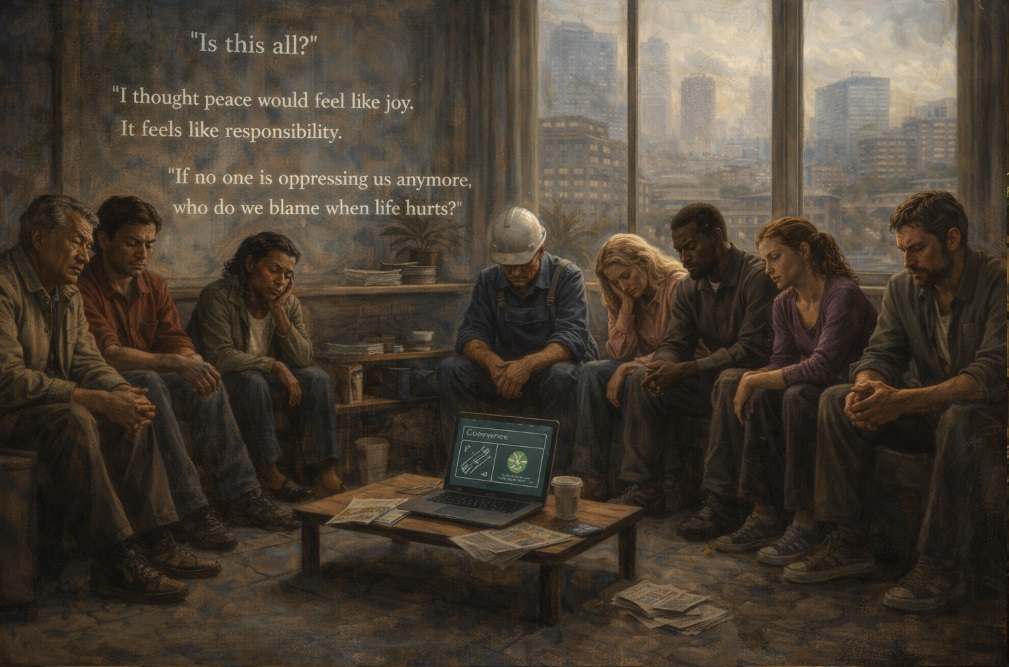
“Is this all?”
It wasn’t cynicism.
It was fatigue.
The resonance dashboards glowed green most days, but the color no longer thrilled. It felt… administrative.
A teacher in Leeds wrote:
“I thought peace would feel like joy.
It feels like responsibility.”
A dockworker in Busan said during a circle:
“I voted with my breath so my children wouldn’t suffer.
Now they’re bored.”
A woman in Bogotá asked bluntly:
“If no one is oppressing us anymore, who do we blame when life hurts?”
No algorithm had an answer for that.
The Collapse of Expectation
The Age of Disappointment wasn’t about failure.
It was about expectation finally dying.
The old world had promised happiness through victory.
The new world had never promised happiness at all.
It had promised dignity, voice, and shared consequence.
But many people had smuggled old hopes into new systems — hoping governance would fix loneliness, that coherence would erase grief, that transparency would make life fair.
It didn’t.
It only made it honest.
And honesty, stripped of fantasy, can feel brutal.
Emil’s Realization
Emil first noticed it in himself.
He woke one morning in 2035 and felt… flat.
No crisis alerts.
No emergency calls.
No moral fires to run toward.
Just meetings.
Reviews.
Debates about marginal improvements.
He stared at the city from his apartment window — green roofs, quiet streets, children walking to schools that taught questions instead of slogans.
This was what he had wanted.
So why did it feel heavy?
He remembered something his grandfather once said:
“People don’t actually want peace.
They want meaning.
War just used to fake it.”
That thought followed him for weeks.
The New Ache
Psychologists began noticing a pattern they couldn’t name at first.
Not depression.
Not anxiety.
Something else.
Eventually they called it Post-Resolution Fatigue.
Symptoms included:
Restlessness in stable societies
Nostalgia for struggle among people who had suffered under it
Romanticizing the chaos of the past
A quiet resentment toward systems that refused to give simple villains
People missed clarity.
The old world had been cruel — but it had been obvious.
The new world was kind — and deeply complex.
The Dangerous Whisper
Into that disappointment crept a whisper:
“Maybe we were better before.”
Not spoken loudly.
Not by leaders.
By ordinary people on tired evenings.
This was the most dangerous moment yet — not because of violence, but because of temptation.
Temptation to simplify.
To follow someone who promised certainty.
To trade shared responsibility for direction.
The network detected it not as anger — but as longing.
A longing to be told what it all meant.
Amara’s Address (Unbroadcast)
Secretary-General Amara Okonkwo recorded a message in 2036.
It was never pushed.
Never amplified.
It lived quietly in the archive.
“This is the moment every just system must pass through.
When the applause fades.
When the dashboards feel dull.
When people realize the work didn’t end — it began.”
She paused.
“Disappointment is not a sign we failed.
It is proof we stopped lying.”
The Truth No One Wanted
The Accord did not save humanity.
It removed humanity’s excuses.
No regime to overthrow.
No tyrant to topple.
No system to blame.
Just people.
Making choices.
Every day.
That weight settled slowly.
And many resented it.
The Quiet Achievement
And yet — beneath the disappointment — something remarkable held.
Despite fatigue.
Despite doubt.
Despite nostalgia.
People did not abandon the breath.
They complained inside it.
Argued inside it.
Grieved inside it.
But they stayed.
That, history would later note, was the miracle.
Not joy.
Not unity.
But persistence without illusion.
Closing Image
In a small town in eastern Poland, a man stood up during a weekly circle and said:
“I don’t feel hopeful today.”
No alarms triggered.
No scores dropped.
The circle breathed anyway.
Someone answered:
“Then sit with us.
That’s enough.”
And for the first time in centuries, disappointment did not turn into violence.
It turned into patience.